1st Aust Tunnelling Co

Edgeworth David, Professor of Geology at Sydney University and Ernest Skeats, Professor of Geology at Melbourne University proposed formation of the Mining Corps to the Federal Government early in 1915 and by June 1916 the 1st Australian Tunnelling Company was operational near Armentieres.

The 1st Australian Tunnelling Company, under Major J. Douglas Henry took over the tunnels and mines at Hill 60 on 9 November 1916.

John Laffin’s Guide to Australian Battlefields of the Western Front describes Hill 60 as:
“One of the most famous positions on the Western Front , the hill had been formed in the 19th century from the spoil of a deep railway cutting. ….. The hill’s height of 60 metres gave it immense strategic importance in a flat country and both sides continually fought for it. The British tunnelled into the hill in 1915 and 1916 to plant mines which killed many Germans when they exploded. 

Photo: AWM E01396, Menin Road Area, Hooge, September 1917. Members of the 1st Australian Tunnelling Company excavating at Hooge, in the Ypres Sector. http://cas.awm.gov.au/item/E01396

“The  Company’s primary job was to keep intact two great mines being prepared for a major assault to break the enemy front.  The galleries’ drainage and ventilation was poor and to improve them the Australians sank a metal-lined shaft 130 metres from a main junction.  They drove an additional gallery under the German line, about 400 metres distance.  The shaft was coded Sydney, the drive leading to it Melbourne, while defensive galleries were called Adelaide, Perth, Brisbane, Newcastle and Hobart.

Photo: AWM E02095, Menin Road Area, Hooge, 18 September 1917, A communication trench 25 feet below the surface, excavated by the 1st Australian Tunnelling Company, in the Ypres sector. Owing to the sodden nature of the earth the passage ways had to be heavily timbered. 3607 Sergeant A. Hood has been up to his knees in mud. http://cas.awm.gov.au/item/E02095

“Protecting the mines from the Germans involved the Diggers in ferocious underground fighting. The work was arduous and exhausting and six months’ service in the tunnels of Hill 60 was regarded as the limit of strain any troops could stand.  In one sector, the Australian listeners reported that enemy miners were so close that their tools were shaking the earth in the Australian tunnel. They packed a ton of ammonal into the end of their tunnel and on 16 December 1916 fired it. Recovering from this shock, the Germans continued their efforts to dig under the shallower Australian tunnels and blow them up. In March , April and May 1917 the Australians were tunneling 5.5 metres per day in their efforts to prepare great mines for the impending attack on Messines Ridge.

Photo: AWM E01911 6 July 1917. Looking from an old crater on the north side of Hill 60, over the shell pitted ground towards Zillebeke Lake.

The 1st Australian Tunnelling Company took over mining operations and mine fighting from the Canadians on Hill 60, the Canadians having previously taken over from the British. For months the underground workings had been dug and re-dug, lost and recaptured, until finally with a tremendous charge of 123,500 pounds of explosive, the Australians blew the craters in the opening phase of the battle of Messines, on 7 June 1917. The result was particularly deadly, for the mine was stated by the Germans to have taken up with it a whole company of Wurtumbergers, and prepared the way for the advance of the British troops over this area. Note the soldier standing to the left of a large water filled crater. http://cas.awm.gov.au/item/E01911

“Among the 1st Tunnelling Company were a father and son from the coal mines of Wallsend NSW,  Sapper J. B. Snedden and Sapper W. F. Snedden. J. B. was killed in action on 7 april 1917 when German miners blew a camouflet and buried him.”  Sapper J. B. Snedden is buried in Railway Dugouts Burial ground (Transport Farm) Zillibeke (Grave 7.K.21).

“Every moment underground was dangerous. Sapper J. T. Landrigan was entombed by a German explosion and survived only because of the frantic rescue digging by his comrades.

“On 25 May a German mine explosion separately entombed two Diggers, Sapper E. W. Earl and Sapper G. Simpson. Earl continued to listen to enemy noises and managed to write a report about them, He tapped out signals on the wall which twenty four hours later were heard. A close friend, Sergeant H. Fraser, led non-stop rescue digging and on 27 May Earl and then Simpson, were brought out. Earl handed over his valuable reports. Suffering from the effects of asphyxia, his breathing chronically hampered, he died three months later. Other Diggers died of asphyxiation while trying to rescue mates.

Photo: AWM P02228.001 Ypres, Belgium. c. 1923. A monument erected at Hill 60 to commemorate men of the 1st Australian Tunnelling Company, who died during mining operations between November 1916 and July 1917. This structure replaced an earlier one constructed in 1919 by the Company. This replacement is very plain and bears no symbols whereas the first memorial was surmounted by a cross. http://cas.awm.gov.au/item/P02228.001

Further reading on the Australian Tunnelling Companies:
Finlayson, Damien; Hades’ Henchmen: The Australian Tunnelling Companies and ‘Alphabet Company’ 1916-1919, Stand To, The Journal of the Western Front Association, No 83 August/September 2008, pps4-11

Finlayson, Damien; Crumps and Camouflets – The Story of Australian Tunnelling Companies in France and Belgium 1916-1919, to be published by the Army History Unit in 2010.  The book also covers the Australian Electrical & Mechanical Mining & Boring Coy – but not to the same extent as the tunnelling coys.

Tunnellers Research website http://www.tunnellers.net

Australian War Memorial, Australian Tunnelling Companies Diaries at http://www.awm.gov.au/collection/war_diaries/first_world_war/subclass.asp?levelID=1667

Davies, Will; Beneath Hill 60, Vintage Press, Australia, 2010

*****

The Families and Friends of the First AIF applauds the joint Australian–UK decision, announced by The Hon Greg Combet AM MP and the Hon Kevan Jones MP, to conduct a full DNA testing program on the remains of Australian and British soldiers found in mass graves at Pheasant Wood (Fromelles), and for their continuing commitment to identify as many of the fallen as is possible. We also thank the Australian, UK and French governments for affording dignified individual reburials for these soldiers, buried by German soldiers following the Battle of Fromelles on 19/20 July 1916, in the new Fromelles (Pheasant Wood) Military Cemetery presently under construction at Fromelles.

Posted in Australian War Memorial, Diggers of First AIF, Hill 60, Ieper/Ypres, The Western Front | Comments Off on 1st Aust Tunnelling Co

Snow in Fromelles

Guillaume Moreel has sent some outstanding photos of the snow at the Cobbers statue and at VC Corner Australian Cemetery near Fromelles. Guillaume is the grandson of Madame Marie-Paule Demassiet, the lady who donated the land at Pheasant Wood that included the burial pits where the German Army buried British and Australian soldiers following the Battle of Fromelles in July 1916. Guillaume, who was recently in Australia for work experience for 5 months, has sent the photos as a contrast with the Australian summer.

Photo: Sgt Simon Fraser with a Cobber in the evening sunlight, Australian Memorial Park, Fromelles [Guillaume Moreel]


Photo: Evening sunlight at VC Corner Australian Cemetery [Guillaume Moreel]

Photo: At the going down of the sun: looking towards the Sugarloaf from VC Corner Australian Cemetery [Guillaume Moreel]

Photo: Sunset across old battlefields, Fromelles [Guillaume Moreel]

*****

The Families and Friends of the First AIF applauds the joint Australian–UK decision, announced by The Hon Greg Combet AM MP and the Hon Kevan Jones MP, to conduct a full DNA testing program on the remains of Australian and British soldiers found in mass graves at Pheasant Wood (Fromelles), and for their continuing commitment to identify as many of the fallen as is possible. We also thank the Australian, UK and French governments for affording dignified individual reburials for these soldiers, buried by German soldiers following the Battle of Fromelles on 19/20 July 1916, in the new Fromelles (Pheasant Wood) Military Cemetery presently under construction at Fromelles.

Posted in Christmas, The Western Front, Top Posts | Comments Off on Snow in Fromelles

Snow in Polygon Wood

Johan Vandewalle, who operates the ANZAC Rest (de Dreve) cafe at Polygon Wood and was a key person in the recovery of the 5 Australian soldiers at Zonnebecke and the subsequent identification of 3 of them, has sent the following photographs of Buttes New British Cemetery, Belgium. Johan is a civil engineer by profession who has developed his expertise in tunnelling and is a co-author of the authoritative book Beneath Flanders Fields: The Tunnellers’ War 1914-1918 along with British Historian Peter Barton and Professor Peter Doyle, Visiting Professor in Geosciences at University College London.

Photo: Buttes New British Cemetery, Polygon Wood, Belgium,
22 December 2009 [Johan Vandewalle] 

Photo: Snow-covered graves at Buttes New British Cemetery
[Johan Vandewalle] 

Photo: Snow-covered graves at Buttes New British Cemetery and snow on the Butte and surrounding the 5th Aust Div Memorial, Polygon Wood [Johan Vandewalle] 

Photo: Headstones of the Zonnebeke 5 with two unidentified Australians, Pte George Storey, Pte John Hunter and Sgt George Calder, Buttes New British Cemetery [Johan Vandewalle] 

Photo: Not identified but not forgotten: Headstone of one of the two unidentified Australians of the Zonnebeke 5 [Johan Vandewalle] 

Photo: Commrades committed to a common cause: graves of two unidentified soldiers, a Canadian soldier and a New Zealand soldier at Buttes New British Cemetery, Polygon Wood [Johan Vandewalle]

*****

The Families and Friends of the First AIF applauds the joint Australian–UK decision, announced by The Hon Greg Combet AM MP and the Hon Kevan Jones MP, to conduct a full DNA testing program on the remains of Australian and British soldiers found in mass graves at Pheasant Wood (Fromelles), and for their continuing commitment to identify as many of the fallen as is possible. We also thank the Australian, UK and French governments for affording dignified individual reburials for these soldiers, buried by German soldiers following the Battle of Fromelles on 19/20 July 1916, in the new Fromelles (Pheasant Wood) Military Cemetery presently under construction at Fromelles.

Posted in Christmas, Memorials, Polygon Wood, The Western Front, Zonnebeke | Comments Off on Snow in Polygon Wood

Western Front Christmas

As Christmas Day approaches it is time to reflect on the Christmas experiences of the AIF during the Great War.

Photo: Christmas silk postcard [Hosken Collection]

The following poem was written by Private Leslie George Rub
(No 3892) 2nd Pioneer Battalion while serving on the Western Front in 1916. Private Rub died of wounds on 22 September 1917 and is buried in The Huts Cemetery Dickebusch Belgium.

Christmas Day On The Somme

’Twas Christmas Day on the Somme
The men stood on parade,
The snow laid six feet on the ground
Twas twenty in the shade.

Up spoke the Captain ‘gallant man’,
“Just hear what I’ve to say,
You may not have remembered that
Today is Christmas Day.”

“The General has expressed a wish
This day may be observed,
Today you will only work eight hours,
A rest that’s well deserved.

I hope you’ll keep yourselves quite clean
And smart and spruce and nice,
The stream is frozen hard
But a pick will break the ice.”

“All men will get two biscuits each,
I’m sure you’re tired of bread,
I’m sorry there’s no turkey
but there’s Bully Beef instead.

The puddings plum have not arrived
But they are on their way,
I’ll guarantee they’ll be in time
To eat next Christmas Day.”

“You’re parcels would have been in time
But I regret to say
The vessel which conveyed them was
Torpedoed on the way.

The Quartermaster’s got your rum
But you may get some yet,
Each man will be presented with
A Woodbine Cigarette.”

“The Huns have caught us in the rear
And painted France all red,
Pray do not let that trouble you,
Tomorrow you’ll be dead.

Now ere you go I wish you all
This season of good cheer,
A very happy Christmas and
A prosperous New Year.”

Photo: Christmas silk postcard [Curley Collection]

If you are interested in reading about the Christmas Truce that took place on the Western Front during December 1914 follow the link to the posting Christmas Truce.

*****

The Families and Friends of the First AIF applauds the joint Australian–UK decision, announced by The Hon Greg Combet AM MP and the Hon Kevan Jones MP, to conduct a full DNA testing program on the remains of Australian and British soldiers found in mass graves at Pheasant Wood (Fromelles), and for their continuing commitment to identify as many of the fallen as is possible. We also thank the Australian, UK and French governments for affording dignified individual reburials for these soldiers, buried by German soldiers following the Battle of Fromelles on 19/20 July 1916, in the new Fromelles (Pheasant Wood) Military Cemetery presently under construction at Fromelles.

Posted in Christmas, The Western Front | Comments Off on Western Front Christmas

'09 Christmas Greetings

Photo: Christmas silk postcard [Hosken Collection]

Throughout 2009 this website has been updated on a regular basis. The number of times the www.fffaif.org.au site has been visited now exceeds 79,000 since the launch on Australia Day 2008. This week’s Web Wednesday brings the number of postings to 330.

All of these postings continue to be available on-line and it is easy to search this resource of both recent and historical events. To do so, use the Search Field located on the top right of web page (near the Members’ Area tab). Simply enter the topic you are searching for in the search field at the top of the screen and click. Alternatively use the TOPICS listing by clicking on the words”Select Category” to see the list of differnet categories and the number of postings related to the category e.g. Gallipoli (7) indicates that 7 postings relate to Gallipoli. Selecting the Gallipoli category will automatically find these 7 postings and list them in chronological order.  Another approach is to search the PAST NEWS drop down menu, located below the FFFAIF Photo strip, on the right hand side of the page to find the particular month of interest and search it day by day.

Over the Christmas Season the web manager will take a break from website postings – we hope you will enjoy taking some time to trawl through past postings. We will be back in time for our 2nd Anniversary on Australia Day 2009- or sooner if  there is ‘breaking news’. It is also a good time to follow-up on some of those actions that you have been encouraged to take e.g.

  • give the Commonwealth War Graves Commission some feedback on their trials for climate change featured in RECENT NEWS Item: CWGC Trial!! by clicking here
  • join the FFFAIF by clicking here;
  • write an article for DIGGER or the website;
  • visit a local war memorial and submit photos and stories to projectffaif@yahoo.com.au for inclusion in Memorial Way on the www.fffaif.org.au website in 2010.

Many thanks for your support throughout the year. Please direct all enquiries to projectffaif@yahoo.com.au until February 2010. FFFAIF members please check out the Members’ Area for more contact details of Committee Members.

During the festive season enjoy the ‘Peace on Earth’ that the men of the First AIF fought to preserve.

Merry Christmas and Happy New Year to All

*****

The Families and Friends of the First AIF applauds the joint Australian–UK decision, announced by The Hon Greg Combet AM MP and the Hon Kevan Jones MP, to conduct a full DNA testing program on the remains of Australian and British soldiers found in mass graves at Pheasant Wood (Fromelles), and for their continuing commitment to identify as many of the fallen as is possible. We also thank the Australian, UK and French governments for affording dignified individual reburials for these soldiers, buried by German soldiers following the Battle of Fromelles on 19/20 July 1916, in the new Fromelles (Pheasant Wood) Military Cemetery presently under construction at Fromelles.

Posted in Christmas, Members' Announcements | Comments Off on '09 Christmas Greetings

*Christmas Gift Idea

Looking for a unique gift for Christmas. Why not consider a Pinus halepensis or Lone Pine?

Photo: Lone Pine tube stock
available from Yarralumla Nursery
in the ACT

The history of the Lone Pine in Australia can be traced back to the Gallipoli Campaign which was fought on the Gallipolli Peninsula from April to December 1915. This week marks the 94th anniversary of the evacuation of the AIF from Anzac Cove. 


Photo: Pinus halepensis growing at
the Lone Pine Memorial 
[Munro Collection]

The Yarralumla Nursery’s website relates the history of the arrival of the Lone Pine in Australia.

The Turks had cut down all but one of the Allepo pines which grew on Plateau 400 to cover their trenches.  This ridge, dominated by the single pine became known as Lone Pine.  Australians lost more than 2000 men and the Turks losses were estimated at 7000 in the three days of fighting which took place in August 1915.  Seven Victoria Crosses were awarded.

Lance Corporal Benjamin Smith of the 3rd Battalion, whose brother was killed in the battle, sent a pine cone home to their mother, Mrs McMullen in Inverell, New South Wales. She grew two seedlings, one of which she presented to the town of Inverell and the other to the Parks and Gardens section of the Department of the Interior in Canberra. This second seedling was planted at the Australian War Memorial by the Governor General, HRH The Duke of Gloucester, in October 1934.  Today it stands over 20 metres in height.

Sergeant Keith McDowell of the 24th Battalion carried a pine cone in his haversack until the end of the war.  Upon returning to Australia, he gave it to his aunt, Mrs Emma Gray of Grassmere near Warrnambool, Victoria.  Four seedlings were grown.  One was planted in Wattle Park, Melbourne, another at the Shrine of Remembrance in Melbourne, yet another at the Soldiers Memorial Hall at The Sisters and the last was planted in the Warrnambool Gardens.

In 1990, two trees were taken back to Gallipoli with war veterans who attended the memorial service to mark the 75th anniversary of the battle of Lone Pine.

Pinus halepensis or Lone Pines are available from
Yarralumla Nursery
Banks Street,
Yarralumla
ACT 2600
Phone: 02 6207 2444
Fax: 02 6207 2455

*****

The Families and Friends of the First AIF applauds the joint Australian–UK decision, announced by The Hon Greg Combet AM MP and the Hon Kevan Jones MP, to conduct a full DNA testing program on the remains of Australian and British soldiers found in mass graves at Pheasant Wood (Fromelles), and for their continuing commitment to identify as many of the fallen as is possible. We also thank the Australian, UK and French governments for affording dignified individual reburials for these soldiers, buried by German soldiers following the Battle of Fromelles on 19/20 July 1916, in the new Fromelles (Pheasant Wood) Military Cemetery presently under construction at Fromelles.

Posted in Christmas, Tips | Comments Off on *Christmas Gift Idea

*Ozzie Wozzie Project

FFFAIF Belgian member Johan Durnez has introduced Australia to his 2009/10 high school students with a program of learning entitled Ozzie Wozzie Westhoek Project. The project integrates aspects of Australia throughout the teaching program, not only in history, but across a broad range of subjects.

Johan describes the philosophy behind the project: The project will focus on Australia, on the First World War and on the ‘Westhoek’ ( the most western corner of Belgium and also the area of the WWI battlefields). This means that lessons will use the theme ‘Australia’ or ‘First World War’ or ‘Westhoek’.  For instance: when they will learn in French on the weather-vocabulary, they will use Australian weathermaps to introduce all the terms and at the same time they will learn about the weather in Australia (like about what you there consider as ‘Winter’… )  In the lessons of music they will work with the song “kookaburra sits in the old gum tree”, in art they will do something with dotpainting. In sports they will try to do a typical Australian sport.

The project was started at the beginning of the school year in September with the introduction of Ozzie Wozzie Newsflashes in the central hall of the school. Johan described how this occurred: In the central hall of our school, we now have a data projector which allows large images to be shown on the wall. The central hall is a place where the students have to assemble when the lessons change and they have to wait for the next teacher who takes them to the next classroom or workingplace. So, every fifty minutes there is a circulation of many hundreds of students in this central hall (as we have almost 1400 students in our school). And that means that this central hall is also the best place to have these slides as we are sure that all students pass there between the lessons or during the breaks. 

The slides show information on the school life, photos of all sorts of activities we do with the students and we (= our team) thought it would be an excellent opportunity to bring all sorts of information on Australia and on Australian news items. So, that’s how we started with the “Ozzie Wozzie Newsflash”. Amongst the first of the slide shows prepared by the teaching team of the Ozzie Wozzie Project depicted the story of Corporal of Horse William Thomas Leggett, as you know was the first Australian who died in the defence of Ieper in 1914.

During November fellow FFFAIF member and school teacher from South Australia Julie Reece visited Johan’s class as a guest speaker.

Johan described her visit: Two “real Australians” visited our school at the end of November. That was really THE highlight of the Ozzie Wozzie project! Our friends Julie and Paul Reece from South Australia came to school to talk to the boys. Wow, they (the boys) felt really important that day as these people who came from the other side of the globe came to talk to THEM!  They had prepared (with their class directors) a whole list of questions on Australia. Some questions sounded a bit funny like: “have you ever been to Australia?” (good question to ask an Aussie!),  “do you have electricity in Australia?”, “are Australians poor?”, “who is the king of Australia?”, etc.  But most of the questions were really interesting and a good start to talk and learn about a country far away and in many aspects very different.  They were surprised to hear about the vast distances between towns and cities. (We had a map of Australia and we had cut out the map of Belgium on the same scale and laid that on this map of Australia. In this way Julie could show that when she goes to watch the AFL Crows playing in Melbourne, she drives three times the distance from North Sea to German border in Belgium (so, three times Belgium.) They were amazed to hear about ‘so many times Belgium’ and so many days driving to go on a holiday.

They were also interested to see the school where Julie is teaching and how different certain things look compared to our school. But they are still happy with our school, especially when they heard about the snake next to the music class! They were interested to hear Julie but their real hero was her husband Paul.

Very special was when Julie explained why she visits Belgium and why our country has a special place in the hearts of so many Australians – even from their (the youngest) generation. She told the story of her great uncle Martin Neagle who joined the AIF in 1916 to keep an eye on his youngest brother who also wanted to go to this war in Europe. She told them how ‘Uncle Martie’ never returned from Passchendaele and his grave in Polygon Wood.  She told about her mother and the grief of the family.  That made the boys silent and I am sure that they will remember Julie and all this when we make our bicycle trip next June and when we will visit the grave of Uncle Martie!

The week after the visit of Julie and Paul, they mentioned (to their teachers) the roadtrains and what they heard about the heat in Australia, but they also mentioned the story of this uncle.  Well, thanks Julie for this wonderful contribution to our project as this is what we want the boys to keep in mind! 

Julie Reece is a teacher at Birdwood High School in South Australia and is the driving force behind the Connecting Spirits Project [http://connectingspirits.com.au/] which began in 2005. Visit the Connecting Spirit website to find out more about the  joint project between Meningie Area School and Birdwood High School which involves students travelling to the World War 1 battlefields, cemeteries and memorials of France and Belgium. While there, the students commemorate individual soldiers from their own families and communities. The first trip occurred in November 2006, the second in 2008 and a third is planned for 2010.

*****

The Families and Friends of the First AIF applauds the joint Australian–UK decision, announced by The Hon Greg Combet AM MP and the Hon Kevan Jones MP, to conduct a full DNA testing program on the remains of Australian and British soldiers found in mass graves at Pheasant Wood (Fromelles), and for their continuing commitment to identify as many of the fallen as is possible. We also thank the Australian, UK and French governments for affording dignified individual reburials for these soldiers, buried by German soldiers following the Battle of Fromelles on 19/20 July 1916, in the new Fromelles (Pheasant Wood) Military Cemetery presently under construction at Fromelles.

Posted in Commemorations, Events, Ieper/Ypres, Projects | Comments Off on *Ozzie Wozzie Project

Rembrella Poppy Umbrellas in Australia

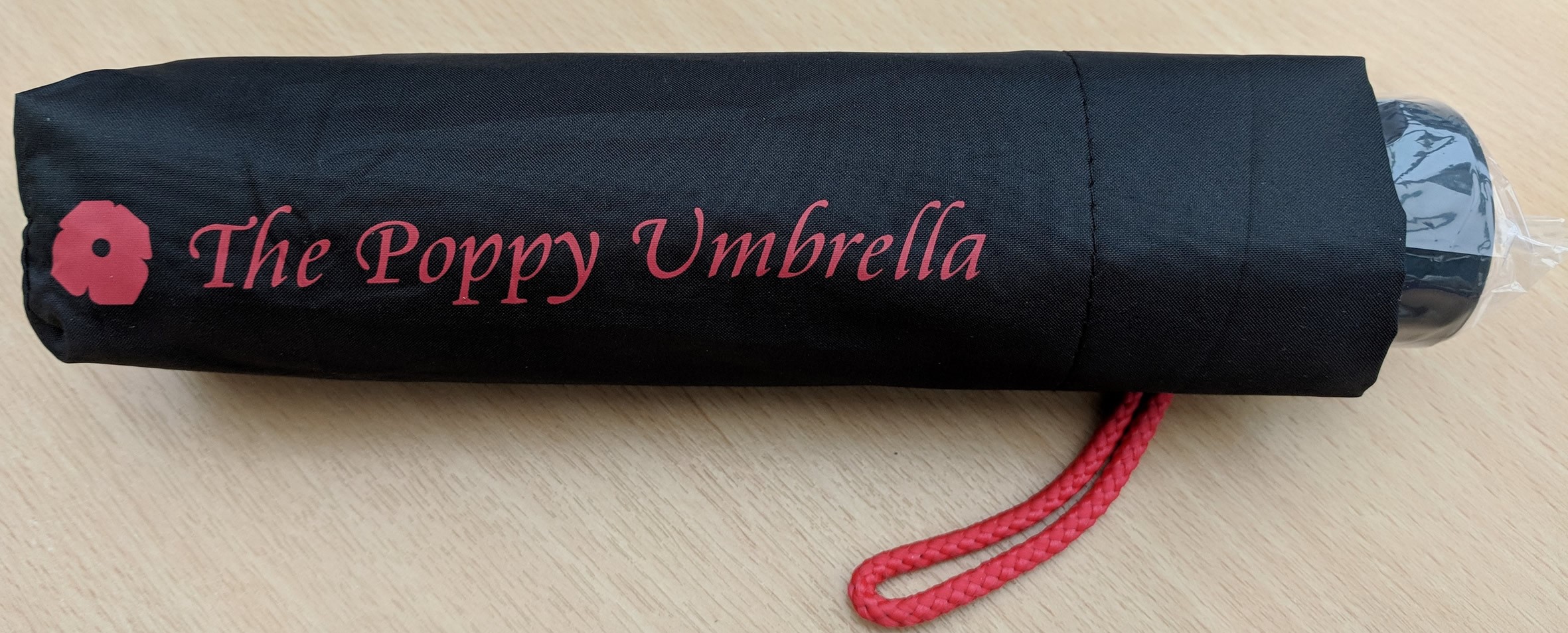
The images of poppies on the old Flanders battlefields and umbrellas lining the route of The Armistice Day Poppy Parade to the Menin Gate Memorial in Ieper (Ypres) in 1995 inspired Lt. Colonel (Rtd) Graham Parker OBE, instigator of the Parade and a respected historian and Vice President of the Western Front Association, to develop the Poppy Umbrella.

Photo: Lt. Colonel (Rtd) Graham Parker OBE
Remembrance Day Ieper 2009
[Rembrella]

The Poppy Umbrella, resembling a Flanders poppy when open, is manufactured for Rembrella by Fultons, the largest supplier of quality umbrellas in the UK, and the holder of a Royal Warrant to Her Majesty The Queen.

The Rembrella products are premium gifts and in the UK and Europe have only been available for sale through registered charities of ex-Service and welfare organizations, or military and heritage museums, or educational associations and not-for-profit organizations and Rembrella’s on-line shop.

The Rembrella Poppy Umbrellas design was registered in Australia and in 2009 Rembrella appointed Families and Friends of the First AIF as its Australian importer. This came about after Lt. Colonel Parker and his family attended the 2007 ANZAC Day commemoration service at St Edith’s, Baverstock, Wiltshire where 29 Australian and 3 British soldiers are buried.

Photo: Lt. Colonel (Rtd) Graham Parker OBE
and his daughter Joanna Legg at the grave of Private Andrew Gibson AIF of Mackay Queensland, at St Edith’s Baverstock, Wiltshire UK on the anniversary of the Battle of Polygon Woods 26 September 2009.  [Rembrella]

Andrew Gibson was a 39-year-old farmer from Mackay, Queensland when he enlisted in the AIF on 6th March 1916. He was the son of Andrew and Margaret Gibson and had been born in Stranraer, Wigtonshire in Scotland.

Private Gibson embarked with the 31st Infantry Battalion on 19th September aboard the HMAT Seang Choon from Brisbane. After a sea voyage of nearly three months Pte Gibson disembarked at Plymouth England on 9th December 1916 and was posted to the 8th Training Battalion located at Hurdcott Camp, on the Salisbury Plain. Three weeks later he was admitted to Fovant Military Hospital on 31st December 1916 where he died of broncho pneumonia on 7th January 1917 and buried at St Edith’s on 10th January.

Private Gibson was a widower and was survived by a son James and daughter Margaret both of Mackay. Andrew’s next of kin was his brother Robert Gibson of Fairleigh Estate, Mackay, Queensland.

Rembrella products are sold in Australia through organisations that commemorate the service and sacrifice of Australians in The Great War including the Australian War Memorial in Canberra, the National ANZAC Centre in Albany and the Anzac Memorial Sydney. More than 5,000 Rembrella products have been sold in Australia with sales benefiting these organisations and also contributing funding to Commemorations and to projects placing headstones on previously unmarked graves of returned Diggers.

Professor the Hon. Dame Marie Bashir AD CVO at the Anzac Memorial for the Commemoration of the Battles of 3rd Ypres, 2017 [Rob Tuckwell Photography]
Headstones on previously unmarked graves of returned Diggers in Cornelian Bay Cemetery, Hobart [Tasmanian Headstone Project, 2017]


Rembrella poppy umbrellas can be purchased when you visit:

Rembrella poppy umbrellas can also be purchased on-line

FFFAIF members at the Remembrance Day Service at the Australian War Memorial in Canberra in 2010

Posted in Commemorations, Events, Members First AIF | Comments Off on Rembrella Poppy Umbrellas in Australia

Search for Memorials

The Australian Governments’ Minister for Veterans’ Affairs Alan Griffin recently launched a new online resource to search for information on Australian overseas war memorials.

Photo: Australian War Memorial, London [Chris Munro]

The Overseas Memorials Search  includes details and photographs of more than 110 official and privately constructed overseas memorials which honour Australian service across the globe. 
“Australians have served in locations throughout the world – not only protecting our nation, but helping to protect our neighbours and allies,” Mr Griffin said. 
“Official memorials have been established by the Australian Government or the Commonwealth in many of these locations, and local communities have also erected special memorials and monuments.
“I encourage all Australians to consider visiting an overseas memorial as part of future travel plans, or as part of research into our wartime history.”
Mr Griffin said the new database provides travellers with details about memorials on the Kokoda Track, a memorial plinth at Subic Bay in the Philippines and a memorial stone in Elands River in South Africa.
“The database will continue to grow as more data is collected, and I invite people with information about the location or details of overseas memorials to contact my Department,” Mr Griffin said.
“The stories behind each memorial are unique and provide a powerful reminder of the courage of Australians who served and died overseas.”
One such story is the moving tribute from the local community in Stadil, Denmark, who built a wooden cross to commemorate the crew of the Lancaster bomber EE138 which was shot down by a Luftwaffe night fighter over Stadil on 4 September 1943. The crew of eight men, four of whom were Australian, managed to steer the damaged Lancaster away from the village before it crashed.  All eight men were killed. 
The cross was engraved with the words “Minde over faldne allierede Flyvere” translated as “In memory of fallen Allied Airmen”, and after an Australian Government grant, now includes a memorial plaque and garden maintained by locals.

Photo: The Bullecourt Cross [Chris Munro] 

The data base also contains lesser known Australian World War 1 Memorials including: The Bullecourt Cross; The Mouquet Farm Battle Exploit Plaque; The Cavalry Memorial ; The ANZAC Memorial, Weymouth; The Fovant Badges.

Do you know of an overseas Australian Memorial which is not already included in The Overseas Memorials Search ?
If so why not contact the Office of Australian War Graves (OAWG) with your information by clicking here.

*****

The Families and Friends of the First AIF applauds the joint Australian–UK decision, announced by The Hon Greg Combet AM MP and the Hon Kevan Jones MP, to conduct a full DNA testing program on the remains of Australian and British soldiers found in mass graves at Pheasant Wood (Fromelles), and for their continuing commitment to identify as many of the fallen as is possible. We also thank the Australian, UK and French governments for affording dignified individual reburials for these soldiers, buried by German soldiers following the Battle of Fromelles on 19/20 July 1916, in the new Fromelles (Pheasant Wood) Military Cemetery presently under construction at Fromelles.

Posted in Events, Memorials, Projects, Tips | Comments Off on Search for Memorials

anzacday.org.au News

 The ANZAC Day Commemoration Committee was founded in Queensland in 1916 and continues to work to fulfil its charter to commemorate our fallen heroes and to honour our surviving veterans.

FFFAIF member and Project Co-ordinator of the Australian War Graves Photographic Archive Matt Smith has been appointed the new Honorary Memorials Officer for the ANZAC Day Commemoration Committee, Queensland.

Photo: 2009 ANZAC DAY Commemorative Committee, 
including Matt Smith standing in the back row
(second from the right),
photographed with Queensland Premier Anna Bligh
(centre front) and Opposition Leader John Paul Lanbroek on her right
[Matt Smith]

*****

The Families and Friends of the First AIF applauds the joint Australian–UK decision, announced by The Hon Greg Combet AM MP and the Hon Kevan Jones MP, to conduct a full DNA testing program on the remains of Australian and British soldiers found in mass graves at Pheasant Wood (Fromelles), and for their continuing commitment to identify as many of the fallen as is possible. We also thank the Australian, UK and French governments for affording dignified individual reburials for these soldiers, buried by German soldiers following the Battle of Fromelles on 19/20 July 1916, in the new Fromelles (Pheasant Wood) Military Cemetery presently under construction at Fromelles.

Posted in Commemorations, Events | Comments Off on anzacday.org.au News