*Gallipoli Podcasts

Melbourne’s Shrine of Remembrance  conducts regular public lectures on a range of war related topics.

Shrine Melbourne_Hector_image006_sml

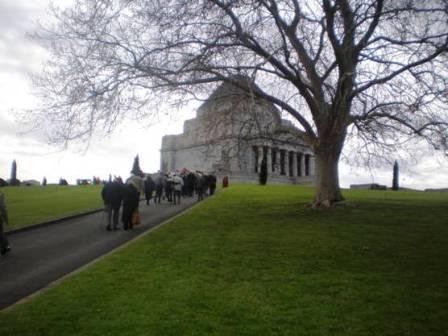
 Photo: Shrine of Remembrance, Melbourne. [H. MacDonald]

Recordings of many of talks are available to download, for a limited time, from the internet or by subscribing to the Shrine’s podcast service.

Amongst the most recent World War 1 lectures available are:

Gallipoli Sniper, presented by Mr John Hamilton on 11 June 2009

Gallipoli: The End of the Myth, presented by Prof. Robin Prior on 16 April 2009

Anzac Sniper_Billy Sing_sml

Photo: Private William (Billy) Sing DCM. [AWM]

A FFFAIF Member who is a regular attendee of the Shrine’s lectures had this to say: I had the great pleasure of attending the lecture by John Hamilton at the Shrine of Remembrance this afternoon. John’s talk on the writing of “Gallipoli Sniper, The Life of Billy Sing” was just exceptional, one of the best talks I have heard at one of these Shrine Public Programs lectures.

Extracts from “Gallipoli Sniper, The Life of Billy Sing” were featured in DIGGER 24, Page 40 .

John Hamilton, a FFFAIF Member, is also the author of “Goodbye Cobber, God Bless You” – the story of the charge of the Light Horse at The Nek.

To download and listen to the lecture click here.

*****

A new exhibition showing how Australia coped with the debilitating effects of the First World War on a young nation was opened by the Minister for Veterans’ Affairs, Alan Griffin at the Shrine on Friday 12 June 2009. Shell Shocked: Australia After Armistice shows that while a great many Australians celebrated the end of the war, the following years brought a period of grief and unparalleled adjustment which quickly tempered the joy of victory.

“Of the more than 330,000 Australians who left our shores to serve overseas during the First World War, more than 61,000 never returned home. Up to 160,000 returned injured or ill and for many their recovery was slow or life-long,” Mr Griffin said. 

“In 1938, twenty years after the war, there remained more than 1,600 veterans in homes for the permanently incapacitated, and around 23,000 seeking care from repatriation hospitals. 

“The human toll on a young nation is highlighted in the exhibition through records, photographs, letters and medical reports which reflect many personal stories of Australians from different walks of life. 

“The exhibition shows the many ways Australia and Australians coped with the aftermath of the war. Its stories include the lasting impact on the women of the Australian Army Nursing Service, the anxiety of those at home and the introduction of the Repatriation system which fulfilled the promise to care for those who suffered from their war service and provide for the dependants of those who did not return. 

Shell Shocked also shows the treatment of returned Indigenous servicemen – equal as soldiers but not as civilians, the internment camps for ‘enemy aliens’, and the community and government response in building memorials on battlefields and here, at home, post war,” Mr Griffin said. 

“It is an insightful exhibition into what was a truly daunting time for our young country.” 

Based on files from the National Archives of Australia and funded by a grant from the Department of Veterans’ Affairs, Shell Shocked is on a national tour and will be on display at the Shrine until 26 July, covering the 90th anniversary of the signing of the Treaty of Versailles on 28 June 1919.

*****

The Families and Friends of the First AIF thanks the Australian, UK and French governments for affording Australian and British soldiers – presently buried in mass graves at Pheasant Wood – dignified individual reburials in a new CWGC cemetery at Fromelles, and applauds Minister Snowdon and his British counterpart, Parliamentary Under-Secretary of State for Defence and Minister for Veterans, Kevan Jones MP, for their joint decision to DNA test the remains at exhumation and use every reasonable method to attempt identification of each soldier.

Posted in Gallipoli, The Shrine, Tips | Comments Off on *Gallipoli Podcasts

*DNA Contractor appointed

It was announced on Tuesday 16 June 2009 on the Australian Army Fromelles Project website that the DNA Contractor for the Fromelles Project has been awarded to LGC Forensics to collect and analyse DNA samples from the remains of the the British and Australian soldiers buried by the Germans at Pheasant Wood following the Battle of Fromelles in July 1916. If this proves viable, then DNA samples will be collected from potential descendants to match with samples from soldiers exhumed from the pits near Pheasant Wood.

FFFAIF Members Sandra Playle and Tim Lycett, with assistance from Andrew Pittaway and others, have developed a database of known descendants of the 191 Australian soldiers thought to be buried in Pheasant Wood to facilitate DNA profiles to be obtained from descendants and compared with those that may be obtained from the soldier’s remains.  In collaboration with the Australian Fromelles Project Group, descendants have now been identified for more than 140 of the soldiers and efforts are continuing to trace and contact descendants. 

The list of the names of the 191 Australian soldiers thought to be buried in Pheasant Wood can be viewed at the Fromelles Descendants’ Database website at http://www.fromelles.net/. It lists the 191 soldiers’ names, presents photogtraphs of more than 80 of the soldiers and reports on the status of the preparation of the family history profiles. The Fromelles Descendants’ Database also lists UK-born Australian soldiers buried at Pheasant Wood for whom no descendants have been identified.

The Australian Fromelles Project Group website at http://www.army.gov.au/fromelles/Fromelles_Home.asp also contains the list of the soldiers’ names at http://www.army.gov.au/fromelles/docs/WorkingList.pdf and requests that descendants register with them to enable details of DNA testing to be circulated to them.  It also identifies 62 Australian soldiers buried at Pheasant Wood for whom the Group does not have any descendants identified as yet at http://www.army.gov.au/fromelles/docs/Soldiers_Without_Contacts_11_Jun_09.pdf

*****

The media release on Wednesday 17 June 2009 from the office of the THE HON. GREG COMBET AM MP Minister for Defence Personnel, Materiel and Science and THE HON. ALAN GRIFFIN MP Minister for Veterans’ Affairs stated:

LGC FORENSICS WINS FROMELLES DNA CONTRACT

Greg Combet, Minister for Defence Personnel, Materiel and Science, and Alan Griffin, Minister for Veterans’ Affairs, today announced that LGC Forensics has been awarded the contract to analyse viable DNA from the remains of up to 400 World War One British and Australian soldiers found in Fromelles, France.

“The awarding of this contract marks the next step in the process in identifying those Australian and British soldiers who fought and died on 19 and 20 July 1916 at the battle of Fromelles,” said Mr Combet.

“The United Kingdom and Australian Governments are jointly committed to honouring the service of these World War One British and Australian soldiers.  The Australian Government will take every reasonable measure towards identifying these brave soldiers.”

“The Commonwealth War Graves Commission is overseeing the project on behalf of the UK and Australian Governments and has engaged LGC Forensics to undertake the DNA analysis.  LGC Forensics provided the best solution to the specific project requirements.”

LGC Forensics commenced a pilot study in early May to determine viability of the DNA in the remains. It is anticipated that the results of this pilot study will be available by the end of July 2009.

All descendants who have registered their details with the Fromelles Project will be contacted soon by the Government.  The UK Government will also be contacting relatives who have registered with it. This will occur regardless of whether the pilot study finds viable DNA or not.

“The process of identification will be complex and is likely to take some time”, said Mr Griffin.

“It will involve examination of records, physical evidence gathered during the recovery of remains, and DNA comparison, if practical.  The findings will then be considered by an identification board, which is likely to sit for the first time in March 2010, to ascertain whether the identity of any remains can be determined.”

“It is the intention of both Australia and the UK, out of respect for the soldiers involved, that reinterment is not delayed pending completion of the identification process.  Once all identification data is obtained, the remains will be reinterred with military honours in the new cemetery at Fromelles.  This reinterment is expected to commence in early 2010.”

“The cemetery will be the first of its kind constructed in over 50 years and it will be dedicated on the anniversary of the Battle of Fromelles in July 2010.  At that time, where identifications have been achieved, named headstones will be placed for each of the identified soldiers.  The placement of named headstones will continue into the future as the identification process continues,” Mr Griffin said.

Background:

The group burial at Pheasant Wood was confirmed during a limited excavation in May 2008 which was contracted by the Australian Government.  It is believed up to 400 Australian and British soldiers were buried there by German forces following the Battle of Fromelles in July 1916.

The Battle of Fromelles began 19 days after the opening of the Somme campaign on 19 – 20 July, and was the first battle fought by Australians on the Western Front.  It is known as Australia’s bloodiest 24 hours with 5533 Fifth Australian Division casualties.   

Archaeological excavation of the site was contracted to Oxford Archaeology and commenced in May 2009.  Individual re-interment of remains the new Commonwealth War Graves Commission Fromelles (Pheasant Wood) Military Cemetery is expected to be completed in February 2010.  The Commonwealth War Graves Commission is overseeing the excavation on behalf of both the Australian and United Kingdom Governments.

For ongoing project updates or to register your details if you believe you may be related to a soldier buried at Pheasant Wood, go to www.army.gov.au/fromelles or call 1800 019 090.

*****

The Families and Friends of the First AIF thanks the Australian, UK and French governments for affording Australian and British soldiers – buried in mass graves at Pheasant Wood by the Geremans following the Battle of Fromelles on 19/20 July 1916 – dignified individual reburials in a new CWGC cemetery at Fromelles, and applauds the joint decision to DNA test the remains at exhumation and use every reasonable method to attempt identification of each soldier.

Posted in Top Posts | Comments Off on *DNA Contractor appointed

*Kids' Art on Display

To secure the construction site of the new Commonwealth War Graves Commission (CWGC) Cemetery at Fromelles a fence has been constructed around the site. School children from France, Australian and United Kingdom were invited produce artwork to commemorate the service and sacrifice of the Australian and the British soldiers involved in the Battle of Fromelles.

To view the artwork of the French and UK school children click on the ‘screen’ below:

[slideshare id=1691049&doc=fromellescemeteryfrenchkids-090707062147-phpapp01]


To view the artwork of the Australian school children click on the ‘screen’ below:

[slideshare id=1691046&doc=fromellescemeteryaussiekids-090707062046-phpapp01]

*****

Construction is well underway at the site of the new CWGC Cemetery at Fromelles. This is the first new cemetery built by the CWGC built in northern France in more than 50 years.

11 06 2009 panels Fromelles 035_sml

Photo: Foundations being dug on cemetery site [Carole Laignel] 

The work is being carried out by the Belgium contractors. The cemetery site must first be stabilized by drilling down into the soil so that concrete piers can be poured. These piers will act as the foundations of the cemetery. The Cross of Sacrifice which will be 7m tall will be placed on a foundation which goes 9m into the ground. 

8.06.2009 New Cemetery Fromelles 038_sml

Photo: Concrete foundations [Carole Laignel]

A large fence has been erected along the roadside boundary of the site. British, Australian and French schoolchildren were asked to produce artwork to decorate the hoardings which surrounds the cemetery construction site using the theme of Remembrance.

 8.06.2009 New Cemetery Fromelles 003_sml

Photo: The fence surrounding the cemetery construction site [Carole Laignel]

Children from the local Fromelles village school and Stonyhurst School in Lancashire, UK were on hand on Monday 8 June to see their artwork on display.

DSC_0012 (2)_sml

Photo: FFFAIF Members Carole Laignel and Lambis Englezos (left) chat with the school children [Carole Laignel]

The artwork of Australian school children from the Camberwell Primary School in Victoria is also included on the display panels in Fromelles. 

The CWGC gave the children the opportunity to adorn the hoardings.  ‘Each Nation was briefed to use images that represented their own country in the design – in the case of Australia and the UK, to bring a little piece of home to a distant field of battle.’

Panel 1 Panel 11

Photo: Samples of some of the art work drawn by French and English school children [Carole Laignel]

Amongst the children gathered to see the display for the first time were several 12-year-olds from Stonyhurst School in Lancashire, England. 

Genevieve Turner said: “All the soldiers had families like us and they were not much older than we are. When I saw my drawing I was happy because those soldiers who died in the war will never be forgotten.”
Favour Maduka, who also attends Stonyhurst said: “Today was one of the proudest days of my life. Seeing our artwork displayed and being given the privilege to enter the excavation site has made me feel proud of the school, of my friends and of myself.”
Fellow pupil Jessica Moyle added: “The artwork was magnificent especially when it had been put up on the boards. All the men who died at Fromelles will finally be put to rest.”

The children’s teacher, Paul Garlington, said: “We were proud and deeply honoured to be asked to do this. It was both moving and humbling to be here today. Perhaps now these men can rest in peace.”

The artwork of the Australian school children from Camberwell Primary School has been incorporated into a large information panel featuring the ‘masthead’ of the Australian Army Fromelles Project .

8.06.2009 New Cemetery Fromelles 012_sml

 Photo: Information Panel at Fromelles (Pheasant Wood) Cemetery featuring the words Don’t forget me Cobber

11 06 2009 panels Fromelles 027_sml

11 06 2009 panels Fromelles 025_sml

Photo: Detail of some of the artwork from Australian school children [Carole Laignel]

Since the artwork went on display the fence has been given a coat of paint.

Painted cemetery fence

Photo: Fence around cemetery construction site being painted, July 2009 [Carole Laignel]

*****

The Families and Friends of the First AIF thanks the Australian, UK and French governments for affording Australian and British soldiers buried in mass graves at Pheasant Wood by German soldiers following the Battle of Fromelles on 19/20 July 1916 dignified individual reburials in a new CWGC cemetery at Fromelles, and applauds the joint decision to DNA test the remains at exhumation and use every reasonable method to attempt identification of each soldier.

Posted in Top Posts | Comments Off on *Kids' Art on Display

Message from Lambis

”Thanks for your support’,
from Lambis Engelzos AM

Lambis Englezos at Pheasant Wood Fromelles. [Carole Laignel]

Lambis Englezos at Pheasant Wood Fromelles. (Carole Laignel)

Lambis Englezos is presently in Fromelles and following his appointment as a Member of The Order of Australia for ‘Service to the community through research and advocacy roles relating to Australian soldiers of the Great War buried in Fromelles, France’ (click here for details) he has sent the following message to FFFAIF members and his supporters:

“I’d like to acknowledge and thank you for your messages of congratulations and endorsement. Over the years I have needed the encouragement and help. Our work in our common cause of commemoration and remembrance continues.

Any work that I have done, I dedicate to the memory of the veterans that I have met, the “19th of July men”. I consider myself very fortunate to have met these men, the survivors. Men like Charlie Henderson, Tom Brain and the wonderful Bill Boyce. I cherish that memory. In a very real sense, my recent work has been fired and energised by them.

2008 was a remarkable year. Pheasant Wood was confirmed, Jim Bourke and his team continued their work to recover our Vietnam ‘missing’ boys and HMAS Sydney was found. Our commemorative legacy and history is tangible.

As mentioned, I have needed help. My thanks go to Ward Selby, John Fielding and Tim Whitford, fellow amateur historians, a badge we wear with honour. It has been a journey: our process and advocacy continues. I would also like to acknowledge the Australian Army for establishing and maintaining the process that has brought us to the present recovery phase. If for no other reason, we needed to pursue this resolution for the message that it sends to our current serving people – it will be a moving sight when ‘our boys’ are carried by them, to dignified burial.

It was Robin Corfield who saw the need to commemorate the 75th anniversary of a little known battle called “Fromelles”. We met at that service and Robin established the “Friends of the 15th Brigade”, established a calendar of commemorative events, researched and wrote a book called, “Don’t Forget Me Cobber“. Robin planted a flag; I picked it up.

So there is a collective ownership of the site at Pheasant Wood. Each of the soldiers will be given their dignity and, hopefully, their identity. Our boys will be in the care of a village that will honour them – the villagers are respectful of their sacrifice and are their custodians; ‘our boys’ are in good hands.

Once again, thank you for your endorsement and encouragement. Our process continues.

We have almost found Harry [Private Harry Willis] and Jack [Lt. Jack Bowden]

Bye for now,
Lambis.”

“]The quest continues for Lambis Englezos............

The quest continues for Lambis Englezos............(Carole Laignel)

*****

The Families and Friends of the First AIF thanks the Australian, UK and French governments for affording Australian and British soldiers – presently buried in mass graves at Pheasant Wood – dignified individual reburials in a new CWGC cemetery at Fromelles, and applauds Minister Snowdon and his British counterpart, Parliamentary Under-Secretary of State for Defence and Minister for Veterans, Kevan Jones MP, for their joint decision to DNA test the remains at exhumation and use every reasonable method to attempt identification of each soldier.

Posted in Lambis Englezos, Members' Announcements | Comments Off on Message from Lambis

Aubers Ridge Service

Battle of Aubers Ridge

The Battle of Aubers Ridge was fought by the British on 9 May 1915.  British troops from General Sir Douglas Haig’s First Army took part in the action suffering 11,000 casualties in one day of fighting on a narrow front. For more information on the Battle click here.

FFFAIF Secretary, Chris Munro attended the Service of Remembrance of the 94th Anniversary of the Battle of Aubers Ridge on 9 May 2009 and has produced the following pictorial report.

94th Anniversary
Battle Aubers Ridge
Service of Remembrance

The Australian Memorial Park was the site of the commemorative service organised by Mrs Victoria Burbidge the British Representative, Fromelles & Weppes Terre de Mémoire 14-18 (Fromelles Museum). The service was attended by dignitaries, officials and descendents of British soldiers who participated in the Battle of Aubers.
Aubers Ridge Service of Remembrance 9 May 2009

Aubers Ridge Service of Remembrance 9 May 2009

The commencement of the Service was heralded by The Passchendaele 1917 Pipes and Drums.

The Passchendaele 1917 Pipes and Drums

The Passchendaele 1917 Pipes and Drums

The memorial address was given by Mrs Victoria Burbidge with Carole Laignel, Secretary Fromelles & Weppes Terre de Mémoire 14-18 (Fromelles Museum) undertaking the role of translator for the service.

Mrs Victoria Burbidge and Mme Carole Laignel

Mrs Victoria Burbidge and Mme Carole Laignel

A lone piper played Flowers of the Forest as wreaths were laid.

Passchaendaele 1917 Pipes & Drums' Lone Piper

Passchaendaele 1917 Pipes & Drums' Lone Piper

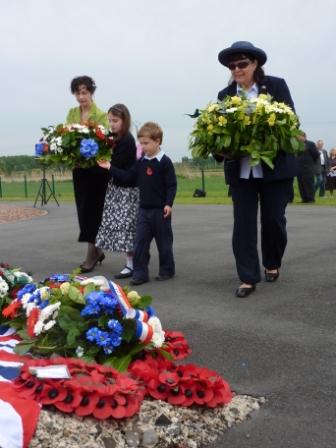
Mrs Victoria Burbidge with her children and Chris Munro lay wreaths during the service

Mrs Victoria Burbidge with her children laying a wreath on behalf of the people of Britain and Chris Munro laying a wreath on behalf of the people of Australia during the service

The wreaths were laid on the remains of one of the German bunkers drapped in the British & Australian flags.

British and Australian flags draped on remains of a German pillbox

British and Australian flags draped on remains of a German pillbox

Peter Barton lays a wreath on behalf of the GUARD team

Peter Barton laying a wreath on behalf of the GUARD team

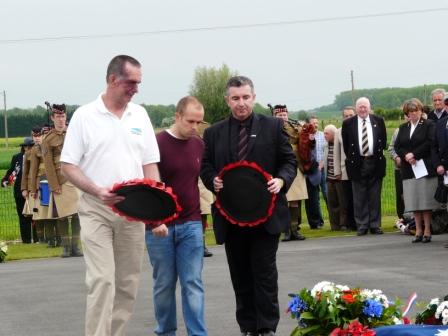
Representatives of the Western Front Association and The British Legion laying wreaths

Representatives of the Western Front Association and The British Legion laying wreaths

Descendants of British soldiers who died in The Battle of Aubers Ridge laying wreaths

Descendants of British soldiers who died in The Battle of Aubers Ridge laying wreaths

The buglers from the Last Post Association, Ieper, played the Last Post and Reveille at the service. 

Last Post Association Buglers who play at the Menin Gate, Ieper.

Last Post Association Buglers who play at the Menin Gate, Ieper.

After the Service the Fromelles village hall hosted a display on the Battle of Aubers Ridge.

Fromelles' village hall

Fromelles' village hall

Historian Peter Barton, a member of the Glasgow University Archaeology Research Division (GUARD) team who carried out the preliminary dig at Pheasant Wood in 2008, supplied many of the photos and maps for the display. 

A section of the photo display

A section of the photo display

Mayor Hubert Hutchet, Mrs Victoria Burbidge, Lord Faulkner of Worcester (Chairman All Party Parliamentary War Graves and Battlefields Heritage Group), Mr Peter Barton (Historian) and Mr David Symons (CWGC Director France)

Mayor Hubert Huchette, Mrs Victoria Burbidge, Lord Faulkner of Worcester (Chairman All Party Parliamentary War Graves and Battlefields Heritage Group), Mr Peter Barton (Historian and Co-Secretary All Party Parliamentary War Graves and Battlefields Heritage Group) and Mr David Symons (CWGC Director France)

6th Bavarian Reserve Division trench plan of the area now occupied by the Australian Memorial Park Fromelles from the research of Peter Barton

6th Bavarian Reserve Division trench plan of the area now occupied by the Australian Memorial Park Fromelles from the research of Peter Barton

The wreaths and tributes from the service were later moved a short distance down the road to the Kennedy Memorial. This memorial was built to commemorate the memory of Captain Paul Adrian Kennedy, who was killed leading “B” Company of the 2nd Rifle Brigade on 9th May 1915. Captain Kennedy’s mother bought this plot of land after the war and erected the memorial in remembrance of her son and his colleagues who fell on the same day. 

Kennedy Private Memorial Fromelles

Kennedy Private Memorial Fromelles

Although the Battle for Aubers Ridge took place a year before the Australian Imperial Forces saw action on the Western Front, there were Australians who took part in the fighting. They included Sergeant Charles Holmes, of the 2nd Battalion East Lancashire Regiment, who was born in Adelaide, and died during the battle. Also Horace Mawdesley who was born in Geraldton, Western Australia, but was living in London when war broke out in August 1914.  Enlisting in September, he was posted to the 2nd Battalion Rifle Brigade and was also killed in the Battle of Aubers Ridge. Neither soldier has a known grave.

LEST WE FORGET

LEST WE FORGET

The photos in this report were taken by Carole Laignel, Secretary Fromelles & Weppes Terre de Mémoire 14-18 (Fromelles Museum); Chris Munro, Secretary Families and Friends of the First AIF (FFFAIF) and Chloe Wootten, Communications Manager Australian Fromelles Project Group (AFPG).

*****

The Families and Friends of the First AIF thanks the Australian, UK and French governments for affording Australian and British soldiers – presently buried in mass graves at Pheasant Wood – dignified individual reburials in a new CWGC cemetery at Fromelles, and applauds Minister Snowdon and his British counterpart, Parliamentary Under-Secretary of State for Defence and Minister for Veterans, Kevan Jones MP, for their joint decision to DNA test the remains at exhumation and use every reasonable method to attempt identification of each soldier.

Posted in Aubers Ridge, The Western Front | Comments Off on Aubers Ridge Service

Lambis Englezos AM

Congratulations to


Lambis Englezos AM

AM_LambisThe 2009 Queen’s Birthday Honours List published today (8 June) proclaims that Lambis Englezos has been appointed a Member of The Order of Australia, within the General Division, for ‘Service to the community through research and advocacy roles relating to Australian soldiers of the Great War buried in Fromelles, France’.

1_Lambis_Castle Hill_sml

The Families and Friends of the First AIF Committee and Members are very pleased that this well-deserved honour was bestowed upon our fellow FFFAIF member, and a recipient of the RSL’s 2009 Anzac of the Year Award, in recognition for his years of untiring effort to preserve the memory of the First AIF and his service to the ex-Service communities and their families and friends, as demonstrated by:

1)         his contribution as co-instigator of the dedication of a plaque and a eucalypt tree to the 60th Battalion AIF, at the Shrine of Remembrance, Melbourne in 1992, which led to the formation of ‘Friends of the 15th Brigade’. This association made and has maintained a friendship with Melbourne’s French community since contacting the French Consul General in Melbourne (Mme Isabelle Costa de Beauregard) and, together, commemorating the 75th anniversary of the Battle of Villers-Bretonneux at the Shrine on Anzac Day Eve, 1993 – the beginning of a tradition still current. The subsequent dedication, that year, of a plaque (donated by the French Government) and a eucalypt tree to the 59th Battalion on 19 July (the 77th anniversary of the Battle of Fromelles) was the first ‘Friends’ Fromelles Commemoration Service at the Shrine which, to this day, Lambis continues to lead each year. His interest in WWI had been ignited by his meetings with WWI veterans, their relatives and friends. He spent years building & nurturing a community network of relatives and others connected with Australian WWI soldiers (who belonged in this instance, of course, to the 15th Brigade). When there were 15th Brigade veterans still alive, Lambis was superb at tracking them down, making them feel good, making them feel special, visiting them, inviting them to functions where they’d be made a fuss of, arranging transport for them etc.

Lambis’ campaign for recognition of Fromelles at the Shrine and his search for the Fromelles burial site had their origins in ‘Friends of the 15th Brigade’– he and this association continue to “Keep The Memory Alive”;

2)         his contribution (while maintaining a full-time position as a high-school art teacher) through untiring research efforts and unceasing dedication at great personal expense over a period of six years lobbying and persuading the Australian Government and Australian Army which ultimately realised positive resolution to the mystery of the ‘Missing’ Australian Diggers and British soldiers after the Battle of Fromelles (19-20 July 1916);

3)         his contribution to Australian and British WWI Military History that this resolution delivers;

4)         his contribution to the subsequent relief that the discovery at Pheasant Wood and the pledge from the UK and Australian Governments to guarantee dignified individual reburials in a new CWGC cemetery at Fromelles (and to DNA test the remains at exhumation and use every reasonable method to attempt identification of each soldier) brings to the ‘Missing’ soldiers’ families and relatives, and to the Service and ex-Service communities;

5)         his contribution to the campaign for erection of the ‘Cobbers’ replica statue (unveiled on 19 July 2008) in the grounds of the Shrine of Remembrance in Melbourne in recognition of the sacrifice made by 5,533 Australian casualties – suffered by the AIF’s Fifth Division, in a single night at the Battle of Fromelles – being the first by any State Memorial in Australia; and

6)         his contribution to the education of the Australian community through media coverage of his example of dedication to Keeping The Memory Alive of the service and sacrifice made by the First AIF during the First World War.

2_ Lambis Englezos at Pheasant Wood 29 April 2008 before Dig - Chris Munro DSCN0064_sml

In Parliament on 28 May 2008, in response to a question by The Hon Chris Trevor MP, the Hon. Warren Snowdon MP, the Minister for Defence Science and Personnel, concluded his reply:

 “Finally, can I recognise here the singular efforts of Mr Lambis Englezos and his supporters, who have researched and urged so persuasively that this research be undertaken. I am sure that, without his commitment and dedication, this mystery would never have been solved.”

Honourable members — “Hear, hear!” (Hansard)

On 9 June 2008, the Minister confirmed that an Australian Rising Sun collar badge had been discovered during the limited excavation of a First World War burial site in Fromelles, France:

 “Our archaeology team in Fromelles has unearthed a Rising Sun badge in Pit 4, which proves that the remains of Australian soldiers are buried at this important site,” Minister Snowdon said.

“This is a momentous discovery and makes this field at Pheasant Wood on the other side of the world, of national significance for all Australians.” (Media Release 068/2008)

On 14 June, Minister Snowdon again praised and recognised Lambis’ achievement:

 “…… And of course we must remember that it is likely that none of this would have happened without the foresight and dedication of Mr Lambis Englezos, the amateur historian and head of the Friends of the 15th Brigade whose research lead to Army’s decision to investigate.” (Media Release 073/2008)

3_Examining artefacts Tim Whitford, unidentified, Lambis Englezos, Lt Col Peter Singh on site June 2008_sml

Media coverage recognising Lambis’ contributions includes, but is not limited to:

60 Minutes TV program “Don’t Forget Me Cobber” aired in Australia on 16 July 2006, with a follow up on 1 June 2008 – view transcript/video by clicking here  with a link to the video, and here  by entering ‘Fromelles’ in the “find video” search box.

ABC TV’s 7.30 Report on 26 May 2008 “Archaeological dig hopes to solve military mystery” – transcript/video available by clicking here.

In addition, he has received extensive coverage in news bulletins on TV, radio, in the printed press and internet-based media, both in Australia and internationally – too numerous to mention. Entering ‘Lambis Englezos’ into an internet search engine will return over 1550 responses which gives some idea of the coverage his contributions have generated.

4_Lambis_JLML 08_sml

 In the Index to Patrick Lindsay’s FROMELLES (Australia’s darkest day – and the dramatic discovery of our fallen World War One Diggers) Hardie Grant Books – 2008 (ISBN 978 1 74066 684 8), Lambis Englezos has 39 references including 14 multi-page references. For further information and insight to Lambis’ story, members and visitors are encouraged to read Part Two of FROMELLES (A Magnificent Obsession P 183-451) which details Lambis’ long campaign to find the Missing Diggers of Fromelles.

5_Tim and Lambis_unveiling Cobbers_sml

Russell Curley
President
Families and Friends of First AIF.
8 June 2009

6_Lambis Pheasant Wood panels_sml

Congratulations Lambis.

*****

Photos of Lambis were taken by Geoff Irvine, Chris Munro, Department Defence, Jim Munro, Fairfax Media, Carole Laignel.

*****

The Families and Friends of the First AIF thanks the Australian, UK and French governments for affording Australian and British soldiers – presently buried in mass graves at Pheasant Wood – dignified individual reburials in a new CWGC cemetery at Fromelles, and applauds Minister Snowdon and his British counterpart, Parliamentary Under-Secretary of State for Defence and Minister for Veterans, Kevan Jones MP, for their joint decision to DNA test the remains at exhumation and use every reasonable method to attempt identification of each soldier.

Posted in Lambis Englezos | Comments Off on Lambis Englezos AM

*New CWGC Cemetery

The Minister for Veterans’ Affairs, Alan Griffin and the Minister for Defence Science and Personnel, Warren Snowdon media update on the new war cemetery at Fromelles was released on Wednesday 3 June.

WORK STARTS ON NEW WAR CEMETERY AT FROMELLES

cemetery-site-begins-2-300x225_CWGC

Photo: Work begins on the new CWGC Cemetery at Fromelles [CWGC]

 “The Commonwealth War Graves Commission has selected Beton-Bouw Bentein BVBA to build the cemetery, which will be the first new war cemetery in almost fifty years,” Mr Griffin said.

“The family-owned firm has worked on more than 30 cemeteries, including Tyne Cot in Belgium which is the largest British and Commonwealth war cemetery in the world.

 “The new cemetery is to be known as Fromelles (Pheasant Wood) Military Cemetery and is where the remains of up to 400 Australian and British servicemen who died during the Battle of Fromelles in July 1916 will be re-interred.

 “Australia suffered 5533 casualties at the Battle of Fromelles including 1917 killed, 3146 wounded and 470 taken prisoner, making it the worst 24 hours in Australian war time history. 

“The Fromelles (Pheasant Wood) Military Cemetery will be place of pilgrimage for Australians, as well as our allies, and will honour the diggers’ courage and sacrifice for many generations to come,” Mr Griffin said.

 The location for the new cemetery, which overlooks the battlefield, was decided after consideration by the CWGC’s horticultural and structural experts and following discussions with the people of Fromelles and the Australian, British and French authorities.

30.05.2009 Sophia & Lambis 033_sml

Photo: The Fromelles (Pheasant Wood) CWGC Cemetery site 30 May 2009 [Carole Laignel]

The cemetery will be flexible in design, given that it is not yet known how many soldiers are buried at Fromelles.

Mr Snowdon said the remains of the Australian and British men currently lie in a number of mass graves in an area known as Pheasant Wood.

“Work has already begun to exhume the men buried in five mass graves at Pheasant Wood.  The recovery of the remains is planned to be completed by September 2009,” Mr Snowdon said.

“The diggers will then be permanently laid to rest with full military honours in individual graves at the new Fromelles (Pheasant Wood) Military Cemetery and it is my hope that many of these soldiers will be laid to rest under named headstones.”

*****

The FFFAIF website will be updated regularly on the activities at Fromelles as information and photos are obtained.

*****

The Families and Friends of the First AIF thanks the Australian, UK and French governments for affording Australian and British soldiers – presently buried in mass graves at Pheasant Wood – dignified individual reburials in a new CWGC cemetery at Fromelles, and applauds Minister Snowdon and his British counterpart, Parliamentary Under-Secretary of State for Defence and Minister for Veterans, Kevan Jones MP, for their joint decision to DNA test the remains at exhumation and use every reasonable method to attempt identification of each soldier.

Posted in Top Posts | Comments Off on *New CWGC Cemetery

*End of an Era

THE LAST OF A GENERATION

Private John Ross – We will remember him

Rising Sun Badge_sml

 The Minister for Veterans’ Affairs, Alan Griffin, today expressed his sorrow at the passing of John ‘Jack’ Ross, the last remaining Australian to have served during the First World War.

 Mr Ross passed away at 3.30 am this morning in Bendigo. Mr Ross is survived by his daughter Peggy and son Robert and four grandchildren.

“Mr Ross showed his willingness to serve Australia and her allies in what was an extremely tumultuous time in our history, and for that we are grateful,” Mr Griffin said.

 “While he did not travel overseas, he completed his training, ready for deployment.”

 Mr Ross was a clerk when he enlisted in the Australian Imperial Force in January 1918.  He trained at the Wireless Training School and was posted to the 1st (Depot) Battalion at Broadmeadows Camp in Victoria.  At the time of his enlistment, he could not – of course – have known that the war would end in November.

With the end of the war and the demobilisation of the Australian Imperial Force, Private Ross was discharged on Christmas Eve, 1918.  He served his country again in the Second World War as a member of the Volunteer Defence Corps.

In civilian life, Mr Ross worked for the Victorian Railways for more than 45 years and retired from the service in 1964.

 On 9 July 1999, Mr Ross was presented with the 80th Anniversary Armistice Remembrance Medal, Australia’s first commemorative honour, marking the 80th anniversary of the end of the First World War.  Mr Ross was also awarded the Centenary Medal, in recognition of his contribution to Australian society.

Mr Griffin said with the passing of Jack Ross, the last of the 417,000 Australians that served in the First World War was now gone.

 “Although our living links to the First World War have been lost, we will continue to remember their heroic deeds and actions through the stories they have shared with us and through the legend that they created,” Mr Griffin said.

“It now falls to Australians everywhere to ensure that their memory is kept alive.  We must ensure that their contribution to Australia’s wartime history is passed on to future generations, so that their sacrifice is never forgotten.”

*****

The Families and Friends of the First AIF will continue to Keep The Memory Alive of  the Australian volunteers who served in the Great War through our members who are “Dedicated to Digger Heritage”. 

Lest We Forget

*****

The Families and Friends of the First AIF thanks the Australian, UK and French governments for affording Australian and British soldiers – presently buried in mass graves at Pheasant Wood – dignified individual reburials in a new CWGC cemetery at Fromelles, and applauds Minister Snowdon and his British counterpart, Parliamentary Under-Secretary of State for Defence and Minister for Veterans, Kevan Jones MP, for their joint decision to DNA test the remains at exhumation and use every reasonable method to attempt identification of each soldier.
Posted in Diggers of First AIF | Comments Off on *End of an Era

*Memorial Way No.11

June 8th is ‘Anniversary Day’ or ‘Bounty Day’ on Norfolk Island. On this day in 1856 the Pitcairn Islanders landed at Norfolk Island to start the Third Settlement. Less than 60 years later, men from the island were volunteering to become ANZACs in the Great War.

Following a recent visit to Norfolk Island, FFFAIF President Russell Curley filed this report on the War Memorials of Norfolk Island. [All photos in the report come from The Curley Collection.]

Norfolk Island War Memorial

206_sml

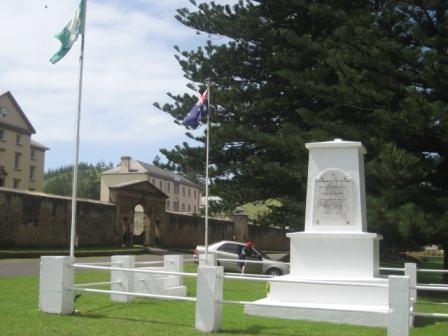
The Memorial is situated opposite All Saints Church, on the South-Eastern corner of the intersection where Country Road becomes Quality Row at Kingston.  This was the site of the First & Second Settlements, on the southern side of the island and is loacted at 29o 03’ 20.84” S, 167o 57’ 25.46” E.  The Memorial was erected using locally sourced blocks, rendered and painted white, at a cost of £145/18/3 ($A291.83) and was unveiled on Anzac Day, 1929. It is surrounded by a white post and twin rail fence and has a flagstaff at each corner. The Australian flag flies at the North East and the Norfolk Island flag at the North West corner. The remaining staffs are used as required. The Memorial’s North face lists 77 names of those who served in WWI on the upper section and ten names of those who died on Active Service during WWII (9) and Korea (1) .

203_sml


The Eastern face inscription reads:

TO

COMMEMORATE THE SERVICES

OF THE INHABITANTS OF THIS ISLAND

WHO FOUGHT IN

THE GREAT WAR

1914 – 1919

 207_sml 

The WWI Memorial’s names include at least two females, Sarah Nobbs and Evelyn (Eva) Nobbs RRC, [Staff Nurse AANS]. The Cross of Sacrifice appears next to 13 names.

The Norfolk Island RSL Sub-Branch Memorial Club WWI nominal roll lists 81 names, which represents about half of the eligible male population on the island at that time. The 81/77 discrepancy remains unresolved.*

Of the 30 surnames listed on the Memorial, eight (Adams, Buffett, Christian, Evans, McCoy, Nobbs, Quintal and Young) are directly descended from the Pitcairn Islanders (HMS Bounty mutineers and their Tahitian wives) who arrived on Norfolk on board the Morayshire on 8 June 1856. From those eight families, there were seven enlistments from the Adams family; five from Buffett; five from Christian; seven from Evans; one McCoy; six from Nobbs (including two females); 14 Quintals and one Young. Of the other surnames listed there are, no doubt, several who can claim similar descendancy through marriage.

204_sml

The National Archives of Australia holds records for no less than 47 who served with the AIF, and on enlistment gave their place of birth as Norfolk Island. These records include two enlistments whose names do not appear on the Memorial (George Evans Hill [20th Bn AIF] who may be ‘George Evans’ and Austin Thomas Quintal [1st Pnr Bn AIF] who may be either ‘A. Quintal’ or known by another name). The remainder may have served with the NZEF or other forces. [The NZ National Archives are not yet digitised and weren’t investigated for this post.] A list of the inscribed names may be viewed by clicking here.  

Norfolk’s highest ranking soldier from WWI was Major James B Metcalfe DSO, MC & MID [MD, 10th FAMB] Died of Wounds at 20th Casualty Clearing Station (CCS) on 25/4/1918. Major Metcalfe practised Medicine in Wellington, NSW, at the time of enlistment and is also included on the Wellington (NSW) Honour Roll. Other Commissions held by Islanders were three captains, including Major Metcalfe’s brother, Captain Francis B Metcalfe [MD, AAMC], who died after amputation of a leg in England on 18/10/1916, and two Lieutenants. Captain Metcalfe was employed at the Children’s Hospital, Brisbane before enlistment at Enoggera, QLD. Other decorated men were Lt JS Robinson MC, Sgt Harry Anderson DCM & clasp (bar), L/Cpl Byron Quintal DCM [53rd Bn AIF] and Pte Arthur B. Menges DCM.**

“Norfolk Island had a remarkable statistical participation rate per head of population for major world war conflicts unsurpassed certainly in Australasia and perhaps the world. Despite difficulty with transportation to & from Norfolk Island and Australasia, nine men departed for the Boer War, 81 of a possible 160 men joined the Australian and New Zealand military for WWI, 280 of a possible 365 men plus eight women joined the Australian and New Zealand military for WWII, and continued participation with Korea, Malaya, Vietnam, Gulf, Kuwait, Somalia, Afghanistan, East Timor, and other United Nations peace keeping forces. The Norfolk Island population dealt with the resulting casualties of war, the prisoners of war, the missing in war, the injuries from war, and some adjustment disorders. Norfolk Island detached military personnel were well decorated and the Norfolk Island Infantry Detachment assigned to protecting its shores were mentioned and recognised for appropriate military service.” *

The Islanders who remained on the island during WWI, had to deal with severe climatic conditions – some of the worst recorded. “On the day WWI was declared, Norfolk recorded its lowest minimum temperature of 4.5oC. Moreover, unprecedented drought conditions, existing over a wide region of the Pacific, compounded the difficulties. Being an island, Norfolk was naturally susceptible to the vagaries of the weather. When a severe drought struck the island, as in 1914, crops failed and this was to be the pattern in subsequent years.”**

*Norfolk Island RSL Sub Branch – looking after the community! ISLANDERS GO TO WAR: Author unknown.

** Norfolk Island and its Third Settlement – Raymond Nobbs (Library of Australian History, Sydney, 2006)

*****

Thanks Russell.
If you know of an Anzac War Memorial you would like to see featured in Memorial Way contact Chris at projectfffaif@yahoo.com.au

*****

The Families and Friends of the First AIF thanks the Australian, UK and French governments for affording Australian and British soldiers – presently buried in mass graves at Pheasant Wood – dignified individual reburials in a new CWGC cemetery at Fromelles, and applauds Minister Snowdon and his British counterpart, Parliamentary Under-Secretary of State for Defence and Minister for Veterans, Kevan Jones MP, for their joint decision to DNA test the remains at exhumation and use every reasonable method to attempt identification of each soldier.

Posted in Members First AIF, Memorial Way, Memorials | Comments Off on *Memorial Way No.11

*Archive Books on CD

A SALE WORTH LOOKING AT!

Archive CD Books Australia offers the unique opportunity to own your own copy of  ‘hard-to-get’ books covering a large range of topics. They produce a range of World War 1 publications on CD.

Until the 15 June they are offering 50% off the price of Australian and New Zealand products. This sale provides a great opportunity to add to your World War 1 Australian Library collection at very reasonable prices. It is worth checking out Archive CD Books Website and the special offers.

 One of the books available on this special offer is All-Australia Memorial (Victorian Edition).

The All Australia Memorial_title page_sml

The All- Australia Memorial  (Victorian Edition) gives an historical outline of the Great War from an Australian perspective, ‘plus an extensive reference section and hundreds of soldier biographies. All complemented by thousands of photos’.  Available on CD for only $29.75

All Australia Memorial_sample page_sml

One of the many other books on offer as a special June sale price is Aussie: The Australian Soldier’s Magazine.

AU0016-2

Aussie was a popular Australian soldiers magazine during and after World War 1. The magazine had its origins in 1914 under a different name and was transformed into ‘Aussie’ in 1918. This compilation covers monthly issues from No 1 in January 1918 to No. 13 in April 1919. The magazine was created for the soldiers and was largely written by the soldiers. Its object was to be “bright, cheerful and interesting, to reflect that happy spirit and good humour so strongly evident throughout the Aussie Army”. Each issue consists of approximately 16 pages. And includes many humorous and personal stories, poems, songs, tips and sketches which reflect the life of ‘the Australian soldier’ in a unique and fascinating way.’ Available at the special CD price of $14.75.

Aussie Mag_title page_sml

Other titles include:
Australia’s Fighting Sons of the Empire (New South Wales & Queensland)

Uncensored Dardanelles

Queenslanders Who Fought in The Great War

Bank of New South Wales Roll of Honour

Anzac Memorial

Tasmania’s War Record 1914-1919

Book of Remembrance of the University of Sydney in the Great War 1914-1918

Click here to visit Archive CD Books Australia and check out the offers.

*****

The Families and Friends of the First AIF thanks the Australian, UK and French governments for affording Australian and British soldiers – presently buried in mass graves at Pheasant Wood – dignified individual reburials in a new CWGC cemetery at Fromelles, and applauds Minister Snowdon and his British counterpart, Parliamentary Under-Secretary of State for Defence and Minister for Veterans, Kevan Jones MP, for their joint decision to DNA test the remains at exhumation and use every reasonable method to attempt identification of each soldier.

Posted in Books, Tips | Comments Off on *Archive Books on CD