Lambis Englezos AM

Congratulations to


Lambis Englezos AM

AM_LambisThe 2009 Queen’s Birthday Honours List published today (8 June) proclaims that Lambis Englezos has been appointed a Member of The Order of Australia, within the General Division, for ‘Service to the community through research and advocacy roles relating to Australian soldiers of the Great War buried in Fromelles, France’.

1_Lambis_Castle Hill_sml

The Families and Friends of the First AIF Committee and Members are very pleased that this well-deserved honour was bestowed upon our fellow FFFAIF member, and a recipient of the RSL’s 2009 Anzac of the Year Award, in recognition for his years of untiring effort to preserve the memory of the First AIF and his service to the ex-Service communities and their families and friends, as demonstrated by:

1)         his contribution as co-instigator of the dedication of a plaque and a eucalypt tree to the 60th Battalion AIF, at the Shrine of Remembrance, Melbourne in 1992, which led to the formation of ‘Friends of the 15th Brigade’. This association made and has maintained a friendship with Melbourne’s French community since contacting the French Consul General in Melbourne (Mme Isabelle Costa de Beauregard) and, together, commemorating the 75th anniversary of the Battle of Villers-Bretonneux at the Shrine on Anzac Day Eve, 1993 – the beginning of a tradition still current. The subsequent dedication, that year, of a plaque (donated by the French Government) and a eucalypt tree to the 59th Battalion on 19 July (the 77th anniversary of the Battle of Fromelles) was the first ‘Friends’ Fromelles Commemoration Service at the Shrine which, to this day, Lambis continues to lead each year. His interest in WWI had been ignited by his meetings with WWI veterans, their relatives and friends. He spent years building & nurturing a community network of relatives and others connected with Australian WWI soldiers (who belonged in this instance, of course, to the 15th Brigade). When there were 15th Brigade veterans still alive, Lambis was superb at tracking them down, making them feel good, making them feel special, visiting them, inviting them to functions where they’d be made a fuss of, arranging transport for them etc.

Lambis’ campaign for recognition of Fromelles at the Shrine and his search for the Fromelles burial site had their origins in ‘Friends of the 15th Brigade’– he and this association continue to “Keep The Memory Alive”;

2)         his contribution (while maintaining a full-time position as a high-school art teacher) through untiring research efforts and unceasing dedication at great personal expense over a period of six years lobbying and persuading the Australian Government and Australian Army which ultimately realised positive resolution to the mystery of the ‘Missing’ Australian Diggers and British soldiers after the Battle of Fromelles (19-20 July 1916);

3)         his contribution to Australian and British WWI Military History that this resolution delivers;

4)         his contribution to the subsequent relief that the discovery at Pheasant Wood and the pledge from the UK and Australian Governments to guarantee dignified individual reburials in a new CWGC cemetery at Fromelles (and to DNA test the remains at exhumation and use every reasonable method to attempt identification of each soldier) brings to the ‘Missing’ soldiers’ families and relatives, and to the Service and ex-Service communities;

5)         his contribution to the campaign for erection of the ‘Cobbers’ replica statue (unveiled on 19 July 2008) in the grounds of the Shrine of Remembrance in Melbourne in recognition of the sacrifice made by 5,533 Australian casualties – suffered by the AIF’s Fifth Division, in a single night at the Battle of Fromelles – being the first by any State Memorial in Australia; and

6)         his contribution to the education of the Australian community through media coverage of his example of dedication to Keeping The Memory Alive of the service and sacrifice made by the First AIF during the First World War.

2_ Lambis Englezos at Pheasant Wood 29 April 2008 before Dig - Chris Munro DSCN0064_sml

In Parliament on 28 May 2008, in response to a question by The Hon Chris Trevor MP, the Hon. Warren Snowdon MP, the Minister for Defence Science and Personnel, concluded his reply:

 “Finally, can I recognise here the singular efforts of Mr Lambis Englezos and his supporters, who have researched and urged so persuasively that this research be undertaken. I am sure that, without his commitment and dedication, this mystery would never have been solved.”

Honourable members — “Hear, hear!” (Hansard)

On 9 June 2008, the Minister confirmed that an Australian Rising Sun collar badge had been discovered during the limited excavation of a First World War burial site in Fromelles, France:

 “Our archaeology team in Fromelles has unearthed a Rising Sun badge in Pit 4, which proves that the remains of Australian soldiers are buried at this important site,” Minister Snowdon said.

“This is a momentous discovery and makes this field at Pheasant Wood on the other side of the world, of national significance for all Australians.” (Media Release 068/2008)

On 14 June, Minister Snowdon again praised and recognised Lambis’ achievement:

 “…… And of course we must remember that it is likely that none of this would have happened without the foresight and dedication of Mr Lambis Englezos, the amateur historian and head of the Friends of the 15th Brigade whose research lead to Army’s decision to investigate.” (Media Release 073/2008)

3_Examining artefacts Tim Whitford, unidentified, Lambis Englezos, Lt Col Peter Singh on site June 2008_sml

Media coverage recognising Lambis’ contributions includes, but is not limited to:

60 Minutes TV program “Don’t Forget Me Cobber” aired in Australia on 16 July 2006, with a follow up on 1 June 2008 – view transcript/video by clicking here  with a link to the video, and here  by entering ‘Fromelles’ in the “find video” search box.

ABC TV’s 7.30 Report on 26 May 2008 “Archaeological dig hopes to solve military mystery” – transcript/video available by clicking here.

In addition, he has received extensive coverage in news bulletins on TV, radio, in the printed press and internet-based media, both in Australia and internationally – too numerous to mention. Entering ‘Lambis Englezos’ into an internet search engine will return over 1550 responses which gives some idea of the coverage his contributions have generated.

4_Lambis_JLML 08_sml

 In the Index to Patrick Lindsay’s FROMELLES (Australia’s darkest day – and the dramatic discovery of our fallen World War One Diggers) Hardie Grant Books – 2008 (ISBN 978 1 74066 684 8), Lambis Englezos has 39 references including 14 multi-page references. For further information and insight to Lambis’ story, members and visitors are encouraged to read Part Two of FROMELLES (A Magnificent Obsession P 183-451) which details Lambis’ long campaign to find the Missing Diggers of Fromelles.

5_Tim and Lambis_unveiling Cobbers_sml

Russell Curley
President
Families and Friends of First AIF.
8 June 2009

6_Lambis Pheasant Wood panels_sml

Congratulations Lambis.

*****

Photos of Lambis were taken by Geoff Irvine, Chris Munro, Department Defence, Jim Munro, Fairfax Media, Carole Laignel.

*****

The Families and Friends of the First AIF thanks the Australian, UK and French governments for affording Australian and British soldiers – presently buried in mass graves at Pheasant Wood – dignified individual reburials in a new CWGC cemetery at Fromelles, and applauds Minister Snowdon and his British counterpart, Parliamentary Under-Secretary of State for Defence and Minister for Veterans, Kevan Jones MP, for their joint decision to DNA test the remains at exhumation and use every reasonable method to attempt identification of each soldier.

Posted in Lambis Englezos | Comments Off on Lambis Englezos AM

*New CWGC Cemetery

The Minister for Veterans’ Affairs, Alan Griffin and the Minister for Defence Science and Personnel, Warren Snowdon media update on the new war cemetery at Fromelles was released on Wednesday 3 June.

WORK STARTS ON NEW WAR CEMETERY AT FROMELLES

cemetery-site-begins-2-300x225_CWGC

Photo: Work begins on the new CWGC Cemetery at Fromelles [CWGC]

 “The Commonwealth War Graves Commission has selected Beton-Bouw Bentein BVBA to build the cemetery, which will be the first new war cemetery in almost fifty years,” Mr Griffin said.

“The family-owned firm has worked on more than 30 cemeteries, including Tyne Cot in Belgium which is the largest British and Commonwealth war cemetery in the world.

 “The new cemetery is to be known as Fromelles (Pheasant Wood) Military Cemetery and is where the remains of up to 400 Australian and British servicemen who died during the Battle of Fromelles in July 1916 will be re-interred.

 “Australia suffered 5533 casualties at the Battle of Fromelles including 1917 killed, 3146 wounded and 470 taken prisoner, making it the worst 24 hours in Australian war time history. 

“The Fromelles (Pheasant Wood) Military Cemetery will be place of pilgrimage for Australians, as well as our allies, and will honour the diggers’ courage and sacrifice for many generations to come,” Mr Griffin said.

 The location for the new cemetery, which overlooks the battlefield, was decided after consideration by the CWGC’s horticultural and structural experts and following discussions with the people of Fromelles and the Australian, British and French authorities.

30.05.2009 Sophia & Lambis 033_sml

Photo: The Fromelles (Pheasant Wood) CWGC Cemetery site 30 May 2009 [Carole Laignel]

The cemetery will be flexible in design, given that it is not yet known how many soldiers are buried at Fromelles.

Mr Snowdon said the remains of the Australian and British men currently lie in a number of mass graves in an area known as Pheasant Wood.

“Work has already begun to exhume the men buried in five mass graves at Pheasant Wood.  The recovery of the remains is planned to be completed by September 2009,” Mr Snowdon said.

“The diggers will then be permanently laid to rest with full military honours in individual graves at the new Fromelles (Pheasant Wood) Military Cemetery and it is my hope that many of these soldiers will be laid to rest under named headstones.”

*****

The FFFAIF website will be updated regularly on the activities at Fromelles as information and photos are obtained.

*****

The Families and Friends of the First AIF thanks the Australian, UK and French governments for affording Australian and British soldiers – presently buried in mass graves at Pheasant Wood – dignified individual reburials in a new CWGC cemetery at Fromelles, and applauds Minister Snowdon and his British counterpart, Parliamentary Under-Secretary of State for Defence and Minister for Veterans, Kevan Jones MP, for their joint decision to DNA test the remains at exhumation and use every reasonable method to attempt identification of each soldier.

Posted in Top Posts | Comments Off on *New CWGC Cemetery

*End of an Era

THE LAST OF A GENERATION

Private John Ross – We will remember him

Rising Sun Badge_sml

 The Minister for Veterans’ Affairs, Alan Griffin, today expressed his sorrow at the passing of John ‘Jack’ Ross, the last remaining Australian to have served during the First World War.

 Mr Ross passed away at 3.30 am this morning in Bendigo. Mr Ross is survived by his daughter Peggy and son Robert and four grandchildren.

“Mr Ross showed his willingness to serve Australia and her allies in what was an extremely tumultuous time in our history, and for that we are grateful,” Mr Griffin said.

 “While he did not travel overseas, he completed his training, ready for deployment.”

 Mr Ross was a clerk when he enlisted in the Australian Imperial Force in January 1918.  He trained at the Wireless Training School and was posted to the 1st (Depot) Battalion at Broadmeadows Camp in Victoria.  At the time of his enlistment, he could not – of course – have known that the war would end in November.

With the end of the war and the demobilisation of the Australian Imperial Force, Private Ross was discharged on Christmas Eve, 1918.  He served his country again in the Second World War as a member of the Volunteer Defence Corps.

In civilian life, Mr Ross worked for the Victorian Railways for more than 45 years and retired from the service in 1964.

 On 9 July 1999, Mr Ross was presented with the 80th Anniversary Armistice Remembrance Medal, Australia’s first commemorative honour, marking the 80th anniversary of the end of the First World War.  Mr Ross was also awarded the Centenary Medal, in recognition of his contribution to Australian society.

Mr Griffin said with the passing of Jack Ross, the last of the 417,000 Australians that served in the First World War was now gone.

 “Although our living links to the First World War have been lost, we will continue to remember their heroic deeds and actions through the stories they have shared with us and through the legend that they created,” Mr Griffin said.

“It now falls to Australians everywhere to ensure that their memory is kept alive.  We must ensure that their contribution to Australia’s wartime history is passed on to future generations, so that their sacrifice is never forgotten.”

*****

The Families and Friends of the First AIF will continue to Keep The Memory Alive of  the Australian volunteers who served in the Great War through our members who are “Dedicated to Digger Heritage”. 

Lest We Forget

*****

The Families and Friends of the First AIF thanks the Australian, UK and French governments for affording Australian and British soldiers – presently buried in mass graves at Pheasant Wood – dignified individual reburials in a new CWGC cemetery at Fromelles, and applauds Minister Snowdon and his British counterpart, Parliamentary Under-Secretary of State for Defence and Minister for Veterans, Kevan Jones MP, for their joint decision to DNA test the remains at exhumation and use every reasonable method to attempt identification of each soldier.
Posted in Diggers of First AIF | Comments Off on *End of an Era

*Memorial Way No.11

June 8th is ‘Anniversary Day’ or ‘Bounty Day’ on Norfolk Island. On this day in 1856 the Pitcairn Islanders landed at Norfolk Island to start the Third Settlement. Less than 60 years later, men from the island were volunteering to become ANZACs in the Great War.

Following a recent visit to Norfolk Island, FFFAIF President Russell Curley filed this report on the War Memorials of Norfolk Island. [All photos in the report come from The Curley Collection.]

Norfolk Island War Memorial

206_sml

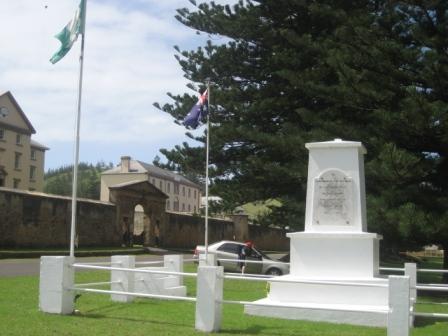
The Memorial is situated opposite All Saints Church, on the South-Eastern corner of the intersection where Country Road becomes Quality Row at Kingston.  This was the site of the First & Second Settlements, on the southern side of the island and is loacted at 29o 03’ 20.84” S, 167o 57’ 25.46” E.  The Memorial was erected using locally sourced blocks, rendered and painted white, at a cost of £145/18/3 ($A291.83) and was unveiled on Anzac Day, 1929. It is surrounded by a white post and twin rail fence and has a flagstaff at each corner. The Australian flag flies at the North East and the Norfolk Island flag at the North West corner. The remaining staffs are used as required. The Memorial’s North face lists 77 names of those who served in WWI on the upper section and ten names of those who died on Active Service during WWII (9) and Korea (1) .

203_sml


The Eastern face inscription reads:

TO

COMMEMORATE THE SERVICES

OF THE INHABITANTS OF THIS ISLAND

WHO FOUGHT IN

THE GREAT WAR

1914 – 1919

 207_sml 

The WWI Memorial’s names include at least two females, Sarah Nobbs and Evelyn (Eva) Nobbs RRC, [Staff Nurse AANS]. The Cross of Sacrifice appears next to 13 names.

The Norfolk Island RSL Sub-Branch Memorial Club WWI nominal roll lists 81 names, which represents about half of the eligible male population on the island at that time. The 81/77 discrepancy remains unresolved.*

Of the 30 surnames listed on the Memorial, eight (Adams, Buffett, Christian, Evans, McCoy, Nobbs, Quintal and Young) are directly descended from the Pitcairn Islanders (HMS Bounty mutineers and their Tahitian wives) who arrived on Norfolk on board the Morayshire on 8 June 1856. From those eight families, there were seven enlistments from the Adams family; five from Buffett; five from Christian; seven from Evans; one McCoy; six from Nobbs (including two females); 14 Quintals and one Young. Of the other surnames listed there are, no doubt, several who can claim similar descendancy through marriage.

204_sml

The National Archives of Australia holds records for no less than 47 who served with the AIF, and on enlistment gave their place of birth as Norfolk Island. These records include two enlistments whose names do not appear on the Memorial (George Evans Hill [20th Bn AIF] who may be ‘George Evans’ and Austin Thomas Quintal [1st Pnr Bn AIF] who may be either ‘A. Quintal’ or known by another name). The remainder may have served with the NZEF or other forces. [The NZ National Archives are not yet digitised and weren’t investigated for this post.] A list of the inscribed names may be viewed by clicking here.  

Norfolk’s highest ranking soldier from WWI was Major James B Metcalfe DSO, MC & MID [MD, 10th FAMB] Died of Wounds at 20th Casualty Clearing Station (CCS) on 25/4/1918. Major Metcalfe practised Medicine in Wellington, NSW, at the time of enlistment and is also included on the Wellington (NSW) Honour Roll. Other Commissions held by Islanders were three captains, including Major Metcalfe’s brother, Captain Francis B Metcalfe [MD, AAMC], who died after amputation of a leg in England on 18/10/1916, and two Lieutenants. Captain Metcalfe was employed at the Children’s Hospital, Brisbane before enlistment at Enoggera, QLD. Other decorated men were Lt JS Robinson MC, Sgt Harry Anderson DCM & clasp (bar), L/Cpl Byron Quintal DCM [53rd Bn AIF] and Pte Arthur B. Menges DCM.**

“Norfolk Island had a remarkable statistical participation rate per head of population for major world war conflicts unsurpassed certainly in Australasia and perhaps the world. Despite difficulty with transportation to & from Norfolk Island and Australasia, nine men departed for the Boer War, 81 of a possible 160 men joined the Australian and New Zealand military for WWI, 280 of a possible 365 men plus eight women joined the Australian and New Zealand military for WWII, and continued participation with Korea, Malaya, Vietnam, Gulf, Kuwait, Somalia, Afghanistan, East Timor, and other United Nations peace keeping forces. The Norfolk Island population dealt with the resulting casualties of war, the prisoners of war, the missing in war, the injuries from war, and some adjustment disorders. Norfolk Island detached military personnel were well decorated and the Norfolk Island Infantry Detachment assigned to protecting its shores were mentioned and recognised for appropriate military service.” *

The Islanders who remained on the island during WWI, had to deal with severe climatic conditions – some of the worst recorded. “On the day WWI was declared, Norfolk recorded its lowest minimum temperature of 4.5oC. Moreover, unprecedented drought conditions, existing over a wide region of the Pacific, compounded the difficulties. Being an island, Norfolk was naturally susceptible to the vagaries of the weather. When a severe drought struck the island, as in 1914, crops failed and this was to be the pattern in subsequent years.”**

*Norfolk Island RSL Sub Branch – looking after the community! ISLANDERS GO TO WAR: Author unknown.

** Norfolk Island and its Third Settlement – Raymond Nobbs (Library of Australian History, Sydney, 2006)

*****

Thanks Russell.
If you know of an Anzac War Memorial you would like to see featured in Memorial Way contact Chris at projectfffaif@yahoo.com.au

*****

The Families and Friends of the First AIF thanks the Australian, UK and French governments for affording Australian and British soldiers – presently buried in mass graves at Pheasant Wood – dignified individual reburials in a new CWGC cemetery at Fromelles, and applauds Minister Snowdon and his British counterpart, Parliamentary Under-Secretary of State for Defence and Minister for Veterans, Kevan Jones MP, for their joint decision to DNA test the remains at exhumation and use every reasonable method to attempt identification of each soldier.

Posted in Members First AIF, Memorial Way, Memorials | Comments Off on *Memorial Way No.11

*Archive Books on CD

A SALE WORTH LOOKING AT!

Archive CD Books Australia offers the unique opportunity to own your own copy of  ‘hard-to-get’ books covering a large range of topics. They produce a range of World War 1 publications on CD.

Until the 15 June they are offering 50% off the price of Australian and New Zealand products. This sale provides a great opportunity to add to your World War 1 Australian Library collection at very reasonable prices. It is worth checking out Archive CD Books Website and the special offers.

 One of the books available on this special offer is All-Australia Memorial (Victorian Edition).

The All Australia Memorial_title page_sml

The All- Australia Memorial  (Victorian Edition) gives an historical outline of the Great War from an Australian perspective, ‘plus an extensive reference section and hundreds of soldier biographies. All complemented by thousands of photos’.  Available on CD for only $29.75

All Australia Memorial_sample page_sml

One of the many other books on offer as a special June sale price is Aussie: The Australian Soldier’s Magazine.

AU0016-2

‘Aussie was a popular Australian soldiers magazine during and after World War 1. The magazine had its origins in 1914 under a different name and was transformed into ‘Aussie’ in 1918. This compilation covers monthly issues from No 1 in January 1918 to No. 13 in April 1919. The magazine was created for the soldiers and was largely written by the soldiers. Its object was to be “bright, cheerful and interesting, to reflect that happy spirit and good humour so strongly evident throughout the Aussie Army”. Each issue consists of approximately 16 pages. And includes many humorous and personal stories, poems, songs, tips and sketches which reflect the life of ‘the Australian soldier’ in a unique and fascinating way.’ Available at the special CD price of $14.75.

Aussie Mag_title page_sml

Other titles include:
Australia’s Fighting Sons of the Empire (New South Wales & Queensland)

Uncensored Dardanelles

Queenslanders Who Fought in The Great War

Bank of New South Wales Roll of Honour

Anzac Memorial

Tasmania’s War Record 1914-1919

Book of Remembrance of the University of Sydney in the Great War 1914-1918

Click here to visit Archive CD Books Australia and check out the offers.

*****

The Families and Friends of the First AIF thanks the Australian, UK and French governments for affording Australian and British soldiers – presently buried in mass graves at Pheasant Wood – dignified individual reburials in a new CWGC cemetery at Fromelles, and applauds Minister Snowdon and his British counterpart, Parliamentary Under-Secretary of State for Defence and Minister for Veterans, Kevan Jones MP, for their joint decision to DNA test the remains at exhumation and use every reasonable method to attempt identification of each soldier.

Posted in Books, Tips | Comments Off on *Archive Books on CD

Dubbo Meeting

The second regional meeting for 2009 of the FFFAIF was held at Dubbo RSL on Sunday 24 May. There were over 50 attendees for a very successful and informative meeting.

P1010945-sml

Photo: FFFAIF members enjoy lunch at the Dubbo RSL’s bistro. [Chris Munro]

Four speakers addressed the meeting:
Bob Newton spoke on Chasing the memory of a fighting family, which followed his initial search for information on the role of the Railway Ordnance Division in which his grandfather served.  This led to investigating the contribution of his grandmother’s family where four of the sons served with tragic loss of lives during and shortly after the war.  

P1010951_sml

Photo: FFFAIF President Russell Curley presents Bob Newton with a Certificate of Appreciation. [Chris Munro]

Mary Newton spoke about her quest to unravel the secret behind three photos from World War 1 kept by her father.

P1010956_sml

Photo: FFFAIF President Russell Curley and speaker Mary Newton. [Chris Munro]

Andrew Dunkley, local ABC Regional Program Manager and radio breakfast announcer, shared his experiences in investigating his grandfather’s service in the Great War which has led to him writing a book based on his grandfather’s war experiences.  

P1010950

Photo: FFFAIF President Russell Curley and Andrew Dunkley. [Chris Munro]

Graeme Hosken provided an interesting insight into what the Aussies got up to after the Armistice with a slide presentation entitled The Australian ‘invasion’ of Belgium 1918-19.

Andrew Dunkley has recorded some details of the FFFAIF Regional Meeting in his web log (blog) for 25/05/09, which can be read by clicking here.  

The next meeting of the FFFAIF will be the John Laffin Memorial Lecture (JLML) to be held on Sunday 12 July at Ashfield RSL Club in Sydney.  Record this in your diary and look for the NEWS ITEM in the next few weeks for more details.

*****

The Families and Friends of the First AIF thanks the Australian, UK and French governments for affording Australian and British soldiers – presently buried in mass graves at Pheasant Wood – dignified individual reburials in a new CWGC cemetery at Fromelles, and applauds Minister Snowdon and his British counterpart, Parliamentary Under-Secretary of State for Defence and Minister for Veterans, Kevan Jones MP, for their joint decision to DNA test the remains at exhumation and use every reasonable method to attempt identification of each soldier.

Posted in Events, Regional Meetings | Comments Off on Dubbo Meeting

Fromelles Cemetery

Work commenced on Monday 18 May preparing the site for the new Commonwealth War Graves Cemetery at Fromelles.

26 05 2009 Pheasant Wood 004_sml

Photo: Work has commenced on new cemetery site. [Carole Laignel]

26 05 2009 Pheasant Wood 007_sml

Photo: Cemetery site after a day & night of rain. [Carole Laignel]

The cemetery is located on Rue de la Basse Ville (50o36’28.66”N, 2o51’03.71”E) and will be known as the Fromelles Pheasant Wood Cemetery.

Fromelles_-_Airial_Shots30.1_sml

Photo: Aerial photo of new cemetery site [CWGC]

The design of the cemetery resembles other World War 1 Cemeteries constructed throughout the Western Front.

site_plan_overhead_final_sml

Photo: Computer generated image of site. [CWGC]

The site will be levelled before the foundations and stabilising piles can be installed on the site.

Upon completion the cemetery will have as its focal point a Cross of Sacrifice as shown in the computer generated graphic.

 *****

The Commonwealth War Graves Commission has provided the following update on work completed so far at the Pheasant Wood archaeological site to exhume the bodies of the soldiers whose final resting place is being prepared.

Thursday 21st May:
Oxford Archaeology have excavated graves 1 and 2 with earthmoving equipment to a level above where remains are expected to be found.

Excavation has now continued by hand using small tool techniques to the level of the remains.

A small quantity of bones which had previously been revealed in last years trial dig have been x-rayed and are further being processed prior to the removal of the full skeletons.

Preparatory work has commenced on the sampling techniques and methodologies which will be used on the remains prior to DNA viability testing.

*****

The Families and Friends of the First AIF thanks the Australian, UK and French governments for affording Australian and British soldiers – presently buried in mass graves at Pheasant Wood – dignified individual reburials in a new CWGC cemetery at Fromelles, and applauds Minister Snowdon and his British counterpart, Parliamentary Under-Secretary of State for Defence and Minister for Veterans, Kevan Jones MP, for their joint decision to DNA test the remains at exhumation and use every reasonable method to attempt identification of each soldier.

Posted in Top Posts | Comments Off on Fromelles Cemetery

ANZAC DAY, U.K. 2009

Continuing our coverage of ANZAC Day commemorations overseas, FFFAIF Secretary, Chris Munro reports on Anzac Day commemorations in UK.

P1010079_sml

Photo: Cross of Sacrifice Church of St John the Evangelist Sutton Veny. [Chris Munro]

25 April is commemorated in the UK as Gallipoli Day and increasingly there are also Anzac Day commemorations.

A Dawn Service was held at 5a.m at the Australian and New Zealand War Memorials at Hyde Park Corner in London with an Anzac Day service at midday at Westminster Abbey. These were in addition to the Gallipoli Service in St Paul’s Cathedral and at the Cenotaph. Other services were held at Arbroath, Brokenhurst, Cannock Chase, Edinburgh, Harefield, Leighterton, Northampton, Oxford and Peterborough.

On the Salisbury Plain, where many training camps were established, the Anzac spirit was commemorated with school and public services.

P1010089_sml

Photo: Sutton Veny school children in churchyard. [Chris Munro]

At Sutton Veny, in the Wyley Valley (GPS 51°10’29.70″N,  2° 8’26.70″W) where FFFAIF member Nicky Barnard lives and works at the village school, the children participated in an uplifting service on Friday 24 April to honour especially those soldiers buried in the churchyard at St John the Evangelist Church adjacent to the school.

Prior to this year’s service the Anzac Room at Sutton Veny School was officially opened by Col Michael Hickey of the Gallipoli Association.

P1010099_sml

Photo: Sutton Veny School’s ANZAC Room. [Chris Munro]

Attending the church service were Major Marcus Beckett and RSM Paul Dunbavin of the Australian Army representing The Australian High Commission. During the service, the children recited poetry, sang songs and told stories of Anzacs and of remembrance. 

P1010097_sml

Photo: RSM Paul Dunbavin and Sutton Veny students Darcie and Larnie Gask, who hail from Adelaide. [Chris Munro]

The children then moved into the churchyard to place a posy of flowers that they had made on the graves of a World War I soldier whose final resting place is the Salisbury Plain. There are 143 Australians from the Great War buried at Sutton Veny and 639 on the Salisbury Plain.

P1010074_sml

Photo: Inside St John’s Church, Sutton Veny. [Chris Munro]

A more formal Anzac Day Service of Remembrance took place at St John the Evangelist Church on Sunday 26 April. With more than 100 attendees, FFFAIF Secretary, Chris Munro participated in the wreath laying following the service.  Wreaths were also laid by Major Christopher Waterhouse of New Zealand, Mrs Sara Jones CBE, Member of the Commonwealth War Graves Commission, Col. Peter Singh representing the Australian High Commission for the second consecutive year, Sir Christopher Benson, Deputy Chair of the British Australia Society and a representative of the British Legion. Nicky Barnard carried the Australian Standard again this year. 

P1010142_sml

Photo: (l to r) Mr J. Winther (Church warden), Chris Munro (FFFAIF Secretary), Major Christopher Waterhouse (N.Z.), Col. Peter Singh Australian High Commission, Mrs H. Jones (CWGC), Sir Christopher Benson (British-Australia Assoc.), British Legion representative. [Chris Munro}

A Dawn Service is held at Codford St Mary’s (GPS 51° 9’25.40″N, 2° 2’17.54″W) at 6:30a.m. on Anzac Day in commemoration of the sacrifice of the original Anzacs.  About 50 people attended the Dawn Service followed by a Gunfire breakfast (where rum is added to the tea or coffee) and Anzac biscuits at the Codford Village Hall. There are 31Australian and 66 New Zealand soldiers buried at Codford.

2007_452191 Codford War Graves med_sml

Photo: Codford Cemetery in Wyley Valley. [Chris Munro]


The Warminster Journal that circulates in the Warminster and Westbury region covered these commemorations in its 1st May edition with one and a half pages devoted to the Sutton Veny services (Children Honour Anzacs and Village Remembers Anzacs) and the Codford service (Anzac Day in Codford).

FFFAIF member, Chris Munro, also participated in Anzac commemorations which took place in a small village 20 km west of Salisbury at St Edith’s Baverstock (GPS 51° 5’0.69″N,  1°57’38.88″W), (near Dinton). The local villagers filled the church to commemorate Anzac Day with special emphasis on the 29 Australians buried in the churchyard.  This year’s service was the fourth Anzac service held at St Edith’s.  The service was led by Alan Jeans, the Archdeacon of Sarum and was attended by descendants of two of the soldiers: Private Albertson (Linda O’Donnell) and CQMS Alan Andrews (Chris Munro).  Wreaths were laid by the descendants, the Australian Defence Forces for the Australian High Commission, Nicky Barnard representing FFFAIF and the British Legion. 

P1010104_sml

Photo: Australian High Commission representative, Chris Munro (FFFAIF) and  Alan Jeans, the Archdeacon of Sarum at St Edith’s Baverstock [Chris Munro]

P1010119_sml

Photo: Grave of Private George Albertson [Chris Munro] 

P1010116_sml

Photo; Grave CQMS Alan Andrews [Chris Munro] 

Once again local school children were involved in the commemoration.  They visited the churchyard which is about 3 km from the school at Dinton to learn about the soldiers and why they came all the way from Australia and how they came to be buried in the churchyard in the UK.  They placed an Australian flag on each grave in preparation for the evening Anzac service.  In the nearby village of Dinton, the New Zealand flag was flown at half-mast until midday and then raised for the remainder of the day. 

P1010067_sml

Photo: Senior class Dinton Village School [Chris Munro]

Over the over four years in which the Anzac Day service has been held at St Edith Baverstock, descendants of four Australian soldiers have made contact with FFFAIF Secretary, Chris Munro, who has compiled profiles of the 29 Australian soldiers buried at Baverstock, along with the 28 buried at nearby Compton Chamberlayne (GPS 51° 3’56.70″N, 1°57’36.52″W).  Any descendants who want a copy of their soldier’s profile or may be able to provide additional information may contact Chris at projectfffaif@yahoo.com.au.

P1010146_sml

*****

The Families and Friends of the First AIF thanks the Australian, UK and French governments for affording Australian and British soldiers – presently buried in mass graves at Pheasant Wood – dignified individual reburials in a new CWGC cemetery at Fromelles, and applauds Minister Snowdon and his British counterpart, Parliamentary Under-Secretary of State for Defence and Minister for Veterans, Kevan Jones MP, for their joint decision to DNA test the remains at exhumation and use every reasonable method to attempt identification of each soldier.

Posted in ANZAC Day | Comments Off on ANZAC DAY, U.K. 2009

*Memorial Way No. 10: Dubbo

Dubbo War Memorial, NSW.

The City of Dubbo is located in western NSW (32o14’46.70”S, 145o36’15.16”E ) and is the location of the FFFAIF’s second Regional Meeting for 2009. The population of Dubbo is nearing 40,000 people with a regional population in excess of 120,000 people.

065_sml

Photo: Dubbo War Memorial [Graeme Hosken]

A crowd of nearly 4,000 people gathered for the unveiling of the Dubbo War Memorial in Victoria Park on 25 April 1925. The memorial was unveiled by Brigadier General James Heane, DSO, CMG, CB who was educated at Dubbo Superior School and served as the Area Officer for Militia Training prior to the Great War.

B-G James Heane_sml

Photo: Brigadier General James Heane [AWM Collection]

The War Memorial was designed by Sydney architects H.Crone and R.W. Hinton and features three bronze panels by leading sculptor Raynor Hoff. These panels were the only commission that Hoff undertook for a town committee. No names are listed on the memorial.

067_sml

071_sml

069_sml

Photo: Bronze panels by Sculptor Raynor Hoff. [Graeme Hosken]

The National Archives of Australia project Mapping Our Anzacs  shows that 2055 men enlisted at Dubbo for service in the Great War.  

Patriotic parade_sml

Photo: Patriotic Parade 1916 – Dubbo. [State Library NSW]

In 1995 a stone obelisk was built to display the names of those who made the supreme sacrifice in both World Wars.

073_sml

The names of 105 soldiers from the Great War appear on the obelisk. One of the names appearing on the honour roll is SILLAR R.A. Captain Roy Allen Sillar was a doctor who enlisted with the Australian Army Medical Corps (AAMC) who died as the result of an accident, while based on the Salisbury Plain, on 30 June 1918.

Sillar's grave_sml

Photo: Grave of Captain Roy Sillar. [Chris Munro]

Captain Roy Sillar is buried at Compton Chamberlayne (via Dinton), Wiltshire, England (51° 3’56.70″N, 1°57’36.52″W). To read Captain Sillar’s story click here.

The Memorial Drive linking the two memorials is dedicated to the memory of those men and women who lost their lives in the defence of their country in 1914 -1918 and 1939 – 1945.

064_sml

Photo: Memorial Gates [Graeme Hosken]

 FFFAIF will be holding its second regional meeting for the year in Dubbo. For details on the meeting click here.

*****

The Families and Friends of the First AIF thanks the Australian, UK and French governments for affording Australian and British soldiers – presently buried in mass graves at Pheasant Wood – dignified individual reburials in a new CWGC cemetery at Fromelles, and applauds Minister Snowdon and his British counterpart, Parliamentary Under-Secretary of State for Defence and Minister for Veterans, Kevan Jones MP, for their joint decision to DNA test the remains at exhumation and use every reasonable method to attempt identification of each soldier.

Posted in Members First AIF, Memorial Way, Memorials | Comments Off on *Memorial Way No. 10: Dubbo

*Fromelles action

The commencement of the process of exhumation of the soldiers buried at Pheasant Wood, Fromelles, in northern France was marked by a special service on 4 May 2009. (To read more on the commencement ceremony click here.)

18 05 2009 Pheasant Wood 010_croppedPhoto: Pheasant Wood archaeological site 18 May 2009. [Carole Laignel]

Since then there have been new structures erected within the Pheasant Wood site.

18 05 2009 Pheasant Wood 014_STITCH_sml

Large canopies have been erected over two areas on the site indicating that Oxford Archaeology has commenced work on the site.

18 05 2009 Pheasant Wood 016_sml

These photos have been provided by Carole Laignel, Secretary of The Association Fromelles-Weppes-Terre de Memoire 14-18 (F.W.T.M. 14-18 ) – The Fromelles Museum.

*****

The Families and Friends of the First AIF thanks the Australian, UK and French governments for affording Australian and British soldiers – presently buried in mass graves at Pheasant Wood – dignified individual reburials in a new CWGC cemetery at Fromelles, and applauds Minister Snowdon and his British counterpart, Parliamentary Under-Secretary of State for Defence and Minister for Veterans, Kevan Jones MP, for their joint decision to DNA test the remains at exhumation and use every reasonable method to attempt identification of each soldier.

Posted in Top Posts | Comments Off on *Fromelles action