Connecting Spirit CD

FFFAIF member and leader of the ‘Connecting Spirits’ Group – a joint project involving students from Birdwood High and Meningie Area Schools, South Australia – Julie Reece extends an invitation to:

 THE LAUNCH
  THE ‘CONNECTING SPIRITS’ CD
ORIGINAL SONGS WRITTEN AND PERFORMED
BY FLO BOURKE AND RITA LINDSAY

connecting-spirit-cd-poster_sml

*Wednesday April 22nd 7.00 p.m.

*Irish Club in Carrington Street, Adelaide

*Complimentary drinks and nibbles on arrival followed by the launch

*Complimentary copy of the book ‘Connecting Spirits 2006’ to all who attend the launch

*Cost $20 per person

You are invited to the launch of the ‘Connecting Spirits’ CD of original songs written and performed by Flo Bourke and Rita Lindsay. Both Flo and Rita were members of the 2006 Connecting Spirits Commemorative trip to the WW1 battlefields, a joint project involving students from Birdwood High and Meningie Area Schools. In 2008 a second ‘Connecting Spirits’ tour took place and over the two projects 150 soldiers have been individually researched and commemorated at the cemeteries and memorials in Europe. (See our website for accounts of the soldiers’ stories and our two trips thus far: www.connectingspirits.com.au)

While on tour in 2006 both Flo and Rita were inspired by the stories of these men and the sacrifices they and their families made in wartime and expressed their feelings and personal responses to the story of the Great War, through music. The CD produced has a range of songs that deal with the tragedy and horror of the war and how it has impacted on the men of 1914 -18 and the generations that followed. The lack of recognition given to indigenous soldiers is a powerful thread through the music of Rita Lindsay and she brings to the WW1 story a very special voice on this little known aspect of our wartime past. While on tour in 2008, Flo as one of the Youth Leaders performed her songs at the original locations she was inspired by in 2006. The footage of Flo singing at Talbot House in Poperinge on the WW1 piano the men used in that period will be featured at the launch as part of the media presentation.

 A booklet outlining the historical and personal context of each of the songs on the CD as well as the inclusion of relevant website addresses, will accompany each CD. It is intended that teachers across primary, middle and senior years of schooling can then incorporate the CD into their curriculum and be a powerful and emotive resource for special events and assemblies in the lead up to ANZAC Day and Remembrance Day. It will also provide a role model to other young people about the importance of learning about our wartime past and the need to acknowledge all Australians in the past and present who have made the ultimate sacrifice for our country.

We look forward to sharing our special night with you in the lead up to ANZAC Day. Could you please RSVP to Julie Reece at reecy@chariot.net.au. Tickets will either be posted or set aside for you on arrival at the launch. There is a limit on the number of tickets for sale so get in early. 

*****

If you are interested in ordering a copy of the CD please contact Julie Reece at reecy@chariot.net.au

*****

The Families and Friends of the First AIF thanks the Australian, UK and French governments for affording Australian and British soldiers – presently buried in mass graves at Pheasant Wood – dignified individual reburials in a new CWGC cemetery at Fromelles, and applauds Minister Snowdon and his British counterpart, Parliamentary Under-Secretary of State for Defence and Minister for Veterans, Kevan Jones MP, for their joint decision to DNA test the remains at exhumation and use every reasonable method to attempt identification of each soldier.

Posted in Uncategorized | Comments Off on Connecting Spirit CD

Briefing Room No. 8

In Briefing Room No. 8, we again join Stuart Curry as he travels through the Messines Ridge area, south of the Ypres salient.

stuart-menin-gate_cropped

Previously Briefing Room No. 3 focussed on the Battle of Menin Road on 20-21 September 1917, Briefing Room No. 4 focussed on the Battle of Polygon Wood, 26-28 September and Briefing Room No. 5 focussed on the Battle of Broodseinde Ridge, 4-5 October, 1917 and the Battle of Passchendaele, 9-12 October, 1917  as part of the battles that Australians were involved in to drive the Germans off the Passchendaele – Messines Ridge. 

The Official History of Australia in the War of 1914-1918, Volume 5: THE A.I.F. IN FRANCE 1917, Chapter 14 THE FLANDERS PLAN and Australians at War: Western Front 1916-1917: the Price of Honour provides the context for the Battle of Messines.

The Battle of Arras commenced on 9 April 1917 intended to draw German troops from the Aisne sector in advance of a major French offensive.  This includes the British First Army under General Horne with the Canadian Corps at Vimy, the Third Army under General Allenby around Arras and to the south the Fifth Army under General Gough with the Australian 4th Division at Bullecourt. 

The French offensive commenced 16 April with four armies but achieved little ground with severe casualties (108,000) and over the following days French troops in 68 of the French Army’s 112 divisions mutinied. Field Marshal Haig extended the Battle of Arras into mid-May with a second offensive along the front from Vimy to Bullecourt, partly to take the German focus from the French held sectors. 

On 3 May, the great attack of which ”Second Bullecourt”  formed part commenced (3-17 May involving the Australian 2nd Division), while the British Prime Minister and senior Government representatives crossed to France for a conference with French counterparts in Paris.  All were agreed that “breaking through the enemy’s front and . . . at distant objectives” were out of the question as these approaches had proved too costly. The only successes presently attainable seemed to be those secured by minutely-prepared offensives with limited objectives. With the artillery now available to the Allies, at nearly any point where guns could be massed, the Germans could be thrust back for a mile or so and the position consolidated. Serious trouble seemed only to begin when the attacking infantry attempted to pass beyond the protection of their guns and then incurred heavy losses out of proportion to the value of the gains. Accordingly, future advances were to be limited to the ground that could be enclosed within an overwhelming artillery-barrage. 

The conference also agreed that the time and place of the various attacks” were to be left for decision by the military commanders, but it was understood that the British would deliver the main stroke, a long-planned blow in Flanders.

The commander of the British 2nd Army, General Sir Herbert Plumer, had been organising a major offensive in the Ypres salient of Flanders since 1915. General Plumer ordered the laying of 21 large explosive mines under and beyond the German lines.  British, Canadian and Australian tunnellers (including the 1st Australian Tunnelling Company) commenced constructed tunnels in early 1916 and installed and maintained the mines until the battle date was set. This was a difficult role, made more hazardous by the counter-mining operations by the Germans, particularly around Hill 60 (a 60 foot high hill of railway spoil).

As a preliminary to the main “push” to drive the Germans off the Passchendaele – Messines Ridge, the 2nd Army was to capture a 5 mile (8km) arc of the Messines ridge. The 2nd Army consisted of 3 army corps, the southern most being II ANZAC under General Godley and comprised of the Australian 3rd Division under Major-General John Monash, the New Zealand Division under Major-General Sir Andrew Russell and the British 25th Division and in May the Australian 4th Division under Major-General Holmes was added. 

the-battle-of-messines_map_2_sml

Plumer was a painstakingly thorough planner as was Monash, and the preparations for the Battle of Messines involved Engineers building models of the battle terrain, with which officers and men familiarised themselves with landmarks and objectives.  It was the Australian 3rd Division’s first major engagement on the Western Front and it was planned with meticulous detail to counter the Division’s lack of experience.

jacka_-messine-plans

Photo:  Captain Jacka, VC, studying the contour map of Messines prior to the battle. [AWM E00631]

hill-63-2_sml

Photo: Messines Ridge

The British (including the 1st Australian Tunnelling Company) set off nineteen underground mines including Hill 60 and the Caterpillar causing panic among the German troops killing over 10,000 men and a further 7,000 men were taken prisoner on the first day. This allowed the allies to straighten the front line on the ridge so they could then proceed with the 3rd Battle of Ypres without being flanked by German Artillery who could have fired shells right in behind them. The ground conditions around Ypres had turned into a quagmire after a few months of fighting. The Australians suffered 38,000 casualties in eight weeks and this resulted in the sixth Division being disbanded.

Following the Battle of Passchendaele (9-12 October), Stuart’s family moved into different areas on the Messines ridge.

The Australian 5th Division where pulled out of Passchendaele on the 10th of November 1917 and swung around the back roads of Ypres and headed south to the Messines ridge area just when the winter was coming.

Stuart’s maternal grandfather Henry John Marchment and his brother Robert Westall Marchment, both from Wauchope, were ranked Drivers in the 14th Machine Gun Company of the 5th Division and had lost their youngest brother Stan Hastings Marchment at the Battle of Polygon Wood a few months earlier. They were sent to the village of Gappard located one mile east of the village of Messines. They arrived on the 12th of November 1917 and held the position.

From family documents Stuart has been able to fit together a ‘picture’ of the battlefield experiences of his relatives:
The Company fired 10,000-20,000 rounds from 16 guns on targets every day for two weeks and then went back to their base camps.
They were always training and keeping highly motivated when they returned from the front line with gun drills, packing and unpacking limbers, cleaning guns, bomb throwing, anti aircraft techniques, pistol targeting, barrage work and numerous games of football and physical training. They formed their own canteen and had Church and Bath parades on certain days and sometimes were presented with medals from their generals or superior officers.

gappard

Photo: The road to Gappard, April 2008.

The Australian 14th Machine Gun Company returned to Messines ridge on the 1st of February 1918. This time the two Marchment brothers were at the northern end of the ridge very close to The Bluff / Hill 60 at a location near the White Chateau known as Ravine Wood. Initially it was pretty quiet but on 21 March 1918, the German Offensive (Operation Michael) commenced and the 14th Machine Gun Company fired over 25,000 rounds that day. They were relieved by the 2nd Machine Gun Company on the 24th of March 1918 and sent to Kemmel to regroup in readiness to head south to the Somme to help counter the German advance.

img_1189_sml

 Photo: Ravine Wood

Stuart’s paternal grandfather, Gunner Albert Alfred Curry and his elder brother Gunner Henry Ernest Curry, No 3067 were both from Granville in Sydney and in the 51st Battery of the 13th Field Artillery Brigade. 

Stuart’s grandfather Albert Alfred Curry suffered double pneumonia caused from the Somme winter of 1916. He survived the 3rd Battle of Ypres and was involved in the battles of Broodseinde Ridge and Passchendaele. After the 3rd Battle of Ypres campaign had finished the 13th Field Artillery Brigade had to ride their gun carriages teams down to Hill 63 located south of the Messines Ridge at least ten miles away. With the cold conditions riding up high on the horses in the open air, Albert’s pneumonia came back and on the 19 of November 1917 he also was sent back to England to recover from his pneumonia for a second time.  His brother Henry Ernest Curry was still in England recovering from gunshot wounds to the head and shoulder that he received at the battery location on the 7 November 1917 at J.8.c.75.93 at Nonne Bosschen. Thus, the Curry brother both spent Christmas 1917 recuperating in England.

Meanwhile, the Battery did not fire a shot while at Hill 63 and retired well inland to the village of Montcavel to rest over the Christmas break for two months and close down for the winter.

 By 14 March 1918 the Curry brothers had recovered from their previous illnesses and returned to their battery location at U.13.a.80.80. on Hill 63 near the Messines Ridge. They where transferred from the 51st battery to a new battery, the 50th, but still part of the 13th Field Artillery Brigade. On 21 of March 1918, very hostile shelling hit the whole area with Gas Shells when the German Offensive (Operation Michael) commenced. It was at this location on the following day when Albert was involved in a major “gun incident”. He was hit in the face from the recoil of an eighteen-pounder field gun.

The unit war diaries states: “Whilst engaged in digging in trench at O.P during the night 22/23 1 O/R severely wounded, 2 O/R slightly wounded. Lieut. M.C. CLARK proceeded on leave.”

messines-medical_sml1

Photo: Shaded area showing Medical Arrangements of II ANZAC Corps

His brother Henry Ernest Curry was close to where the gun incident had happened. He went back to pickup a bit of Albert’s ear and then carried his brother for two days over a distance of four miles (six kilometres) by himself from Hill 63 to Trois Albres where the 2nd casualty clearing station was located on a railway line between Armeteries to St Ommer and saved his brothers life. Albert’s service record casualty form shows he was admitted to the 2nd Casualty Clearing Station on the 25th March 1918.

img_0712

Photo: CWGC Cemetery at Trois Albres

Albert’s youngest daughter Myrell Curry, now aged 80 and still living in the Blue Mountains, west of Sydney told Stuart .”There was a terrible battle and Albert had been hit by the gun in the face and stomach and was carried by his brother for two days.  When he finally arrived at the hospital he was in a very bad shape. He was tagged to be left alone and there were hundreds of wounded soldiers lying in their beds and in the isles at the hospital. Apparently a doctor was walking past, saw him move and stopped and started to attend to him. He began to recover and was sent by rail to another Hospital. His brother Henry Ernest Curry was able to join his artillery unit again as the gun carriage teams were heading down south from Hill 63 to Somme Area. He did not get court-martialled for leaving his post – maybe there was too much going on at the time”

img_0718_sml

 Photo: Railway at Trois Albres 

Posting prepared by FFFAIF members Stuart Curry and Jim Munro.

 *****

The Families and Friends of the First AIF thanks the Australian, UK and French governments for affording Australian and British soldiers – presently buried in mass graves at Pheasant Wood – dignified individual reburials in a new CWGC cemetery at Fromelles, and applauds Minister Snowdon and his British counterpart, Parliamentary UnderSecretary of State for Defence and Minister for Veterans, Kevan Jones MP, for their joint decision to DNA test the remains at exhumation and use every reasonable method to attempt identification of each soldier.
Posted in Briefing Room | Comments Off on Briefing Room No. 8

Dinner with Pompey

 An invitation to

pompey-elliot

 Pompey Elliott Tribute Dinner

at

Ballarat College

1425 Sturt Street Ballarat

on

 Saturday 18 April 2009

Tickets: $75,

available from the school
 or
Phone: 03 5330 8211.

  Speakers for the evening include Tony Charlton; John Brit – former VFL star; and FFFAIF member and historian Ross McMullin. Ross will talk about Ballarat College’s most distinguished student: Pompey Elliott.

 *****

The Families and Friends of the First AIF thanks the Australian, UK and French governments for affording Australian and British soldiers – presently buried in mass graves at Pheasant Wood – dignified individual reburials in a new CWGC cemetery at Fromelles, and applauds Minister Snowdon and his British counterpart, Parliamentary Under-Secretary of State for Defence and Minister for Veterans, Kevan Jones MP, for their joint decision to DNA test the remains at exhumation and use every reasonable method to attempt identification of each soldier.

Posted in Uncategorized | Comments Off on Dinner with Pompey

*Fromelles Missing List

LIST OF FIRST AUSTRALIAN IMPERIAL FORCE SOLDIERS BELIEVED BURIED AT FROMELLES

The President of the Families and Friends of the First AIF, a group dedicated to keeping the memory alive of the Diggers who served in the First Australian Imperial Force, Mr Russell Curley, welcomed the release by The Hon. Warren Snowdon, MP, Minister for Defence Science and Personnel of the list of the soldiers thought to be buried in pits at Pheasant Wood, near Fromelles in French Flanders. 

minister-snowdon-laying-wreath_sml

  Photo: Minister Snowdon  laying a wreath at Pheasant Wood Memorial, October 2008.

Mr Curley said he hoped that relatives for all of the 191 soldiers on the list can be identified and would offer to participate in DNA matching to assist in identification of the soldiers’ remains. 

Mr Curley paid tribute to members of the Families and Friends of the First AIF who had invested much of their personal time in the development of the list:
o Lambis Englezos, who was assisted by John Fielding and Ward Selby of The Friends of the 15th Brigade, in developing the initial list;
o Tim Whitford, whose uncle Harry Willis is on the list, for his assistance in further research on the list;
o Professor Bruce Scates, of Monash University, who had highlighted the importance of the Red Cross Wounded and Missing Enquiry Bureau Files as a source of detailed information on missing soldiers; and
o Tim Lycett and Sandra Playle for the development of the Fromelles Descendants Database and its photographic Gallery of the Missing of more than 70 of the soldiers and the researching of family histories that when combined with those who have contacted the Department of Defence mean that relatives have been identified for more than 60% of the soldiers on the list.

momplhait_alfred_victorpte_sml

Photo: Private Arthur Momplhait, whose name appears on the working list. [AWM H06484]
This photo has been reproduced with the permission of the
Australian War Memorial

The soldiers thought to be buried at Pheasant Wood were most likely killed in or behind the German front line and were buried by the Germans after they returned to their original front line on 20 July 1916. The identity tags and personal effects of the soldiers were removed by the Germans and returned to the families in Australia through the International Red Cross and Australian Red Cross in March 1917. This is why the Australian soldiers thought to be buried in the pits at Pheasant Wood are known by name and DNA samples are being sought from relatives to match with the DNA profiles from the individual soldier’s remains and so return to the soldiers their identities.

 The Minister’s statement follows and the list of soldier names in alphabetical order is available on the Defence website at http://www.defence.gov.au/fromelles/buried.htm and additional details and photographs, where  available, are on the Fromelles Descendants Database at http://www.fromelles.net/.  Descendants and relatives of soldiers thought to be buried at Pheasant Wood are invited to make contact through either web-site and further photographs to add the the Gallery of the Missing and family history contributions should be sent to fromelles@gmail.com

*****

The Minister’s statement:

 The group burial at Pheasant Wood was confirmed during a limited excavation in May 2008. It is believed up to 400 Australian and British soldiers still lie at this site where they were buried by German forces following the Battle of Fromelles in July 1916.
“Following intensive research and consultation, we have identified a list of 191 Australian First World War soldiers who we believe may be among those buried at Fromelles,” Mr Snowdon said.
He cautioned that the list was not definitive and that research into the group burial at Fromelles would continue; both in Australia and abroad.
“Given the information available, it is impossible to be absolutely certain who is buried at Pheasant Wood.  However we, and many other historians and interest groups, believe this list provides a solid foundation for further investigation.
“Together with the British Government, we have contracted research at the Red Cross in Geneva and the German War Archives in Bavaria in the hope we may uncover more conclusive information regarding the burials at Fromelles.”

Members of the public are encouraged to check the published working list and contact Army to register their details if their relative’s name appears.
“We have already established contact with relatives of approximately 40 per cent of those who appear on the list, and we want to reach more,” Mr Snowdon said.
“It is my hope that we can lay many of these soldiers to rest under a named headstone so their kin may know their final resting place and have the opportunity to pay respects.”
The working list of names is a result of intensive research conducted by Professor Peter Dennis, an independent historian contracted by Army, and follows consultation with several well-recognised War historians late last year. Those involved in the research include individuals from Friends of the Fifteenth Brigade; Families and Friends the First AIF (Australian Imperial Force); Australian War Memorial; Army History Unit; Fromelles.net; Office of Australian War Graves, and; Monash University.   

For more information about the project, including the working list of names, or to register your details, go online at http://www.defence.gov.au/fromelles/ or call 1800 019 090. 

Background:
The Battle of Fromelles began 19 days after the opening of the Somme campaign, and was the first battle fought by Australians on the Western Front.  It is known as Australia’s bloodiest 24 hours with 5,533 Fifth Australian Division casualties including 1,917 killed.  

The group burial at Pheasant Wood was confirmed during a limited excavation in May 2008. It is believed up to 400 Australian and British soldiers still lie at this site where they were buried by German forces following the Battle of Fromelles in July 1916.

Planning is underway for a full archaeological excavation of the site and individual re?interment of remains in a new Commonwealth War Cemetery at Fromelles, to be known as the Fromelles (Pheasant Wood) Military Cemetery.  The archaeological excavation is scheduled to commence in May 2009 and the Commonwealth War Graves Commission is overseeing the work on behalf of both the Australian and British Governments.

new-site_sml

Photo: Site of the new CWGC Fromelles (Pheasant Wood) Military Cemetery

*****

News reports on the announcement include:

Nine News: Diggers buried at Fromelles named. Click here.

Nine News: Unknown diggers finding their names. Click here to view video

The Sydney Morning Herald: Defence releases the names of 191 Aussies dead at Fromelles. Click here.

ABC pm: List of lost World War 1 Diggers released. Click here to listen to the interview with Roger Lee, Head of The Army History Unit.

The Australian: DNA brings closure for Digger’s families. Click here.

Yahoo 7 News: Diggers buried at Fromelles named. Click here

The Bendigo Advertiser: Our fallen found at last. Click here.

The Illawarra Mercury: Soldier may be located at last. Click here.

*****

The Families and Friends of the First AIF thanks the Australian, UK and French governments for affording Australian and British soldiers – presently buried in mass graves at Pheasant Wood – dignified individual reburials in a new CWGC cemetery at Fromelles, and applauds Minister Snowdon and his British counterpart, Parliamentary Under-Secretary of State for Defence and Minister for Veterans, Kevan Jones MP, for their joint decision to DNA test the remains at exhumation and use every reasonable method to attempt identification of each soldier.


Posted in Uncategorized | Comments Off on *Fromelles Missing List

Memorial Way No.8

Allora, in country Queensland, 28km north of Warwick, (28o02’07.97S 151o58’49.49″) is the focus for this week’s Memorial Way.

There are two World War 1 Memorials in the town. Located in Memorial Park is the town’s Memorial which was unveiled by General Robertson  on 11 November 1921.

allora-ww1-memorial_4_matt-smith_sml

Photo: Allora World War 1 Memorial [Salute the Brave – A Pictorial Record of Queensland War Memorials]

The memorial was built by Warwick stone mason W P Prout. The sandstone monument on a stepped base is noted for the intricate carving of Australian Commonwealth Military Forces badge, two cannon, rifle, laurel wreaths and other symbolic designs.

allora-ww1-memorial_2_matt-smith_sml

Inscribed on the Honour Rolls of the Memorial are the names of those who served, including the 23 men who did not return.

masters-cpl-sidney-georgePhoto: Corporal Masters KIA 14 July 1918

See the slide show below for more photos of the memorial. The slideshow can be viewed full screen by clicking on the projector screen icon in the bottom right corner. To return to this story simply press the escape key.

[slideshare id=1226017&doc=allorawarmemorialv2-090331024155-phpapp02]

One of the names inscribed on the memorial is that of Ada Smith. Ada served as a nurse during the Great War and the Australian War Memorial Collection contains a series of photos depicting Sister Smith’s time with the Australian Medical Corps.

sister-ada-smith_8Photo: Sister Ada Priscilla Smith [Australian War memorial Collection]

The following slide show contains images of Sister Smith. The slideshow can be viewed full screen by clicking on the projector screen icon in the bottom right corner. To return to this story simply press the escape key.

[slideshare id=1216765&doc=sisteradasmith-090329075523-phpapp02]

The Allora World War 1 Shrine is located beside St Patrick’s School, Warwick Street, Allora. It is the only Shrine of this type known in Queensland.

allora-stpatricks-shrine1_matt-smith_smlPhoto: Allora’s World War 1 Shrine

Built of sandstone blocks with an iron roof, it features many plaques honouring individual soldiers. Angels stand “on guard” on each side of the peaked roof, which is topped by a Sacred Heart. A plaque reads: This Shrine was erected by the Friends of the Sacred Heart. To its Honour and Glory. Many of the original features of the shrine are missing and stained glass windows originally on either side of the front door, in the front door, and in side windows, have been removed and replaced by covers to keep out the weather.

The following slide show features details of the Allora World War 1 Shrine.

[slideshare id=1216421&doc=alloraww1shrine-090329051059-phpapp01]

*****

The Families and Friends of the First AIF thanks the Australian, UK and French governments for affording Australian and British soldiers – presently buried in mass graves at Pheasant Wood – dignified individual reburials in a new CWGC cemetery at Fromelles, and applauds Minister Snowdon and his British counterpart, Parliamentary UnderSecretary of State for Defence and Minister for Veterans, Kevan Jones MP, for their joint decision to DNA test the remains at exhumation and use every reasonable method to attempt identification of each soldier.
Posted in Uncategorized | Comments Off on Memorial Way No.8

Briefing Room No. 7

Zonnebeke Chateau

In Briefing Room No. 7, we re-join Stuart Curry as he travels through the Ypres salient. Previously Briefing Room No. 3 focussed on the Battle of Menin Road on 20-21 September 1917, Briefing Room No. 4 focussed on the Battle of Polygon Wood, 26-28 September and Briefing Room No. 5 focussed on the Battle of Broodseinde Ridge, 4-5 October, 1917 and the Battle of Passchendaele, 9-12 October, 1917 as part of the battles that Australians were involved in to drive the Germans off the Passchendaele – Messines Ridge. This week in Briefing Room Stuart tells of his extraordinary day at the Passchendaele Museum. 

img_0761-1_sml1

When I was at Bullecourt, I was told about a big day at Zonnebeke involving over one hundred re-enactment soldiers from around the world. I was not sure exactly where the event was, but as I was driving from Ypres to Zonnebeke early one morning I noticed a green sign post with Polygon Wood, 5th Divisional Memorial on it.  I drove to Polygon Wood, parked the car and as I walked up to the Butte I heard a bagpipe playing in the woods. I walked up to a man and asked if he knew anything about the reenactment day at Zonnebeke. He said, “yes, it is at the Passchendaele Museum right next to Zonnebeke Church you can’t miss it”. I thanked him and went on my way. 

img_0731_sml 

I found the Memorial Museum Passchendaele quite easily and as I was walking through the front gates of the former Zonnebeke Chateau, it was like going back in time. Reenactment soldiers from all around were dressed up in World War I uniforms for the annual Living History event. With all the props and equipment from Machine Guns, Rifles to the tents soldiers billeted in, it was a great experience to get the feeling of what it would have been like for the Australians to walk into this world conflict.

img_0736-1_sml

There were English, French, German, Russian, Belgium, American, Italian and Dutch soldiers just to name a few, and all of them talking different languages. I was the only Australian in uniform that day and felt very proud to be a part of it.

img_0729_sml

I could not recognize the uniform of the first soldiers I came upon. They had a barbwire fence set up behind them and a checkpoint gate to enter the grounds. I asked one of them what army they represented. He replied “we are Dutch”. I said I did not realize that the Dutch were in World War One. He said “yes we had to use electrical fences on our borders to stop the Belgium’s from escaping into our country, otherwise the Germans would have classed it as an act of war.

 img_0750_sml 

The soldier then showed me a device called a wooden window. It could be folded up and put into a pocket for concealment and when you came up to the electrical fence you can open it up place it carefully between the wires and pass through without being zapped. 

img_0737_sml

He also talked about a German Soldier being careless one day during the early part of the war. It is claimed that he lent over too far and the spike on his helmet (Pickelhaube) touched the electrical fence and killed him. It’s a good story, but if it actually happened, he would have to be one of the unluckiest soldiers during the war.

 img_0739-1_sml 

The Museum itself was very well presented with a range of military weapons, equipment and dioramas. There were videos showing real footage of the war and at the very bottom of the museum there were the dugouts. Walking through mine tunnels with timber beams supporting everything, you get a good idea of what the underground living conditions would have been like for soldiers. The only way you could survive these relentless artillery bombardments during the war was to live like a rat underground in these Dugouts. I didn’t realise there were thousands of them connected by subway tunnels which adds a third dimension to the war: the aerial war above, the ground-level war and the under-ground war.

Story and photographs by FFFAIF member Stuart Curry 

To take a closer look at the Memorial Museum Passchendaele, click here.

*****

The Families and Friends of the First AIF thanks the Australian, UK and French governments for affording Australian and British soldiers – presently buried in mass graves at Pheasant Wood – dignified individual reburials in a new CWGC cemetery at Fromelles, and applauds Minister Snowdon and his British counterpart, Parliamentary Under-Secretary of State for Defence and Minister for Veterans, Kevan Jones MP, for their joint decision to DNA test the remains at exhumation and use every reasonable method to attempt identification of each soldier.

Posted in Uncategorized | Comments Off on Briefing Room No. 7

2007 GUARD Report

fromelles_dig_5

Photo: Pheasant Wood Fromelles, April 2008 [Chris Munro]

The Department of Defence has posted the 2007 report from Glasgow University on the non invasive investigation at Pheasant Wood Fromelles.

guard-finds_07_sml

Photo: Figure 8 from GUARD Report – Metal Detector Finds.

The GUARD report can found on the Australian Government Department of Defence website. Click here to access the report.

The Department of Defence is scheduled to release on Thursday 2 April the list of names of those Australian Soldiers thought to be buried at Pheasant Wood. Look for the separate posting on 2 April.

*****

The Families and Friends of the First AIF thanks the Australian, UK and French governments for affording Australian and British soldiers – presently buried in mass graves at Pheasant Wood – dignified individual reburials in a new CWGC cemetery at Fromelles, and applauds Minister Snowdon and his British counterpart, Parliamentary UnderSecretary of State for Defence and Minister for Veterans, Kevan Jones MP, for their joint decision to DNA test the remains at exhumation and use every reasonable method to attempt identification of each soldier.
Posted in Uncategorized | Comments Off on 2007 GUARD Report

V-B never forgets

2007_454118-villers-bret-school-yard_sml

The following article appeared in The Melbourne Age newspaper on 31 March 2009:

Diggers remembered as French town gives back

Saying they will “never forget” the valour of Australian diggers, residents of the French town of Villers-Bretonneux have pledged funds to rebuild a bushfire-affected Victorian school.

At the end of World War I, Victorian school children donated money to rebuild the school at Villers-Bretonneux, after Australian soldiers recaptured the town from the Germans in bitter hand-to-hand combat on April 24, 1918.

When the town’s residents heard about the Victorian bushfires, the local French-Australian association started a campaign urging members and residents to donate money.

Villers-Bretonneux’s town mayor Patrick Simon and the local council have committed one euro per resident (€4135 or $A7984), and the town will choose an Australian school to rebuild.

“This way Australia will forever stay in the hearts of the people from Villers-Bretonneux,” French-Australian Association president Jean-Pierre Tranchard said.

Villers-Bretonneux was reduced to rubble during the fierce battle in World War I and more than 1200 Australian soldiers were killed.

2007_454117-villers-bret-school-sign_sml

*****

The Families and Friends of the First AIF thanks the Australian, UK and French governments for affording Australian and British soldiers – presently buried in mass graves at Pheasant Wood – dignified individual reburials in a new CWGC cemetery at Fromelles, and applauds Minister Snowdon and his British counterpart, Parliamentary Under-Secretary of State for Defence and Minister for Veterans, Kevan Jones MP, for their joint decision to DNA test the remains at exhumation and use every reasonable method to attempt identification of each soldier.

Posted in Uncategorized | Comments Off on V-B never forgets

*Memorial Way No.7

This weeks Memorial Way features the north coast city of Lismore, New South Wales. The National Archives of Australia (NAA) Mapping Our Anzacs  shows that 3,088 men enlisted at Lismore for the AIF during the Great War.

The Lismore Memorial Baths were built to honour 183 of these local men who lost their lives during the conflict.

dscn0386_sml

The Memorial Baths are located in War Memorial Park on Molesworth Street at GPS 28°48’39.14″S, 153°16’26.44″E. In front of the entry to the baths is the Second World War Memorial. Further along the park are the Boer War Memorial and Vietnam Memorial.

lismore-war-memorials_sml 

The Northern Star newspaper in its insert ICON Landmarks in January 2009 described the memorial as: an unusual way of honouring the fallen from the Great War. They were designed by Lismore architect Colonel F.J. Board….. Completed in 1928, the baths have an unusual entrance, which some say is modelled on the Menin Gate, the Memorial to the Missing at Ypres Belgium. 

The foundation stone of the memorial was laid by Lt. General Sir Harry Chauvel CCMG – KGB on 1st October 1927. The baths were opened by NSW Minister for Local Government and Gallipoli veteran Colonel M.F. Bruxner. Colonel Bruxner said at the opening ceremony fallen soldiers would have approved of swimming baths, ‘more than anything else you could erect’

The slideshow below contains photos of the memorials in War Memorial Park at Lismore. The slideshow can be viewed full screen by clicking on the projector screen icon in the bottom right corner. To return to the article simply press the escape key.

 [slideshare id=1179750&doc=lismorewarmemorials-090322052624-phpapp02]

Scroll down for more information…….

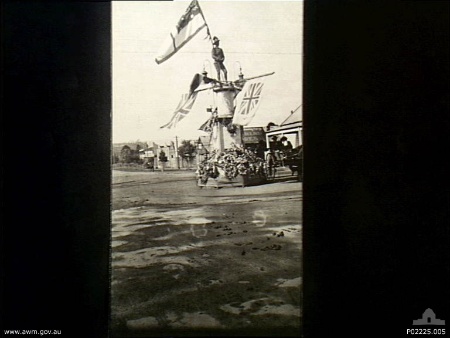
Before the erection of the Memorial Baths the Lismore Boer War Memorial was used as the site of commemoration. The photo below from the Australian War Memorial Collection shows the NSW Lancer atop the Boer War Memorial decorated with the flags of Australia, Britain and France for victory celebrations held in the town on 19 July 1919.

boer-war-memorial-1919Source: Australian War Memorial Collection 

The Northern Star article goes on to say: Public funds for construction [of the baths] were raised by holding events such as a street carnival and using the slogan: ‘Be a Brick, Buy a brick for Lismore’s Memorial Baths’. Dressing sheds were added in 1929 and by January 1930 a second level housed the Lismore Soldier’s Club. 

The slide show below records the faces of 31 of the 183 men whose names are recorded on the Honour Roll of the Memorial Baths, including Private Patrick Bugden VC.  For more information on Private Bugden see Briefing Room No. 6.

 [slideshare id=1177286&doc=lismoresoldiers-090321052320-phpapp01]

The slideshow can be viewed full screen by clicking on the projector screen icon in the bottom right corner. To return to the article simply press the escape key.

The current State Member for Lismore, Thomas George, has produced an Anzac booklet, which is available on line by clicking here. This document also contains an article on Private Bugden V.C. as well as Corporal Stratford – a Lismore soldier in the 9th Battalion claimed by witnesses to be the first ashore at Gallipoli and killed during the landing(C. E. W. Bean, official historian, concluded that the first ashore was possibly Lieutenant Duncan Chapman of the 9th Battalion but possibly both were in the same boat).

*****

The Families and Friends of the First AIF thanks the Australian, UK and French governments for affording Australian and British soldiers – presently buried in mass graves at Pheasant Wood – dignified individual reburials in a new CWGC cemetery at Fromelles, and applauds Minister Snowdon and his British counterpart, Parliamentary Under-Secretary of State for Defence and Minister for Veterans, Kevan Jones MP, for their joint decision to DNA test the remains at exhumation and use every reasonable method to attempt identification of each soldier.

Posted in Uncategorized | Comments Off on *Memorial Way No.7

*Briefing Room No.6

One of the names inscribed on the Lismore War Memorial featured in Memorial Way No. 7 is that of Private Patrick Bugden VC. In Briefing Room No.6 we look at Private Bugden’s final resting place Hooge Crater Cemetery Zillebeke Belgium.

cross-of-sacrifice-hooge-crater-cemetery_sml

Hooge Crater Cemetery is located opposite Hooge Crater at GPS 50°50’46.67″N,   2°56’36.11″E. The crater is the result of a mine explosion set by the British on 19 July 1915. The crater now forms a pond adjacent to the present day theme park. For more details on the formation on Hooge Crater click here.

The Cross of Sacrifice at Hooge Crater Cemetery is located in a symbolic depression to represent the crater. The cemetery was started in October 1917 with 76 burials. After the Armistice the bodies of 5,800 soldiers were brought in from smaller outlying cemeteries.

The Australian Government’s website Australians on the Western Front 1914-1918  gives details of the Australian involvement in the area during the fighting of September 1917.

Opposite the cemetery is the privately owned Hooge Crater Museum. Click here  for a virtual visit to the museum.

entrance-to-hooge-crater-cemetery_smlPhoto: Hooge Crater Museum [Munro Collection]

Patrick Bugden is one of 183 names listed on the Honour Roll at the Lismore (NSW) Memorial Baths.

pte-patrick-bugden_smlPhoto: Private Patrick Bugden [Australian War Memorial]

Patrick Bugden  was born, educated and worked in and around the Lismore district before enlisting on 25 May 1916. At the time of his enlistment Patrick was working as a hotelier in Alstonville, NSW.

Private Patrick (Paddy) Bugden was killed on 28 September 1917 and was awarded, posthumously, the Victoria Cross for his most conspicuous bravery and devotion to duty when on two occasions our advance was temporarily held up by strongly defended ‘pillboxes’ on 26 – 28 September 1917 at Polygon Wood, near Ypres, Belgium. Pte Bugden, under heavy machine gun fire, led small parties to attack the machine guns and captured the garrison. On another occasion he single handedly rescued a fellow soldier who had been taken prisoner. On five other occasions he rescued wounded men under heavy shell and machine gun fire.

tony-edwards-of-cwgc-hooge-crater-cemetery_sml

Photo: Tony Edwards, CWGC, examines the headstone  of Private Bugden, as FFFAIF member Chris Munro looks on. Mr Edwards is responsible for ensuring that engravings on CWGC headstones are legible and for their re-engraving or replacement as appropriate in CWGC cemeteries in Belgium. [Munro Collection]

Private Bugden’s medals are on display on the Brisbane Museum. Held within the museum’s collection are family photos and letters. For more details click here.

bugden-display-qld-museum

Photo: Brisbane Museum display. [Munro collection]

Private Bugden is commemorated around his home town in a memorial at Alstonville (GPS 28°50’31.53″S,   153°26’24.59″E) and a bridge bearing his name at South Gundurimba, NSW (GPS 28°52’24.84″S,   153°15’25.89″E).

bugden_vc_memorial_alstonville_smlPhoto: Private Patrick (Paddy) Bugden Memorial, Alstonville NSW.

*****

The Families and Friends of the First AIF thanks the Australian, UK and French governments for affording Australian and British soldiers – presently buried in mass graves at Pheasant Wood – dignified individual reburials in a new CWGC cemetery at Fromelles, and applauds Minister Snowdon and his British counterpart, Parliamentary Under-Secretary of State for Defence and Minister for Veterans, Kevan Jones MP, for their joint decision to DNA test the remains at exhumation and use every reasonable method to attempt identification of each soldier.

Posted in Uncategorized | Comments Off on *Briefing Room No.6