Legacy Australia

Legacy has its origins in the Great War of 1914-18.
To read more on the history of Legacy click here.

AUSTRALIANS ASKED TO GIVE GENEROUSLY IN LEGACY WEEK 

Launching Legacy’s nation-wide fundraising initiative, Legacy Badge Week 2008, in Sydney today, Minister for Veterans’ Affairs Alan Griffin encouraged all Australians to ‘dig deep’ to support the good work of Legacy.
Legacy is a non-for-profit organisation established by the ex-service community in 1923 to support and care for the families of those lost in war.
“Legacy supports around 122,000 war widows from two world wars, Korea and Vietnam as well as the families of those who have lost a parent or partner in more recent deployments,” Mr Griffin said.
“Legacy provides invaluable services to Australia’s veteran community and I encourage individuals and the corporate sector to give generously.
“Legacy complements the work of my Department–offering advice and assistance to the dependents of those lost in conflict and forging an important link between the two.
“Together, we can ensure that the families left behind have access to the best care and support available.
“As the majority of our war widows are now elderly and their health and care needs change, Legacy’s services will continue to be vital into the future.”
Mr Griffin said Legacy services took many forms, providing assistance to individuals depending on their needs, including counselling, special housing, medical, advocacy and social support.
“I encourage all Australians to give generously in Legacy week to show our support for the volunteers and all those involved in this valuable organisation,” Mr Griffin said.

Posted in Legacy | Comments Off on Legacy Australia

German Records

FFFAIF member Ross McMullin’s article in Saturday, 30th August, Sydney Morning Herald reports on the discovery of “remarkably rich German records about he disastrous attack at Fromelles’. Click here to read Ross’ article, New light on battle mystery.

Ross is the author of Pompey Elliott – the biography of Brigadier-General Harold ‘Pompey’ Elliott, commander of Australian 15th Brigade.

*****

Sydney Morning Herald: A matter of death and life by Paola Totaro investigates the work of a real-life crime investigator, Gaille MacKinnon. MacKinnon was a member of the GUARD team investigating Pheasant Wood, Fromelles. To read more click here. 


Posted in Books, Top Posts | Comments Off on German Records

'Moo Cow' Farm

Throughout August 1916 the 1st, 2nd & 4th Divisions of the AIF attacked the German stronghold of Mouquet Farm, near Pozieres, in the valley of the Ancre River, a tributary of the Somme. At this time the 5th Division was recovering from the Battle at Fromelles, 80 kilometeres to the north and the 3rd Division was still training on the Salisbury Plain in the United Kingdom. Mouquet Farm was commonly referred to as ‘Moo Cow’ Farm by the Diggers and today there is little evidence of the intensity of the battles fought and casualties suffered during those 4 weeks.

Photo: Mouquet Farm 2007

The Australian War Memorial describes the fighting at Mouquet Farm as:
the site of nine separate attacks by three Australian divisions between 8 August and 3 September 1916. The farm stood in a dominating position on a ridge that extended north-west from the ruined, and much fought over, village of Pozieres. Although the farm buildings themselves were reduced to rubble, strong stone cellars remained below ground which were incorporated into the German defences. The attacks mounted against Mouquet Farm cost the 1st, 2nd and 4th Australian Divisions over 11,000 casualties, and not one succeeded in capturing and holding it. The British advance eventually bypassed Mouquet Farm leaving it an isolated outpost. It fell, inevitably, on 27 September 1916.

More details on the Battle for Mouquet Farm can be found by clicking here.

To discover what it was like to fight at ‘Moo-Cow’ Farm click here.

Read more about the Australian’s final fight at Mouquet Farm click here.

Visitors today will find the spot marked by a Dr Ross Bastian bronze memorial plaque. In nearby Pozieres there are visible reminders of the Australians presence during the Great War.  Click here to read more.

Photo: Bronze Memorial Plaque at Mouquet Farm 2007

The Families and Friends of the First AIF annual John Laffin Travel Prize , in 2005, featured an essay by University of N.S.W. student Patrick Maloney which explores the evidence available in the Red Cross Wounded and Missing Files to give an insight into the actions at Mouquet Farm. The following is an extract from the essay:
…Unlike the ‘glorious’ and individualistic character of the Dardanelles campaign, or the victorious and well coordinated August Offensive that led to ultimate victory in 1918, the actions of the Australian 2nd Division in August and September 1916 in the battle for Mouquet Farm personifies what the Great War was for many. It was chaotic, indiscriminate, wasteful and utterly horrific in the true sense of the word. It is at ‘Moo-cow’ Farm where we see the true slaughter of Australian youth and with it the tenacity, self sacrifice and mateship that gave rise to the Anzac legend. Yet ironically it is also a struggle – the significance of which has been lost to the general public. Mouquet Farm has become a footnote to Pozieres, which itself has become nothing more than another insignificant sideshow in the carnage of the Battle of the Somme. Many Australians have not heard of the place. Many less will visit the site. The significance of the battle for the men who fought it is perhaps best described in the official 21st Battalion history: We have been in hotter holes since then but never has the Battalion suffered under intense shellfire for such long periods and with such little movement. The casualty lists bear this out. The conditions were vile. The weather being hot and everyone fully occupied on other tasks, the dead lay unburied for weeks and the stench was frightful. To come through a period such as this and then go on fighting is evidence of the temper of the British armies in general and of our unit in particular … under the heading of the First Battle of the Somme is told the story of our first and heaviest try out. The time which is vividly imprinted in the memories of those who saw the whole show through.
It is important when describing these actions that one has an understanding of the men themselves. Unlike many battalions thrown together in the heady days of 1914, the 21st was formed in early 1915. This, coupled with an average age of 29, seems to indicate a more considered decision to enlist. The ramifications of the battalion’s higher than average enlistment age is evident in the Red Cross Missing and Wounded files. Not only do mothers and siblings write to the Red Cross begging information, but also wives and lovers, some with children or others to represent, such as a woman only identified as Miss E. Robertson, who writes as late as 1918 asking for more information regarding Pte Robin Davey, refusing to believe the report of his death in action on the 26th August at Mouquet Farm. There were also veteran soldiers amongst their number, such as Joe Miller, who proudly displayed “ribbons from Somalia, South Africa and the DCM” in battle. Miller fell at Mouquet Farm, leaving behind a wife and two children. His mother and father heard mixed reports that he was recovering in hospital for months after the battle. There was no proper confirmation of his death sent to relatives until November 1918. The Miller family was to join thousands of Australian families who lost a relative in the Somme offensive, many of whose remains were never recovered and the grieving process never quite completed……………………..

The complete essay appeared in DIGGER issue 17. If you found this article of interest and would like to read more on other soldiers of the First AIF, why not fill out a Membership Application Form today and enjoy the benefits of our DIGGER magazines? Membership is $A40 p.a. For more details visit our Members Area.

Each edition of DIGGER contains many articles and photos, the majority of which are published for the first time and are provided by members. Details of the contents of past DIGGER magazines can be viewed by clicking on the DIGGER tab at the top of this page.

Copyright © DIGGER Magazine. All material in DIGGER is copyright. Subject to the fair dealing provisions of the Copyright Act 1968, reproduction in any form is not permitted without written permission of the Editor or Author/s.

All website information (i.e. the images, graphics, text etc) on our website are copyright © Families and Friends of the First AIF Incorporated (FFFAIF Inc.) or its individual Members. 

*****

You can view Mouquet Farm plaque location using Google Earth at GPS co-ordinates: 50° 2’58.00″N, 2°42’29.00″E

*****

To check out the new photos of some of the items found with the Australian soldier, discovered near Plugstreet, click here.

FROMELLES IS NOT HONOURED ON THE NATIONAL OR ANY STATE MEMORIAL IN AUSTRALIA.

FFFAIF SUPPORTS ALL EFFORTS TO RECOGNISE FROMELLES ON OR AT THE NATIONAL AND ALL STATE MEMORIALS THAT PRESENTLY LIST BATTLES BY NAME.

Posted in Diggers of First AIF, Mouquet Farm, The Western Front | Comments Off on 'Moo Cow' Farm

Buried where he fell…

More news on the Australian Digger found, still carrying his full kit and holding his rifle, 91 years after he was killed on the Western Front in Belgium.

The Australian: DNA testing could reveal WW1Digger’s identity.

The Age: Buried where he fell-the digger who went down fighting

The Canberra Times: Battlefield detectives examine digger mystery

For more information and photos take a look at the Plugstreet Archaeologist site. Click here.

defence news (Ministry of Defence, UK): Defence archaeologists discover Australian soldier from Great War  and Unplugging the legacy of Plug Street

*****

More on Private Storey:

ABC News: DNA tests identify Aust WW1 digger’s body found in Belgium

*****

Lost familiy letter delivered:

The Illawarra Mercury: World War 1 Digger’s letter traced to family

Posted in Diggers of First AIF, Projects, The Western Front | Comments Off on Buried where he fell…

New Find In Belgium

From Fairfax Digital: the age.com.au
Wednesday 20 August 5:11pm

Old Aussie soldier uncovered in Belgium

Ninety-one years ago, an Australian soldier fell dead on a Belgian battlefield and unnoticed by his mates, was buried, perhaps by a shell blast.

Last week he was found, astonishingly still clutching his rifle and carrying every other item of equipment with which he lumbered into battle.

Battlefield historian Mat McLachlan said that made him very unusual indeed.

“This is an interesting discovery and a lot more important for us because he was dressed in full kit,” he said.

“We actually find out a lot more about the Australians during the First World War by finding bodies such as this one.”

This follows the recent discovery of the remains of a considerable number of Australians interred after the 1916 Battle of Fromelles.

The latest find was made last week by United Kingdom Ministry of Defence archaeologists Richard Osgood and Martin Brown, members of a historical group called No Man’s Land which includes Mr McLachlan.

They are researching the Australian 3rd Division which trained in England then fought in the Battle of Messines in southern Belgium on June 7, 1917.

The aim was to capture a low ridge. The attack was preceded by a week-long artillery bombardment and the detonation of 19 giant mines, containing more than 400 tonnes of explosives, placed under German lines by Australian, British and Canadian tunnellers.

These explosions were heard in London and killed as many as 10,000 German soldiers. Consequently the ensuing attack was successful, albeit at substantial cost of 6,800 Australian dead and wounded.

Mr McLachlan said his British colleagues uncovered the soldier’s intact skeleton in excavations near the old German frontline.

“The most likely scenario, from what we can tell at this stage, is that he was part of the attack on Messines Ridge,” he said.

“Then they were pushing on to further objectives when he was hit and fell and was then covered over by a shell blast or buried in some way and that is where he has lain for 91 years.

“We definitely know he wasn’t buried by his mates because he was in full battle kit. He was still holding his rifle when they uncovered him. He had his backpack on. He had hand grenades in his pockets and he had all his ammunition and his helmet.”

Mr McLachlan said soldiers burying a comrade would always remove weapons and other items.

Much other equipment was found, including Australian insignia, a wallet containing 1916 French francs, medical and mess kit, toothbrush, boots and cloth fragments. Most intriguing, in the soldier’s backpack was a German spiked “pickelhaub” helmet, a highly prized souvenir.

This was an era before soldiers routinely carried durable identity discs. But found with this soldier was what appears to be a homemade metal dog tag, albeit very corroded.

Mr McLachlan said this was to be x-rayed in the hope of discerning some details.

“It is a very positive start to the ID process,” he said.

“The Belgian war graves currently have custody of the body. The Australian army will then be in charge of the investigation to try and identify him.”

Posted in Diggers of First AIF, Projects, The Western Front | Comments Off on New Find In Belgium

Britain At War

The following article appeared in the August 2008 edition of the magazine Britain at War :

Mass Grave uncovered at Fromelles.

To read the article just RIGHT click on the following: mass-grave-uncovered-at-fromelles

Britain at War Magazine is issued monthly and covers the history of conflicts that have involved Britain.  Details of the contents of the 16 issues of the magazine are contained on the Magazine’s web-site, along with subscription details and Books and DVDs available through their on-line bookshop.  The web-site also contains some links to major military web-sites of interest for British military history. To visit the website of the magazine Britain At War , A history of Britain at war in the 20th Century to now.
click here.

Posted in Books, Top Posts | Comments Off on Britain At War

3 out 5 @ Zonnebeke

Photo: ‘Zonnebeke 5’ graves, Buttes New British Cemetery, Belgium

The following news bulletin has been received from the Memorial Museum Passchendaele 1917, Zonnebeke:

On 3 July we announced that the remains of an unknown Australian soldier, killed in September 1917, had been identified. Together with 4 other bodies he was salvaged in September 2006 near the hamlet of Westhoek in Zonnebeke by a team of the Memorial Museum Passchendaele 1917. Two of them could be identified last year by means of thorough historical research and comparative DNA-tests on possible descendants, both carried out in Australia and Belgium. The five Australians were buried with military honours in Buttes New British Cemetery on 4 October 2007 in the presence of among others, the Governor General of Australia, the Prime Minister of New Zealand and family members of the identified Sergeant George Calder and Private John Hunter.
The now identified third casualty is Private George Storey, who was born in the vicinity of London and who migrated to Western Australia, where he worked on a farm. At the end of March 1916 he enlisted and together with his elder brother Jack, he was assigned to the 51st battalion with which he moved to the front in France by the end of 1916. On 9 June 1917 George got wounded during the Battle of Messines, but by the end of August he was able to return to his unit. On 26 September 1917 George was involved in the fighting near Polygon Wood, which was part of the important Battle of Passchendaele. In the following days the Germans tried to recover the terrain lost to the Australians by an extraordinarily heavy artillery barrage. During this, George, together with three others was hit by an exploding shell when leaving his shelter Anzac of Westhoek Ridge. The 22-year old was killed instantaneously and eventually moved to a make-shift burial place, which after the war was not entirely cleared. His personal belongings – two wallets, photographs, belt, and ‘rifle shot register’ – were sent to his mother Hannah. His brother Jack also got badly wounded, but could go back to Australia in January 1918. Ninety one years later, George Storey will get a known grave thanks to comparative DNA-tests on Jack’s son David.
It’s expected that the headstone erected above his remains last year, and carrying the word ‘unknown’ will be replaced still this year. The identification of World War 1 missing based on historical research and DNA-tests constitutes a real scientific breakthrough, opening perspectives towards the future.

DIGGER, the quarterly magazine of the Families and Friends of the First AIF, featured an article in issue 21, by Belgium member Johan Durnez, describing the burial service for the ‘Zonnebeke Five’ in October 2007. To read Johan’s article click on the following link: military-funeral-for-zonnebeke-5

If you found this article of interest and would like to read more on other soldiers of the First AIF, why not fill out a Membership Application Form today and enjoy the benefits of our DIGGER magazines? Membership is $A40 p.a. For more details visit our Members Area by clicking here.

Each edition of DIGGER contains many articles and photos, the majority of which are published for the first time and are provided by members. Details of the contents of past DIGGER magazines can be viewed by clicking here.

Copyright © DIGGER Magazine. All material in DIGGER is copyright. Subject to the fair dealing provisions of the Copyright Act 1968, reproduction in any form is not permitted without written permission of the Editor or Author/s.

All website information (i.e. the images, graphics, text etc) on our website are copyright © Families and Friends of the First AIF Incorporated (FFFAIF Inc.) or its individual Members.

Posted in Diggers of First AIF, Zonnebeke | Comments Off on 3 out 5 @ Zonnebeke

Football & The AIF


With the ‘footie’ season throughout Australia approaching its final rounds, a timely addition to the website is Laura Grumley’s winning essay for the 2007 John Laffin Memorial Travel Prize (JLTP) which traces the war experience of four footballers in the AIF. To read Laura’s essay click here.

Other winning essays of the John Laffin Memorial Travel Prize awarded to students from the University of New South Wales include:

Posted in Diggers of First AIF, John Laffin Memorial Lecture | Comments Off on Football & The AIF

First to see action.

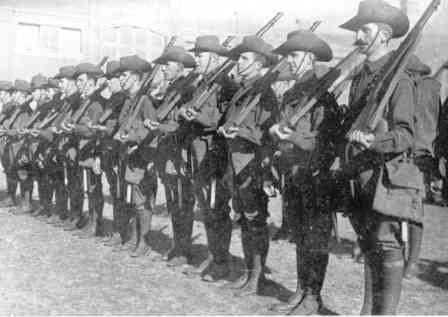
The Australian Naval and Military Expeditionary Force (A.N & M.E.F.) sailed from Australia on 19th August 1914 to occupy the German colonies in the South Pacific and prevent wireless transmissions to the German Pacific naval squadron.

Photo: The Australian Naval and Military Expeditionary Force at Randwick, Sydney August 1914

The Australian War Memorial describes the A.N & M.E.F as the first Australian fighting force in the First World War. In September 1914, while the Australian Imperial Force was still being formed, the Royal Australian Navy and the Australian Naval and Military Expeditionary Force under Colonel William Holmes captured Rabaul. Within three months, Holmes’s forces had garrisoned the remainder of Germany’s Pacific possessions south of the Equator, stretching from northeast mainland New Guinea to the Admiralty Islands, New Ireland, Bougainville, and Nauru.

A detailed account of the actions of the Australian Naval and Military Expeditionary Force can be read on line at the Australian War Memorial in the Official Histories Volume X The Australians at Rabaul: The Capture and Administration of the German Possessions in the Southern Pacific. This volume presents the background to and a detailed account of the capture of German New Guinea, and it also covers many aspects of administration until 1921, when Australia’s civilian rule of those territories began as a League of Nations mandate. This story of Australia’s military occupation “up north” is crucial to our understanding of this country’s role as a colonial power and of W.M. Hughes’s campaign at the Paris Peace Conference to shore up the post-war defence of Australia’s interests in the Pacific. It is also pertinent to the history of the infamous White Australia Policy.

Posted in A.N. & M.E.F., Diggers of First AIF | Comments Off on First to see action.

Call for Assistance

The Fromelles Descendant Database, in co-operation with British Historian Peter Barton, are seeking assistance in gathering evidence for the Fromelles study.

Are you able to assist in the following request from Tim Lycett, Fromelles Descendant Database, in regard to Australian Soldiers ‘missing at Fromelles’:
I have recently been speaking to the very respected British Historian, Peter Barton, who is the Co-Secretary, All Party Parliamentary War Graves and Battlefields Heritage Group.   He has been very involved in the official Fromelles investigation as it’s primary historian and is currently still searching through the archives of the Red Cross in Geneva and the German war records in Bavaria.
He has requested that I collate a list of the personal belongings returned to relatives after the soldier’s death that remain in the family’s possession today.   This could include the ID discs, bibles, coins, letters, wallets, rings, buttons, badges etc.    It is important to make a comprehensive study of every available aspect of this case. The ‘material culture’, as it is so blandly called, is one such aspect and is as important a part of the historical jigsaw of this project as any other.
I would therefore very much appreciate if everyone could possibly forward me a list of any items known to still be with your respective families.   (If possible a photo or scanned copy would be very helpful) . 

If you are descendant or know of a descendant who could assist please contact Tim Lycett at fromelles@gmail.com

Posted in Diggers of First AIF, Projects, Top Posts | Comments Off on Call for Assistance