* Gallipoli 2010

25th April 2010 will be the 95th Anniversary of the landing of Australian troops on the shores of Gallipoli.

The Minister for Veterans’ Affairs, Alan Griffin, has recently announced a number of initiatives to commemorate the Anniversary including:

  • Gallipoli’s Victoria Cross Medals to tour Australia;

Photo: Corporal Alexander Burton VC [AWM H06785]

Scroll down to see more details of the Tour for the Australian War Memorial’s collection of Victoria Cross medals from Gallipoli.

  • The release of a new walking guide to the peninsula, The Anzac Walk – Gallipoli in a day;

Scroll down to see more details of the new walking guide to the Gallipoli peninsula, The Anzac Walk – Gallipoli in a day.

  • The launch of a trial of a new visitor registration service to help travellers attending Anzac Day services at Gallipoli.


GALLIPOLI’S VICTORIA CROSS MEDALS TO TOUR AUSTRALIA

The Australian War Memorial’s collection of Victoria Cross medals from Gallipoli will tour the nation for the first time to commemorate the 95th anniversary of the landing.

Announcing the tour, Minister for Veterans’ Affairs Alan Griffin said it was a valuable opportunity for more Australians to see Anzacs’ Victoria Cross medals.

“Gallipoli was where the Anzac legend was born. These nine Anzacs epitomise the courage and sacrifice of those who fought there,” Mr Griffin said.

Australian War Memorial Director Steve Gower said the special touring exhibition This company of brave men; the Gallipoli VCs, is presented by the Australian War Memorial and made possible through the generous support of Mr Kerry Stokes AC and Seven Network Limited.

“The Victoria Cross is the highest form of recognition that can be bestowed on a soldier for remarkable and unselfish courage in the service of others. The entire nation draws pride and inspiration from these brave men,” Mr Gower said.

The nine Victoria Crosses will travel to Western Australia, Northern Territory, South Australia, Victoria and Queensland, from 20 March 2010.

Mr Stokes said he was always conscious of the special place the VCs have in the hearts of all Australians. 

“When the Australian War Memorial presented an opportunity to tour the Gallipoli VCs for the first time, I personally sought to ensure that all Australians would be able to visit the exhibition free of charge and learn about the lives of these brave men.  The VCs are such an important vital part of our lives, in many respects they are a part of our core essence as Australians. 

“I am also pleased that Seven is playing such an important role in ensuring all Australians are aware of this extraordinary and touching exhibition.”

The touring exhibition will feature the medals of Corporal Alexander Burton, Corporal William Dunstan, Private John Hamilton, Lance Corporal Albert Jacka, Lance Corporal Leonard Keysor, Captain Alfred Shout, Lieutenant William Symons, Second Lieutenant Hugo Throssell, and Lieutenant Frederick Tubb.

Seven of the nine Victoria Crosses awarded at Gallipoli were for bravery during the battle of Lone Pine, on 6-7 August 1915. A total of 97 Australians have received the Victoria Cross.

Photo: Lance Corporal Leonard Keysor  [AWM P02939.007]


WALKING IN THE FOOTSTEPS OF OUR ANZACS

Australian visitors to Gallipoli will benefit from two initiatives launched by the Minister for Veterans’ Affairs, Alan Griffin, at the Australian War Memorial.

A new walking guide to the peninsula, The Anzac Walk – Gallipoli in a day, has been produced in time for Anzac Day and a new visitor registration service is being trialled this year to help travellers attending Anzac Day services at Gallipoli.

“Gallipoli marks a defining moment in our nation’s history,” Mr Griffin said.

“To be at Gallipoli, on Anzac Day or at any time, is opportunity to get a glimpse into that moment, especially as we near the 95th anniversary of the landing.

“Many Australians visit Gallipoli each year to pay tribute to the soldiers who forged the Anzac legend and the Australian Government is pleased to offer resources to ensure they get the most of out of their visit.  We would like them to come prepared,” he said.

“In the past we have seen some Australian travellers arrive at Gallipoli wearing just thongs on their feet and a light jumper to keep warm. The weather at Gallipoli can be extreme – below zero and often windy overnight, hot during the day and there is always a chance of rain.

“I encourage travellers planning to attend Anzac Day services at Gallipoli to register and receive important updates in the lead-up to Anzac Day, helpful information on what to bring with them and what to expect at Gallipoli.” 

Registration is via the Department of Veterans’ Affairs website, www.dva.gov.au/anzac 

Mr Griffin said Australians travelling to Gallipoli at any time of the year should pack or download a copy of The Anzac Walk – Gallipoli in a day.

“Starting at North Beach the guide takes you on foot to key sites including Anzac Cove, Lone Pine, the Nek, Johnston’s Jolly and Shrapnel Valley,” said Mr Griffin.

“The guide gives first-hand accounts of what it was like for an Australian soldier at that particular stop on the Gallipoli battlefield. To understand our history, particularly those dark parts where pain and loss prevailed, is to understand the incredible resilience of our Anzacs.”

Mr Griffin also launched the 2010 Anzac Day poster today, featuring images of the Anzacs arriving at Gallipoli in 1915 and of Anzac Cove today.

“This year marks 95 years since the Anzac legend was forged on the shores of the Gallipoli peninsula.  To help commemorate this anniversary my Department has produced an Anzac Day commemorative poster focused on Gallipoli and the legacy of the Anzacs. These will be mailed nationally to schools, ex-service and community organisations in the coming weeks,” he said.

* Copies of The Anzac Walk are available from the Australian War Memorial, Canberra, and Shrine of Remembrance, Melbourne. Audio and text excerpts of the guide, in English and Turkish, can be downloaded from www.anzacsite.gov.au

*****

The Families and Friends of the First AIF applauds the joint Australian–UK decision to conduct a full DNA testing program on the remains of Australian and British soldiers found in mass graves at Pheasant Wood (Fromelles), and for their continuing commitment to identify as many of the fallen as is possible. We also thank the Australian, UK and French governments for affording dignified individual reburials for these soldiers, buried by German soldiers following the Battle of Fromelles on 19/20 July 1916, in the new Fromelles (Pheasant Wood) Military Cemetery.

Posted in ANZAC Day, Australian War Memorial, Commemorations, Diggers of First AIF, Gallipoli | Comments Off on * Gallipoli 2010

Fromelles ID Board meet

The Joint Identification Board, co-chaired by Major General Mike O’Brien from the Australian Army, and Air Commodore Chris Bray from the Royal Air Force convened on 1 March 2010 at Australia House, London to try to identify as many of the 250 soldiers whose remains have been recovered from the burial pits at Pheasant Wood and have been re-buried in the new Fromelles (Pheasant Wood) Military Cemetery. The Board will end on March 12 but is likely to meet again in late April or early May to consider any further evidence. 

Photo: Major General Mike O’Brien, Co-chair of the Fromelles Joint Identification Board [Chris Munro]

The Australian Army has provided some details about the identification process on its web site at Key Activities – Identification.

A joint media release by the Minister for Defence Personnel, Materiel and Science, The Hon. Greg Combet MP, and the Minister for Veterans’ Affairs, The Hon Alan Griffin MP gives the following information:

Identification of Fromelles fallen begins
A joint Australian/British Identification Board is now considering evidence in an attempt to identify the 250 soldiers recovered from the World War One mass grave at Fromelles, France. 
Minister for Defence Personnel, Materiel and Science, Greg Combet, and Minister for Veterans’ Affairs, Alan Griffin, welcomed the commencement of this important process.
“The identification of the remains is an extremely complex process involving the review of anthropological, archaeological, historical and DNA information,” Mr Combet said.
“The Joint Identification Board will seek to determine as many of the soldiers identities as possible. The Army will then notify registered relatives of identified soldiers.”

“More than 1300 Australians soldiers died at Fromelles and have no known grave,” Mr Griffin said.
“Almost all of the 250 sets of remains have yielded viable DNA samples.
“Nearly 600 DNA samples collected from descendants will be considered by the Joint Identification Board.

“A commemorative event to open the cemetery is scheduled for the 94th anniversary of the Battle of Fromelles on 19 July 2010.  The battle was the bloodiest 24 hours in Australian history with 5,533 Australian soldiers killed, wounded or missing,” Mr Griffin said.

The Board will be co-chaired by Major General Mike O’Brien (Australian Army) and Air Commodore Chris Bray (RAF). The Board will convene on 1 March 2010 at Australia House, London and will conclude on 12 March 2010. Planning is also underway for an additional board in late April or early May to consider samples that were not available for the March board.

People who believe their relative may be buried at Fromelles and have not already registered should do so at www.army.gov.au/fromelles or by calling 1800 019 090.

The inaugural meeting of the Joint Identification Board is reported in the media report ID process begins for Fromelles soldiers.

 *****

The Families and Friends of the First AIF applauds the joint Australian–UK decision to conduct a full DNA testing program on the remains of Australian and British soldiers found in mass graves at Pheasant Wood (Fromelles), and for their continuing commitment to identify as many of the fallen as is possible. We also thank the Australian, UK and French governments for affording dignified individual reburials for these soldiers, buried by German soldiers following the Battle of Fromelles on 19/20 July 1916, in the new Fromelles (Pheasant Wood) Military Cemetery.

Posted in Top Posts | Comments Off on Fromelles ID Board meet

Fromelles re-burials

Added 28 February
Pete Richardson, Secretary of the Royal British Legion Rheindahlen Branch in Germany and a new FFFAIF member has provided a Report on Our Second Trip to the Burial Services at Fromelles France and a Visit to Tyne Cot and Ypres that extends his previous report on the Reburial service of 30 January 2010 and his participation as a RBL Standard Bearer.  Follow the links to see some very evocative photos of the re-burials in the snow and the young soldiers, Chaplains and RBL Standard Bearers who braved these conditions to honour the fallen of Fromelles.

Updated Monday 22 February 2010
Major General Mike O’Brien has indicated that the first group of Australian soldiers killed in the Battle of Fromelles and buried by the Germans at Pheasant Wood will be identified by Anzac Day.  Click here to read: Fromelles dead to be revealed by Anzac Day.

The re-burial of 17 soldiers occurred on Friday 19 February 2010. This means that the remains of 249 of the 250 soldiers recovered from the burial pits at Pheasant Wood have been re-buried with military honours.  The final re-burial will occur at the dedication of the Fromelles (Pheasant Wood) Military Cemetery on 19 July. 

Photo: Arrival of hearse for the re-burial service
30 January 2010 [Johan Durnez]

The Families and Friends of the First AIF, on behalf the familes and friends of the soldiers who served in The Great War, wish to thank those who have contributed to the dignified re-burial of these soldiers. 

Photo: Bearer Party [Mike Rimmer]

In particular, FFFAIF would like to thank the members of the Australian Federation Guard, the 1st Battalion Royal Regiment of Fusilliers, the 4th Battalion The Rifles, the Chaplains and Commonwealth War Graves Commission staff and Royal British Legion members who, with care and dignity, formed the Bearer Parties, the Firing Party and assisted in the re-burials in cold and difficult conditions. 

Photo: Firing Party and Chaplains [CWGC]

Photo: Firing Party and Musicians [Ann Vanhaverbeke]

Photo: Royal British Legion Standard Bearers [Johan Durnez]

Thanks also go to the the Australian and British military personnel, the many support staff and dignitaries who have assisted in or facilitated the re-burial services. 

Photo: Dignitaries at Re-burial Service 30 January 2010 [CWGC]

In addition, a special thank you to the residents of Fromelles, led by Mayor Hubert Huchette, for their committment to assisting in locating the “missing” soldiers, the recovery of their remains, the construction of the new Fromelles (Pheasant Wood) Military Cemetery and the re-burial services and who have offerred to be the protectors of the burial pits at Pheasant Wood and the new Cemetery.

Photo: Mayor Hubert Huchette accompanies Her Excellency Ms Quentin Bryce, AC Governor-General of the Commonwealth of Australia, Colonel Skowronski, Australian Military Attaché, His Excellency David Ritchie, Australian Ambassador and dignitaries November 2008 [Hubert Huchette]

Photo: Martial Delebarre (President Association Fromelles-Weppes-Terre de Memoire 14-18 (F.W.T.M. 14-18), Hubert Huchette (Mayor of Fromelles) and Francis Delattre (President de Union des Anciens Combattants – de l’UNC) [Carole Laignel]

Thanks also to the Association pour le Souvenir de la Bataille de Fromelles en 1916 / F.W.T.M., Fromelles Weppes Terre de Mémoire 1914-1918 who operate the Fromelles Museum and welcome visitors and explain the history of the Battle of Fromelles to them.

Photo: David Marshall, Jean Marie Bailleul, Vice Président de FWTM 14-18 and Martial Delbarre AM with the Australian flag presented to the Fromelles Museum by Mike Rimmer [Mike Rimmer]

Thanks also to the French Government and Officials and military, as well as to the French veterans of the l’Union Nationale des Combattants for their support. 

Photo: l’Union Nationale des Combattants Standard Bearers 
[Mike Rimmer]

Photo: French soldiers’ honour guard for the Bearer Party with coffin [Mike Rimmer]

Finally, thanks are due to those who undertook the research, considered the evidence, participated in the archaeologcial digs, undertook the scientific analysis and the families who have enabled the soldiers to be recovered, re-buried with dignity with individual headstones and have provided the basis for returning the soldiers’ identity to them.

Photo: Lambis Englezos with Tim Whitford and Ward Selby
at Pheasant Wood [Lambis Englezos ]

Photo: Lambis Englezos with John Fielding at Pheasant Wood
[John Fielding ]

Photo: FFFAIF researchers Bruce Scates, Lambis Englezos, Sandra Playle, Tim Lycett, Tim Whitford, Jim Munro [Jim Munro]

Photo: Dr Tony Pollard with Roger Lee,
Major General Mike O’Brien, Dr Denise Donlon, Peter Barton,
Major General Paul Stevens (Rtd) [CWGC]

Photo:  Tim Whitford examining Uncle Harry’s medallion with Frank Fremaux, Vice Président de FWTM14-18, Lambis Englezos and 
Col. Peter Singh, June 2008 [CWGC]

Photo: Professor Richard Wright and Ambika Flavel as part of the Oxford Archaeology Team [Chris Munro]

Keep The Memory Alive – Lest We Forget.

*****

Updated 20 February: February Re-burial Program Completed 

The re-burial of 17 soldiers occurred on Friday 19 February 2010 means that the remains of 249 of the 250 soldiers recovered from the burial pits at Pheasant Wood have been re-buried with military honours. The final re-burial will occur at the dedication of the Fromelles (Pheasant Wood) Military Cemetery on 19 July.

On Wednesday 17 February, 18 soldiers were re-buried with military honours.     

The 4th Battalion The Rifles replaced the 1st Battalion Royal Regiment of Fusilliers and 26 soldiers were re-buried with military honours on Monday 15 February. The Rifles is a Regiment of the British Army formed in 1 February 2007 by the amalgamation of four Light Infantry and Rifle Regiments. The 4th Battalion is the redesignation of the 2nd Battalion Royal Green Jackets. 

30 soldiers were re-buried with military honours on Friday 12 February, bringing to completion the duties of the 1st Battalion Royal Regiment of Fusilliers.

On Wednesday 10 February, 24 soldiers were re-buried with military honours in freezing cold and snow.

On a cold and drizzly Monday, 8 February, 35 soldiers were re-buried with military honours.

On Friday the re-burial of soldiers killed at the Battle of Fromelles whose remains were recovered from the burial pits at Pheasant Wood continued in showery and cold weather.  See photos taken during the re-burial of soldiers on Friday 5 February in RECENT NEWS Item: Friday re-burials  

Carole Laignel is pictured with members of the Australian Army Federation Guard who provided the Australian component of the Bearer Parties. [Glen Phillips]

See photos taken during the re-burial of 34 soldiers on Wednesday 3 February in RECENT NEWS Item: 34 soldiers re-buried 

The Last Post is sounded on the cornet of the 31st Battalion AIF

The cornet presented to the 31st Battalion in August 1915 has been sounding the Last Post and the Rouse at the re-burial of soldiers killed at the Battle of Fromelles whose remains were recovered from the burial pits at Pheasant Wood.  Read RECENT NEWS Item: Last Post on Cornet for the story behind how this came about. 

See photos taken during the re-burial of 30 soldiers on Monday 1 February in RECENT NEWS Item: Burials continue …  

The reinterment of the first of the Australian and British soldiers in the Fromelles (Pheasant Wood) Military Cemetery
on Saturday 30 January, 2010

FFFAIF Members Johan Durnez and Anny de Decker travelled from Belgium to Fromelles for the service on 30 January, 2010. Read Johan’s account of the service in RECENT NEWS Item: Fromelles burials begin

FFFAIF member Carole Laignel, who is also Secretary, Fromelles Museum (Fromelles Weppes Terre de Mémoire 1914-1918), has sent a photo report of the service that may be seen in RECENT NEWS Item: Fromelles Service.

The Commonwealth War Graves Comission has released video footage of the re-burial service at the Fromelles (Pheasant Wood) Cemetery on 30 January 2010. To view the CWGC coverage of the service, follow the links in RECENT NEWS Item: Re-burial video.

The military funeral at the Fromelles (Pheasant Wood) Military Cemetery has had extensive coverage in the media. Follow the links in RECENT NEWS Items: Fromelles media reports and Fromelles Media #2 to see this coverage.

A number of videos have appeared on YouTube featuring the military funeral for the reinterment of the first of the 250 Australian and British soldiers in the Fromelles (Pheasant Wood) Military Cemetery  on Saturday 30 January, 2010.  View these in RECENT NEWS Item: Fromelles on YouTube

A number of web-sites provide an overview of the Battle of Fromelles, the search for the “missing” soldiers, the archaeological digs and the recovery and re-burial services.  Click on RECENT NEWS Item: Key Fromelles Websites for links to these web-sites.

The background to the Battle of Fromelles is covered in two RESEARCH postings:

Background to the Battle of Fromelles Part 1: 1915 and the Battle of Aubers Ridge
Background to the Battle of Fromelles Part 1: 1916 and the Battle of the Somme  

The soldiers thought to be buried at Pheasant Wood were most likely killed in or behind the German front line and were buried by the Germans after they returned to their original front line on 20 July 1916. The identity tags and personal effects of the soldiers were removed by the Germans and returned to the families in Australia through the International Red Cross and Australian Red Cross in March 1917.  For details of how to access the list of 191 names on the “working list”, follow the links in NEWS Item: *Fromelles Missing list.

The Minister for Veterans’ Affairs, The Hon. Alan Griffin MP announced that viable DNA samples had been obtained from the remains of more than 90% of the soldiers recovered from Pheasant Wood.  To find out more about DNA techniques, follow the links in NEWS Item: *DNA and Family Trees.

Johan Durnez took Ozzie the kangaroo to the Fromelles service as part of enabling Belgian school students to better appreciate the contribution Australians made in the Great War and to learn more about Australia through the Ozzie Wozzie Project. Ozzie appeared in some of her first photos and in the news reports on television. Johan now provides more details of Ozzie in RECENT NEWS Item: Ozzie’s Digger tribute.

Posted in Commemorations, The Western Front, Top Posts | Comments Off on Fromelles re-burials

Key Fromelles websites


Photo: Bearer Party at Re-burial Service January 2010
[Anny DeDecker]

A number of web-sites provide an overview of the Battle of Fromelles, the search for the “missing” soldiers, the archaeological digs and the recovery and re-burial services.

Commonwealth War Graves Commission: Remembering Fromelles

Australian Army Fromelles Project Group: Don’t forget me Cobber

Fromelles Descendant Database Project: Fromelles Descendant Database

ABC NEWS Special: Fromelles Fallen

Fairfax Sydney Morning Herald: Pheasant Wood: The  Lost Diggers of Fromelles

 Royal British Legion Rheindahlen Branch (Germany) Report on the Reburial service of 30 January 2010

Association pour le Souvenir de la Bataille de Fromelles en 1916 / F.W.T.M. ,Fromelles Weppes Terre de Mémoire 1914-1918: Fromelles Museum

Posted in Top Posts | Comments Off on Key Fromelles websites

Fromelles Media #2

Links to Media coverage of the reburial of the Australian and British soldiers at Fromelles since Friday 5 February 2010.


Photo: UNC Standard Bearers 30 January 2010 [Johan Durnez]

For the earlier period from Friday 29 January, 2010 to Friday 5 February, go to: Fromelles Media Reports 

Wednesday 24 February 2010

Fairfax Digital – The Sydney Morning Herald: Soldier’s family calls for inclusive service
By BRIDIE SMITH
Monday 22 February 2010

Fairfax Digital – The Age: Reburial rites ‘biased to one faith’
By BRIDIE SMITH
Monday 22 February 2010
At least 11 Jewish soldiers were killed in the Battle of Fromelles according an article by Ben Hirsh of VAJEX (Victorian Association of Jewish Exservicemen) in The Australian Jewish News: Lost at Fromelles

news.com.au – The Australian: Fromelles soldiers are laid to rest
By Leigh Dayton, Science Writer
Monday 22 February 2010
Reports that forensic archeologist and anthropologist Caroline Barker is in Australia to visit University of Sydney’s emeritus professor Richard Wright, senior forensic adviser to Oxford Archaeology as reports are being finalised in preparation for evidentiary and DNA-based identification.

Emeritus Professor Richard Wright, senior forensic adviser and Australian Archaelogist Ambika Flavel on-site at Fromelles as members of the Oxford Archaeology Team in June 2009 [Chris Munro]

Monday 22 February 2010

The Age: Fromelles dead to be revealed by Anzac Day
BRIDIE SMITH
Monday 22 February 2010
Interview with Major General Mike O’Brien

Saturday 20 February 2010

Bigpond News: Soldiers reburied at Fromelles
Saturday 20 February 2010

Friday 19 February 2010

Fairfax Digital – The Flinders News: Local soldier among unidentified at Fromelles?
By SHANE MILLS
19 February 2010 01:15 PM
Tells the story of Lieutenant Eric Chinner of the 32nd Battalion, thought to have been buried at Pheasant Wood.

The Coffs Coast Advocate: Students to see WWI battlefields
19 February 2010
Features Coffs Harbour English and history teacher Jon Hart who will accompany 12 NSW students on the Premier’s ANZAC Memorial Scholarship to see the WWI battlefields and trenches of the the Western Front in France and Belgium.

Tuesday, 16 February, 2010

Central Coast Express Advocate: Poignant search for uncle lost at Battle of Fromelles
Tuesday, 16 February, 2010 @ 09:27am by Alicia McCumstie
Relates to Private Harold Bourke and his nephew Justin Bourke. The story of Private Harold Bourke featured on the FFFAIF website in July 2008 in Hit in No-Man’s Land.

 Thursday 11 February, 2010

ABC NEWS: Wrong flag used in Fromelles burials
Posted Thursday 11 February, 2010 1:05am AEDT
Updated Thursday 11 February, 2010 1:16am AEDT

 Wednesday 10 Febraury, 2010

Fairfax Digital – Campbelltown Macarthur Advertiser:  Student steps back to WWI battles
BY MICHELLE TAVERNITI
Wednesday 10 February, 2010 10:19 AM
The story of Laura Trevaskis, a student at The Campbelltown Performing Arts High School who is one of 12 NSW students to be awarded the Premier’s Anzac Memorial Scholarship, which involves a fully funded trip to France and Belgium in September/October. 

Monday, 8 February, 2010 

Coventry Telegraph.net: Coventry soldier raises flag to Fromelles fallen
Monday 8th February 2010 

Bucks Free Press: Family still waiting for identity of war grave body
By SimonParr
9:30am Monday 8th February 2010 

Sunday, 7 February, 2010 

Andover Advertiser: Burial honour for our boys
2:50pm Sunday 7th February 2010 

Saturday, 6 February, 2010 

stv (Scotland on TV): Scots family to bury war hero
A Scottish family may have the chance to honour a soldier who was killed in the Second World War [and this is not the only error]
06 February 2010 14:52 PM 

Posted in Events, Top Posts | Comments Off on Fromelles Media #2

Last Post on Cornet

The cornet presented to the 31st Battalion at Enoggera Army Barracks in Brisbane, Queensland, in August 1915, on the occasion of the Battalion’s inclusion as part of the  8th Brigade has been sounding the Last Post and the Rouse at the re-burial of soldiers killed at the Battle of Fromelles whose remains were recovered from the burial pits at Pheasant Wood.

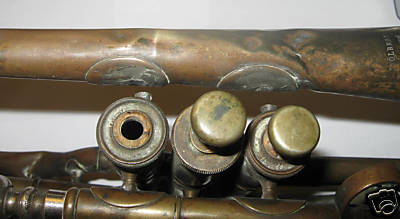
The cornet, made in about 1911 by Boosey & Co, of London, was presented to the 31st Battalion by Mr A J Cotton of “Hidden Vale”, a sizeable property at Grandchester.

The cornet is a close relative of the trumpet and is typically pitched in B-flat. Larger brass bands usually include an e-flat soprano cornet. The cornet is the smallest instrument used in the brass band. When played, the cornet is held straight out from the lips with the valves vertical or slightly inclined to the player’s right. The right hand is used to manipulate the valves and the left hand supports the instrument.

The cornet is engraved with “Solbron (Registered) Class A Trademark BOOSEY Light Valve Boosey & Co, Makers, London, 90735, Guaranteed British Made Throughout. Presented to 31st Battalion A.I.F. by Mr. A. J. Cotton, “Hidden Vale”, Grandchester, August, 1915”.

Shortly after the presentation of the cornet, 31st Bn had a Ragtime Band that may have included the cornet, as evidenced by the following photo held in the Australian War Memorial Collection.  While it is not possible to detect the engraving in the photo and the mouthpiece was longer in 1915, the cornet looks to be otherwise identical to the 96 year old cornet that was presented to the 31st Bn.

Portrait of A Company, 31st Battalion, Ragtime Band October 1915 AWM DAX0831

The names of the 31st Bn soldiers who played the cornet are not known, however it is known that the 31st Bn, as part of the 8th Brigade, 5th Australian Division was one of the attacking battalions in the Battle of Fromelles on 19 July, 1916, the battalion’s first major battle.

Presumably the cornet remained with the 31st Bn for some or all of its time during The Great War before returning to Australia. The battalion’s other Great War Battle Honours include Somme 1916, Bapaume (March 1917), Bullecourt (May 1917), Menin Road (September 1917), Polygon Wood (October 1917), Poelcappelle (October 1917), 1st Passchendaele (October 1917), Ancre (April 1918), Amiens (August 1918), Albert (August 1918), Mont St. Quentin (September 1918), Hindenburg Line (September – October 1918), and St. Quentin Canal (September – October 1918).

What happened to the cornet after that is a bit of a mystery until FFFAIF member and long-time researcher into historical aspects of the 31st Battalion in World War I, Peter Nelson, saw an engraved brass cornet appear in eBay on-line auctions in mid 2009.

Peter had also found a photograph in his grandfather’s photo collection showing  three soldiers, two of whom are holding bugles.  They are thought to be from the 31st Battalion based on Peter’s grandfather’s war service and supported by the shape and shades of their colour patches.  The photo was possibly taken in later in the war – perhaps in 1917 or 1918 based on comparisons of uniforms and buttons. Peter would appreciate any information identifying the soldiers or location.

The cornet needed some repairs after 96 years, so in early September 2009 Peter decided to have the cornet brought back to working order and placed it with a restorer, Legato, in the eastern suburbs of Melbourne. This firm was set-up in the 1930s and specialises in brass and woodwind instruments. They have parts for musical instruments dating back to the 1890s and had a true understanding of the significance of the history of this instrument. They have also provided bugles to Army Messes over the years and know a bit about military bands.

The task was to find and replace two valves, repair the small tear to the back of the tube, get the sliding parts moving again, and remove a couple of dents, but leave enough to keep the ‘feeling’ of the journey that this instrument has been through, and lightly highlight significant parts of the cornet.

It was Peter’s hope to have the instrument played at the dedication of the cemetery at Fromelles on July 19 this year, as quite a few of the missing are 31st men — and the cornet would have been with the battalion at this first terrible action.  Peter commented to the 31st Infantry Battalion Association’s News Bulletin The Whispering Boomerang “This seems a wonderful opportunity to restore some of the cornet’s former glory, at a ceremony which is sure to resonate with poignant memories of the brave Australian soldiers — some of whom served in the 31st — who will be re-buried with honours at Fromelles in a final, full recognition of their sacrifice.”

Peter’s hopes have been exceeded in that the cornet will be played at the Fromelles Cemetery Dedication on 19 July 2010 and Peter will be at Fromelles with the FFFAIF Western Front Tour and hopes to be able to see the Dedication Service. In addition, special dispensation was obtained to allow the Last Post to be sounded on the cornet at the military funerals accompanying the re-burials of all of the soldiers killed at the Battle of Fromelles whose remains were recovered from the burial pits at Pheasant Wood.

The Last Post is sounded on the cornet of the 31st Battalion AIF

The Cornet has been played in Fromelles for each day of re-burials, where it has performed either the Last Post or the Rouse.  The Cornet also sounded The Rouse at the Last Post Ceremony at Menin Gate on Thursday 11 February.

BBC News carried an interview with MUSC Jeffrey Poole, who sounded the Last Post on the cornet during the ceremony.  Click on the following link to see the informative BBC News interview from Saturday, 30 January 2010: ‘Special significance’ of cornet played at Fromelles.

FFFAIF would like to thank the 31st Infantry Battalion Association’s News Bulletin The Whispering Boomerang and its editor Colin Jackson as well as Peter Nelson for permission to use extracts from the December 2009 issue of The Whispering Boomerang.

Posted in Top Posts | Comments Off on Last Post on Cornet

Fromelles on YouTube

A number of videos have appeared on YouTube featuring the military funeral for the reinterment of the first of the 250 Australian and British soldiers in the Fromelles (Pheasant Wood) Military Cemetery  on Saturday 30 January, 2010 . Click on the triangle to play.  The image can be made full screen size by clicking on the button second from the right edge at the bottom of the video player.

[youtube=http://www.youtube.com/watch?v=M4-zscM0cB0]

French News Report on the re-burial service:

[youtube=http://www.youtube.com/watch?v=b-7tuTmeZuI&feature=related]

More coverage from members of the public:

[youtube=http://www.youtube.com/watch?v=13T6yvgIUPc&feature=related]

This coverage was posted in three parts:

[youtube=http://www.youtube.com/watch?v=g483bYGTvq8&feature=related]

[youtube=http://www.youtube.com/watch?v=IK2RTclZXd0&feature=related]

[youtube=http://www.youtube.com/watch?v=w8Ei5tm06VQ&feature=related]


Posted in Top Posts, Uncategorized | Comments Off on Fromelles on YouTube

Friday re-burials

On Friday the re-burial of 34 soldiers killed at the Battle of Fromelles whose remains were recovered from the burial pits at Pheasant Wood continued in showery and cold weather. 

Carole Laignel is pictured with members of the Australian Army Federation Guard who provided the Australian component of the Bearer Parties.

Carole Laignel, FFFAIF member and Secretary, Fromelles Museum (Fromelles Weppes Terre de Mémoire 1914-1918)  has provided a photographic record of some of the re-burials on the morning of Friday 5 February 2010.  The re-burials continue to follow the Commonwealth War Graves Commission The Order of Service for the re-burial of soldiers killed in the Battle of Fromelles 19 July at Fromelles (Pheasant Wood) Military Cemetery available for download on their website remembering Fromelles.

Re-burials commenced near the Cross of Sacrifice, where members of the Royal British Legion provided an honour guard.


The Bearer Party awaited the arrival of hearse to receive the coffins.


The Bearer Party marched to the hearse to receive the coffins.


The Chaplain led the Bearer Party and coffin to the graveside where she recited a prayer as the Bearer Party lowered the coffin into the grave.

The grave was then covered.

This part of the service was followed for the re-burial of 18 soldiers during the morning.  This photo report was sent by Carole before a further 16 re-burials had taken place in the afternoon and before the Close of Day had been completed.

Once again we would like to record our appreciation for the efforts of Carole in providing photo reports of the re-burial services.

FFFAIF would also like to thank the Commonwealth War Graves Commission, the Fromelles Management Board, the Australian Fromelles Project Group, the Office of Australian War Graves, the members of the Australian Federation Guard and the Chaplains and their support groups as well as their British counterparts for the professional and dignified conduct of the re-burials.

Posted in Commemorations, Top Posts | Comments Off on Friday re-burials

Honouring Diggers

Neil McDonald contributed an Opinion piece Best intentions can dishonour diggers published in The Sydney Morning Herald, 5 February 2010. 

Families and Friends of the First AIF, Vice President, Jim Munro has responded as follows:

In Mr McDonald’s opinion, in relation to the Australian and British soldiers buried by the German Army at Pheasant Wood in France following the Battle of Fromelles on 19/20 July 1916, “it would have been better to have left the grave as they found it and to have set up some kind of memorial nearby”. We respect his right to his opinion – that’s one of our democratic freedoms worth defending – even if we don’t agree with him.

Unfortunately for Mr McDonald, this argument was run in early 2008 and was lost on Thursday 30 July 2008 when The Hon. Warren Snowdon MP, Minister for Defence Science and Personnel, in the presence of the Friends of the Fifteenth Brigade, announced at the ‘Cobbers’ statue in the grounds of Melbourne’s Shrine of Remembrance that:
a new Commonwealth War Graves Cemetery would be created at or near the Pheasant Wood site and the soldiers’ remains would be exhumed and reburied with full military honours beneath individual headstones.

(Refer to the web posting of 1 August 2008 Reaction to decision at http://fffaif.org.au/2008/08/01/reaction-to-decision/)

Mr McDonald’s credentials as a historian are greatly diminished with statements such as:

“Haking, however, believed in all-out attack which, in a war of machine-guns, heavy artillery and barbed wire, was ludicrous.

The British general had already presided over more than 50,000 casualties – 20,000 men dead – on the notorious first day of the Somme.”

To claim that the beliefs of a distinguished British General in 1916 were “ludicrous” would not have been a contemporary judgement, but is a modern view, distant in time and geography from the circumstances.  Secondly, General Haking was a Corps commander in the British First Army commanded by General Monro which had no direct involvement in the fighting on the first day of the Battle of the Somme (more than 80 km from Fromelles and separated by the Third Army). The first day of the Battle of the Somme involved the British Fourth Army commanded by General Rawlinson and the Reserve Army commanded by General Gough.  Mr McDonald would do well to check his facts by looking at the Background to the Battle of Fromelles at  http://fffaif.org.au/research-tools/background-to-the-battle-of-fromelles-part-2-1916-and-the-battle-of-the-somme/.

Mr McDonald’s credentials as a historian are further diminished with statements such as:

 “The Australian and British dead were pitched into these mass graves in France and Germany because, in a day and a night of fighting to retake a salient north of the German-occupied village, 1500 British soldiers and 5535 Australian troops were killed on July 19-20, 1916”.

His reference to Australians being buried in mass graves in Germany shows little knowledge of The Great War. As to the numbers of troops killed in the battle, the Australian Army Fromelles web site states:

The Battle of Fromelles cost the following casualties:

5th Australian Division 5,533 casualties, including 1917 killed;
61st British Division 1,547 casualties, including 519 killed.

If Mr McDonald was more familiar with Battle of Fromelles and its aftermath he would know that the soldiers whose remains were recovered from Pheasant Wood were those who had died in or behind the German front line and that the Bavarian Reserve Infantry Regiment issued specific orders for the recovery and burial of both German and “English” bodies.  Major General von Braun’s order is reproduced in full in Patrick Lindsay’s book Fromelles. To the credit of the German Army, the identity disks were removed from the Australian and British soldiers’ bodies and returned through the Red Cross to London by November 1916 and Australian families had received these and personal effects by April 1917.

Mr McDonald’s opinion piece states that “The full story of Fromelles was covered up at the time ..”.  This is true and contributes to Mr McDonald not having a full understanding of the facts of the Battle and its consequences. It is a sad fact that while the Battle of Fromelles ranks alongside other major battles involving Australian soldiers, the sacrifice of the Australian soldiers is not recognised by inscription on the National and State war memorials in Australia.  It is recognised on the 5th Division Memorial at Polygon Wood in Belgium, on the Australian War Memorial in Hyde Park in London, but is not on the ANZAC Memorial Building in Hyde Park Sydney, or The Shrine of Remembrance in Melbourne, or the State memorials in Brisbane, Adelaide, Hobart or Perth. 

 The ceremonies at Fromelles are very moving and the dedication ceremony on 19 July 2010 will provide closure for some of the many families who lost relatives in the Battle of Fromelles.  It is hoped that most of the soldiers whose remains have been recovered from the German burial pits at Pheasant Wood can be identified using DNA matching and other archaeological techniques so that their names can be added to their headstones – it is a small form of recognition that means so much to their families and is a very tangible commemoration of an individual life.

 No doubt the upgraded Fromelles Museum and interpretive / research centre that is planned will be significant, as it will enable the circumstances of the Battle of Fromelles to be better understood, the impact on Australia and its families to be better appreciated and hopefully the service and sacrifice of the soldiers and their families to be appropriately recognised.

Jim Munro
Vice President
Families and Friends of the First AIF

Posted in Top Posts | Comments Off on Honouring Diggers

Re-burial video

The latest edition of the Commonwealth War Graves Commission e-newsletter contains footage of the re-burial service at the Fromelles (Pheasant Wood) Cemetery held on 30 January 2010. To view the CWGC coverage of the service click here.

Photo: Awaiting the arrival of the coffin at the re-burial service at Fromelles (Pheasant Wood) Cemetery. [CWGC]

You can subscribe to the e-newsletter by visiting the Commonwealth War Graves Commission website or by clicking here.

The CWGC has added photographs to its Image Library taken at the first re-burial service. To view these photos and others from the archaeological dig at Pheasant Wood Fromelles click here.

Photo: Firing Party at Fromelles Cemetery re-burial service [CWGC]

Posted in Commemorations, CWGC, Events, Top Posts | Comments Off on Re-burial video