Cobbers In France

Commemorations at Fromelles
92nd Anniversary The Battle of Fromelles
Saturday 19th July 2008

The small French village of Fromelles in northern France was once again a place of pilgrimage when it commemorated the 92nd anniversary of the Battle of Fromelles.  The commemorations began at 5:00pm at VC Corner Military Cemetery with villagers, dignitaries, guests and visitors gathering for a wreath laying service.

Photo: Master of Ceromonies, Jean Marie Bailleul and members of Sing Australia choir

Colin Slater, National Director of Sing Australia and 87 members of the choir were at the service where they performed a bracket of songs, before several members laid floral tributes to family members who are commemorated at VC Corner.

Photo: Members of Sing Australia laid wreaths during the service

Wreaths were laid before the sounding of the Last Post, a minute’s silence and playing of Reveille.

Photo: Australian Army representative laying a wreath at VC Corner

The Ode was recited by Carole Laignel, Secretary of the Association Fromelles-Weppes-Terre de Memoire 14-18 (F.W.T.M. 14-18 or Fromelles Museum)

The commemorations then continued at the Australian Memorial Park, Fromelles where the deputy mayor of Fromelles, Bernard Lebleu, gave his welcoming address. The english translation of the speech was read by Carole Laignel, Secretary, F.W.T.M. 14-18 (Fromelles Museum):
It is with real pleasure and emotion that I am here on behalf of the mayor Mr. Hubert Huchette, who has gone to Melbourne with Martial Delebarre to represent France and, in particular, our small village of Fromelles, for the inauguration of the copy of our Cobbers statue, where we are today.   For Mr. Huchette, the town council and me, this visit improves our friendship with Australia.
When the Association for the Remembrance of the Battle of Fromelles was established, I became an active member with the President Benoît Delattre.  The fields which I work in this area have frequently been excavated.  Within the last few years the Association has uncovered, in the course of four excavations, an underground structure dating from 1915.  It is eleven metres deep with a main tunnel one hundred metres long.  Sometimes, I feel that I walk in the footsteps of the soldiers and the traces of the bad living conditions which they have left in the countryside.
2008 : An exceptional year
For the first time we are commemorating the anniversary of the Battle of Fromelles 19th-20th July 1916, simultaneously both here and in Australia.  Since the end of WWI, the Australians have been searching for the bodies of their soldiers who were killed in the German lines and buried close to the village.  Following the positive site investigations in 2007 at Pheasant Wood in Fromelles, the team from Glasgow University led by Dr. Tony Pollard, supported by the Commonwealth War Graves Commission and the British Government and under the control of the Australian Army with General Mike O’Brien, Colonel Skorowski, military attaché at the Australian Embassy, Sam Rossato and historian Roger Lee, undertook an excavation to uncover the Australian and British bodies buried behind the German line since 1916.
This event touched us deeply and made us realise the horror of war.  As a result of these digs, the people of Fromelles today feel closer to those men who gave their lives for our freedom.
Thank you so much to everyone who participated in this event.  Meeting the media from so many different nations has been very interesting to us.  Through this dialogue we will get to know one another and create a peaceful place.
That was the reason behind the invitation given to Colonel Duhr, German military attaché in Paris.  So, we respond to the wishes of our Minister for Veterans, Mr. Bocquel, to welcome our German friends to 2008’s service of commemoration.  This is a new step to peace.
Lest we forget.

Photo: German military attaché, Colonel Duhr laying a wreath at VC Corner

Wreaths were laid at The Cobbers statue and the Last Post and Reveille sounded, followed by the singing of the French and Australian National Anthem.

Photo: Peter Barton laying a wreath at the Cobbers Statue for the Glasgow University Archaeological Research Division (GUARD).

The Official Party and others present then moved to the field adjacent to Pheasant Wood, the site of the recent archaeological excavations, to conclude the formal part of the commemorations. This included the reciting of the poem In Flanders Fields and the singing of La Marseilles, Advance Australia Fair and God Save The Queen

Photo: Salutations to flag bearers by official party

The official party members present at the service were:

-His Excellence David Ritchi – ambassadeur d’Australie en France
– Le Colonel Skowronski – attaché militaire à l’ambassade d’Australie
– Le Colonel Duhr – attaché militaire à l’ambassade d’Allemagne en France
– Sir Ian Andrews – sous secrétaire d’état à la défense en Grande Bretagne
– Lord Faulkner du parlement britannique – Chairman of the All Party War Graves and Battlefields Heritage Group (APWGBHG)
– M. David Symons – directeur de la CWGC ( patron de Martial)
-M. Peter Barton -co secretary  de APWGBHG  – a représenté  Dr Tony Pollard directeur centre for Battlefiled Archeology Glasgow University
– M. Bernard Lebleu  – adjoint au maire de Fromelles
– M. Francis Delattre – président de l’ UNC – AFN de Fromelles
– M. Mike Bemrose – représentant les familles britanniques – hommage à son grand père décédé le 19.7.1916 à Fromelles
– Mme Carole Laignel – secrétaire de la FWTM14-18
– Mme Victoria Burbidge – déléguée de FWTM en Grande Bretagne
– Jean Marie Bailleul – vice président de FWTM14-18

Photo: Wreaths laid at Pheasant Wood.

An invitation was then extended to share a ‘glass of friendship’ at the Salle du temps Libre.

Photo: Madame Demassiet talking with historian Peter Barton at the conclusion of the Pheasant Wood commemorative service.

Photo: Colonel Christian Duhr and Carole Laignel at the Salle du temps Libre.

All of the above photos were generously supplied by Carole Laignel, Secretary of the Association Fromelles-Weppes-Terre de Memoire 14-18 (F.W.T.M. 14-18 ), The Fromelles Museum.

*****

The Australian Government’s Minister for Minister for Defence Science and Personnel Warren Snowdon, released the following statement to the media on Saturday:

REMEMBERING THE BATTLE OF FROMELLES

The Minister for Defence Science and Personnel, the Hon Warren Snowdon MP, today called on Australians to remember and honour the sacrifice of our soldiers at the Battle of Fromelles, 19th July, 1916.

“The Battle of Fromelles was the Australian Imperial Force’s first on the Western Front and remains the single bloodiest day in the history of the Australian Army,” Minister Snowdon said.

“On this 92nd anniversary, we pay tribute to the incredible courage and determination of the Australian and British soldiers who attacked the heavily fortified German frontline.”

The battle cost more than 1,700 Australian lives, and many of the dead were recovered and buried by the defending Bavarian troops in graves behind the enemy’s line.  Still others lay unrecovered in No Man’s Land between the two front lines until after the war.

Whilst post-war recovery operations found and re-interred a great many remains in permanent Commonwealth War Graves cemeteries, more than a hundred from this battle were never located.

A recent archaeological excavation near Fromelles, at Pheasant Wood, has identified the mass graves of many of the unaccounted from this battle and confirmed historical research by Mr Lambis Englezos of Melbourne who brought the site to the attention of the Australian Army.  The limited excavation revealed the presence of a large number of human remains as well as material evidence which confirmed that the remains were Australian and British soldiers who had fallen during the Battle of Fromelles.  No remains were exhumed during the process.

“The Australian and British Governments are committed to appropriately commemorating these brave soldiers who died in the service of their country,” Minister Snowdon said.

“I have recently written to the British Minister for Veterans, the Hon. Derek Twigg, to formally confirm his agreement to draft a joint approach for commemoration at the site.  Once we have secured the agreement of the French Government and the Commonwealth War Graves Commission, I will announce the Governments’ decision.”

Meanwhile in Melbourne today, attended by the Minister for Veterans’ Affairs, Alan Griffin, a replica of the “Cobbers” statue that stands in the Australian Memorial Park at Fromelles was unveiled at the Shrine of Remembrance.

*****

The Australian Government’s Department of Veterans Affairs also released this media report on the unveiling of the Cobbers Statue in Melbourne:

“COBBERS” STATUE – TRIBUTE TO FROMELLES FALLEN

On the 92nd anniversary of the Battle of Fromelles a replica of the magnificent “Cobbers” statue at Fromelles was unveiled at the Shrine of Remembrance today by the Victorian Premier John Brumby.

Speaking at the reception, the Minister for Veterans’ Affairs, Alan Griffin said the iconic “Cobbers” statue was a fitting tribute to the men who served on the battlefields along the Western Front. “The statue tells the story of Sergeant Simon Fraser who, after the horrific 24-hour battle that was the Battle of Fromelles, returned to the battlefield with his fellow comrades to rescue wounded Australians,” Mr Griffin said. “Under fire they managed to rescue around 300 men. On one of his trips back to the battlefield Sergeant Fraser heard a plea from one soldier ‘Don’t forget me cobber’, and he didn’t.”

“The battle was, and remains, the worst 24 hours in Australian wartime history. 5,533 Australians were casualties of the Battle of Fromelles including 1917 killed, 3146 wounded, and 470 taken prisoner.”

Mr Griffin said the original “Cobbers” statue by Australian sculptor Peter Corlett stands in the Australian Memorial Park at Fromelles in France.

“I am pleased Australia now has a replica of this great statue. The many thousands of visitors to the Shrine each year will now be able to see a great tribute to the mateship of Australians on the Western Front,” he said.

Mr Griffin said honouring Australia’s past and present servicemen and women is a priority of the Rudd Government. “Australia suffered its greatest losses on the battlefields across the Western Front. This year, to recognise the 90th anniversary of the final battles fought there, the Government held the first Anzac Day Dawn Service at Villers-Bretonneux. This service will now be held every Anzac Day.

“Later this year, the Australian Corps Memorial at Le Hamel will be re-dedicated, and the story of Australians on the Western Front is now told on my Department’s new website, http://www.ww1westernfront.gov.au/, ” he said. “The website takes us on a journey to the places where Australians served and died, and it provides a vivid picture of our wartime history through the experiences of our servicemen and women.”

*****

FFFAIF Policy Statement
The Families and Friends of the First AIF believes that the Australian Government through the Minister for Veterans’ Affairs should commit the to re-burial of the “missing of Fromelles” with individual graves and headstones in a new Commonwealth War Graves Commission Cemetery at Pheasant Wood after DNA testing.

FROMELLES IS NOT HONOURED ON THE NATIONAL OR ANY STATE MEMORIAL IN AUSTRALIA.

FFFAIF SUPPORTS ALL EFFORTS TO RECOGNISE FROMELLES ON OR AT THE NATIONAL AND ALL STATE MEMORIALS THAT PRESENTLY LIST BATTLES BY NAME.

Call back soon for more UPDATES.

Posted in Commemorations, Events, Top Posts | Comments Off on Cobbers In France

Tales of Two Cities

Saturday 19 July 2008: The 92nd anniversary of The Battle of Fromelles was commemorated in Sydney and Melbourne with services of commemoration held in both cities. During the Battle of Fromelles the AIF suffered 5,533 casualties in a single day.

In Sydney:

Photo: FFFAIF member Stuart Curry on steps of Anzac Memorial, Hyde Park, Sydney [Alan Kitchen]

The Commemoration Service commenced at 10:45am with a solemn crowd gathering at the Anzac Memorial Hyde Park. Those who had attended braved the city centre and the many pilgrims attending World Youth Day to be present. During the service wreaths were laid on behalf of the Memorial Trustees, 5th Division Association, the Fallen at Fromelles and the Missing at Fromelles. Before the Last Post was sounded those present were invited to release poppies into the Well of Contemplation as an act of remembrance.

Photo: Crowd gathering at Anzac Memorial Hyde Park [Jim Munro]

Photo: FFFAIF members Margaret Snodgrass and Frank Finch lay the wreath for The Missing at Fromelles. [Jim Munro]

Photo: FFFAIF member Stuart Curry and Janet Daly lay the wreath for The Fallen at Fromelles [Jim Munro]


Photo: FFFAIF members Neville Kidd (pictured wearing medals) who with Jim Munro laid the wreath on behalf of the 5th Division Association [Jim Munro]

*****

In Melbourne:

In the grounds of The Shrine of Remembrance a large crowd gathered at 11:00am for the unveiling of the Cobbers Statue which was followed, at 1:30pm, by a Commemorative Service held in the crypt of The Shrine.

[Warren Baker]

The media was present to record the unveiling of the Cobbers Statue. The following media reports are enhanced with photos supplied by FFFAIF members.


[Warren Baker]

The Herald Sun: Memorial for soldiers unveiled

A NEW memorial dedicated to Australian soldiers who fought at the Battle of Fromelles in France during World War One was unveiled in Melbourne today.

 [Warren Baker]

It is the anniversary of the brutal fight.

Victorian Premier John Brumby and the Mayor of Fromelles, Hubert Huchette, unveiled “Cobbers”, before hundreds of spectators, including family and friends of the fallen soldiers.

 [Tim Whitford]

 [Chris Munro]

A twin of the statue stands at Australian Memorial Park at Fromelles in France and was installed in 1998. The actions of soldier Simon Fraser – a stretcher bearer and one of the heroes of the Battle of Fromelles – was the inspiration behind the bronze statute. The statute depicts him rescuing a wounded soldier in no-man’s-land.

Martial Delebarre OAM, President of the Fromelles Weppes Territoriale Memoriale, The Honourable John Brumby, Premier of Victoria Monsieur,  Hubert Hutchette, Mayor of Fromelles and Peter Corlett, sculptor [Chris Munro]

His family also attended the ceremony. They included his great nephew Trooper Russell Woodward who is serving in the Australian Army.

Mr Brumby described the Battle of Fromelles – on July 19, 1916 – as the worst day in Australia’s military history where more than 2000 were killed and 3500 wounded.

“This is a powerful image that captures the indomitable ANZAC spirit that has sustained Australians in war and peace, in times of crisis and danger, when ordinary people perform extraordinary feats to help others,” Mr Brumby said.

The memorial is installed on the Shrine precinct close to St Kilda Road.

 The Shrine Guard [Warren Baker]

The ABC News carried the following report: Fromelles digger statue unveiled in Melbourne

 [Warren Baker]

A statue paying tribute to the Australian soldiers who fought in the 1916 battle of Fromelles has been unveiled at Melbourne’s Shrine of Remembrance.

It is the first time the World War I battle has been recognised at an Australian war memorial. (emphasis added)

The statue, entitled ‘Cobbers’, depicts soldier Simon Fraser carrying his wounded comrade. It is based on a statue which already stands at the Australian Memorial Park at Fromelles in France. Sergeant Fraser’s grand-nephew, Max Cameron, says the statue is a long overdue tribute that is very moving.

Monsieur Hubert Huchette, Mayor of Fromelles. [Chris Munro]

“It’s a fabulous statue, absolutely fabulous statue,” he said.

Earlier this year a team of archaeologists conducted an exploratory excavation on a mass grave at the scene of the battle. The grave was found to contain the remains of both Australian and British soldiers. The Defence Department says it is working on plans to commemorate the men who lie buried in the grave.

 [Tim Whitford]

*****

FFFAIF member Ross McMullin filed this report for The Melbourne Age: Fromelles records revealed

REMARKABLY rich German records relating to the disastrous Australian attack at Fromelles in 1916 are providing fresh insights into the catastrophe.
The battle, which began 92 years ago today and led to 5533 Australian casualties in one night, was the worst 24 hours in Australian history.
Major-General Mike O’Brien, in charge of the recent archaeological dig at Fromelles, said the archival material came to light after he asked German authorities to make an exhaustive search for records relating to the battle. As well as records of German units and details of their counter-attacks at Fromelles, the material – found in Munich – includes photographs, maps, information about prisoners, and transcripts of interviews with captured Australians.
General O’Brien said it reveals that senior German commanders rejected – as did the Australian divisional commander and his British superiors – the proposal of a battlefield truce to allow the wounded to be rescued. He was speaking at the Shrine of Remembrance, where Premier John Brumby and the Mayor of Fromelles, Hubert Huchette, will unveil the sculpture Cobbers today at 11am.

Following the unveiling of the Cobbers Statue a Commemorative Service was held inside the Shrine. The following photos and comments were supplied by FFFAIF member Tim Whitford.


Lambis Englezos conducting the service inside Melbourne’s crypt. Martial Delebarre, Hubert Huchette, and Major-General Mike O’Brien are also present.

Monsieur Hubert Huchette lays the first wreath at the emotional Fromelles service held at the crypt inside the Shrine of Remembrance. The crypt was filled to overflowing with families of Fromelles men.


Tim Whitford and Harry Willis Junior (84 year old veteran of WW2) both descendants of 983 Pte Harry Willis 31 Battalion AIF buried at Pheasant Wood, lay a wreath to the memory of their “missing” Uncle. 15 of Harry Willis’s family honoured him today.  

*****

FROMELLES IS NOT HONOURED ON THE NATIONAL OR ANY STATE MEMORIAL IN AUSTRALIA.

FFFAIF SUPPORTS ALL EFFORTS TO RECOGNISE FROMELLES ON OR AT THE NATIONAL AND ALL STATE MEMORIALS THAT PRESENTLY LIST BATTLES BY NAME.

FFFAIF Policy Statement
The Families and Friends of the First AIF believes that the Australian Government through the Minister for Veterans’ Affairs should commit the to re-burial of the “missing of Fromelles” with individual graves and headstones in a new Commonwealth War Graves Commission Cemetery at Pheasant Wood after DNA testing.


Call back tomorrow for MORE PHOTOS & a report on services held at Fromelles.

Posted in Commemorations, Events, Top Posts | Comments Off on Tales of Two Cities

Twin Cobbers

Memorial services will take place today in Sydney and Melbourne for the 92nd anniversary of the Battle of Fromelles, fought on the Western Front in France, 19 July 1916 during the Great War 1914-1918. The Battle of Fromelles caused the greatest loss of life of any 24 hour period in Australian history. With 1,917 soldiers killed and 3,616 wounded and taken prisoner (5,533 total casualties), and had a major impact on many Australian families. In Melbourne there will be an additional service in the grounds of The Shrine of Remembrance where the unveiling of the Cobbers Statue will take place at 11:00am.

Ross McMullin, author of Pompey Elliott, filed this report for The Melbourne Age:

After 92 years, cobbers stand tall at the Shrine

AN IMPORTANT step towards recognising a disastrous Australian action in World War I takes place on Saturday. Premier John Brumby will unveil at the Shrine of Remembrance a sculpture that replicates one that graces the old battlefield in France. 


Photo: Cobber’s statue arriving at The Shrine

In the battle of Fromelles, which began on the Western Front 92 years ago on Saturday, there were no fewer than 5,533 Australian casualties in one night, a tally equivalent to those of the Boer, Korean and Vietnam wars combined.

Yet for decades Fromelles was Australia’s forgotten battle – partly because of a British cover-up imposed immediately afterwards, partly because Fromelles was away from the main action, and partly because it was a ghastly disaster with no redeemable justification.

In recent years, though, awareness of the Fromelles fiasco has been increasing. In recent months this has accelerated, thanks to the publicity sparked by the archaeological discoveries there.


Photo: Cobber’s statue being lowered into position

Peter Corlett’s sculpture Cobbers has been enriching the experience of Australians visiting Fromelles since it was erected a decade ago. It shows a sturdy, resolute Australian carrying a wounded comrade.

Both are identifiably from the 15th Australian Brigade, which was led by a famous Australian commander, Harold “Pompey” Elliott. Brigadier-General Elliott had anticipated that the attack at Fromelles, initiated by his British superiors, would end in disaster and had tried to stop it. When his brigade of Victorians was slaughtered, as he had feared, his distress was unconcealed. After the battle, rescuers ventured into no-man’s-land to bring in the wounded.

Brigadier-General Elliott estimated that in his brigade 300 wounded were rescued, and about 30 rescuers became casualties in the process.

Sergeant Simon Fraser, a farmer from Byaduk, in Victoria’s Western District, was one of the rescuers. Writing home afterwards, he described looking after a wounded soldier, when another called out: “Don’t forget me, cobber.” He did not. For his sculpture at Fromelles, Corlett decided to depict Simon Fraser doing what he did after the battle. Cobbers is splendidly authentic and evocative.


Photo: Peter Corlett and his sculpture

But even though more visit Fromelles than they once did, not many Australians have had the opportunity to see Cobbers. Three Melbourne-based admirers of Cobbers resolved to do something about it. They included Garrie Hutchinson, an author who has recently concentrated on Australian battlefield pilgrimage, and Lambis Englezos, whose persistent campaign about the location of Australians missing at Fromelles has been spectacularly vindicated, generating headlines around the world.


Photo: Lambis Englezos, Peter Corlett and Tim Whitford

Their idea was for Corlett to create a replica of Cobbers that could be prominently located at the Shrine, where many more Australians would be able to see it than its twin at Fromelles. The money for the new Cobbers was provided by the State Government and the Tattersalls George Adams Foundation.

Mr Brumby, in association with Fromelles Mayor Hubert Huchette, will unveil Cobbers at the Shrine at 11am on Saturday. Mr Huchette is not the only French visitor. Also attending will be Martial Delebarre, who has helped so many Australian visitors to Fromelles that he has been awarded the Order of Australia Medal.


Photo: Mayor Hubert Huchette and Martial Delebarre at Australian Memorial Park, Fromelles. [Carole Laignel, Secretary Fromelles Museum]

The list of the ‘missing at Fromelles’ compiled by Lambis and his fellow researchers contains the names of 175 Australian diggers lost to their families after the Battle of Fromelles. Amongst those listed is Lance Sergeant Ernest Augustus Jentsch, No3331, one of the 14 members of the 53rd Battalion, 14th Brigade, 5th Division AIF.

Ernest Jentsch lived in Petersham, an inner western suburb of Sydney, when he volunteered for service with the AIF until the end of the war (plus 4 months) on 13th June 1915.  Sadly Sergeant Jentsch was to serve for only 13 months before becoming one of the 5,533 casualties of the Battle of Fromelles and one of the 495 men of the 14th Brigade to die during the disastrous attack on the German lines at Fromelles.


Photo: Lance Sergeant Ernest Jentsch [AWM P02150.001]
This photo has been reproduced with the permission of the
Australian War Memorial

Private Jentsch underwent his basic training at the Liverpool camp before embarking for overseas service on 2 November 1915 aboard HMAT Euripides from Sydney, as a member of the 11th Reinforcement, 3rd Battalion. Upon arrival in Egypt, Ernest was transferred to the 53rd Battalion two days after its formation as part of the ‘doubling’ of the AIF. Whilst posted in Egypt he served at Tel-el-Kebir and Ismailia and was promoted to Corporal at the beginning of May and by the end of May had reached the rank of Lance Sergeant. The 53rd Battalion embarked from Alexandria on 19th June 1916 as part of the British Expeditionary Force (B.E.F.) bound for the Western Front, France.

The Australian War Memorial states: The battalion arrived in France on 27 June 1916, entered the front line for the first time on 10 July, and became embroiled in its first major battle on the Western Front, at Fromelles, on 19 July. The battle of Fromelles was a disaster. The 53rd was part of the initial assault and suffered grievously, incurring 625 casualties, including its commanding officer, amounting to over three-quarters of its attacking strength. Casualty rates among the rest of the 5th Division were similarly high, but despite these losses it continued to man the front in the Fromelles sector for a further two months.

The infantry attack on the German lines in the Battle of Fromelles by the British 61st Division commenced at 5:30pm at a time noted by historian CEW Bean that the sun of a bright sunny day was still fairly high. The Australian attack began thirteen minutes later at 5:43pm when the Diggers ‘hopped the bags’. The 14th Brigade was in the centre of the 5th Division attacking forces opposite Delangre Farm.


Map: FROMELLES by Patrick Lindsay.

In no more than a quarter of an hour from the commencement of the Australian attack Sergeant Jentsch lay dead on the battlefield.  The reports in his Red Cross Wounded and Missing Enquiry Bureau File give details of his death which was reported by the Commanding Officer 53rd Battalion on 28 July 1917. A graphic report by eyewitness Corporal L.Perry states:
I saw Jentsch on July 19 at dusk with his head blown off.
Another report from C.S. Major L. Gale, A Company 53rd Battalion states:
Jentsch was killed instantly by a shell at about 6pm on July 19 1916, during our attack at Fromelles. This was out in the open. I do not know what afterwards became of his body…….

Thanks to the research of Lambis Engelzos and his team, we now know what happened to Lance Sergeant Jentsch and 190 other Australians of the previously “missing” that were unaccounted for after the Battle of Fromelles and the clearing of the No-Man’s Land after the Armistice. The Red Cross Wounded and Missing Enquiry Bureau Files of these men contained the clues which led to the archaeological excavation of the field adjacent to Pheasant Wood. The German army kept meticulous records of those they buried when clearing their lines of the battle dead, completing ‘Death vouchers’ for each victim and removing their identification discs. Both of which were returned to the Australian Army through the Red Cross. The originals of the documents and vouchers from the Prussian War office can be viewed on-line at the National Archives of Australia in the Service Records of the ‘missing at Fromelles’.

Photo: Example of German documents from Service Record of L/Sgt E.A. Jentsch [www.naaa.gov.au]

Mr E. and Mrs Alice Jentsch received a cable, dated 19 August 1916, stating that their son had been killed in action. The only possession of Ernest, that appears from his records, to have been returned to the family was his identity disc.

It appears that Mr E. Jentsch was a member of the Ashfield Bowling Club, located in the inner western suburbs of Sydney, as his sons name appears on the Roll of Honour of the club.


Photo: Ashfield Bowling Club Roll of Honour -which still hangs in the club today. [AWM P02150.002]
This photo has been reproduced with the permission of the
Australian War Memorial

Lance Sergeant Jentsch was one of the Australian soldiers whose bodies were taken to the field adjacent to Pheasant Wood where they were placed in pits and lay undetected for nearly 92 years.

 *****

The next stage is for the Australian Government to consider the preliminary report prepared by GUARD containing the recommendations in the context of the The Defence Instructions (General) Missing In Action Presumed Killed: Recovery Of Human Remains Of Australian Defence Force Members.
It is the Australian Government’s policy that where human remains are reported to the ADF and those remains are verified to be those of ADF members serving during World War I and listed as missing in action, presumed killed, the remains are to be buried in the nearest Commonwealth War Graves Commission cemetery to the place of death.
In regard to Fromelles, the Australian Army is nominated as the investigating authority and the Defence Instruction sets out its responsibilities to “assess the feasibility of successfully recovering any remains given the information provided, the size of the area to be searched, sensitivity to local issues (for example the need to disturb other grave sites in order to recover unknown remains) and the reliability of the informant.”
If the preliminary report containing the recommendations of the Glasgow University Archaeological Research Department (GUARD), recommends that the recovery of the remains is feasible, The Australian Army, as the investigating authority, is required by the Defence General Instructions 14 to “liaise with the Surgeon General ADF … for provision of forensic experts.”
The Office of Australian War Graves is to advise of the appropriate Commonwealth War Graves Commission Cemetery in which the remains should be interred. As Madame Demassiet has indicated her intent to gift the Pheasant Wood land for the purposes of a Commonwealth War Graves Cemetery, this will be the most likely site.
Where remains are identified as belonging to an ADF member, funeral arrangements are to be in accordance with normal military procedures and where and next of kin can be contacted, the Australian Army is to notify the next of kin of the circumstances surrounding the finding of the remains and a funeral arrangements being undertaken.
For a more detailed account of how The Defence Instructions (General) Missing In Action Presumed Killed: Recovery Of Human Remains Of Australian Defence Force Members PERS 20-4, issued on 12 December 1996 applies to the circumstances of Pheasant Wood click here and a full copy of The Defence Instructions (General) is available on-line at http://austmia.com/DI(G)PERS20-4.htm

FFFAIF Policy Statement

The Families and Friends of the First AIF believes that the Australian Government through the Minister for Veterans’ Affairs should commit the to re-burial of the “missing of Fromelles” with individual graves and headstones in a new Commonwealth War Graves Commission Cemetery at Pheasant Wood after DNA testing.

FROMELLES IS NOT HONOURED ON THE NATIONAL OR ANY STATE MEMORIAL IN AUSTRALIA.

FFFAIF SUPPORTS ALL EFFORTS TO RECOGNISE FROMELLES ON OR AT THE NATIONAL AND ALL STATE MEMORIALS THAT PRESENTLY LIST BATTLES BY NAME.

Call back tomorrow for MORE UPDATES


Posted in Commemorations, Memorials, Top Posts | Comments Off on Twin Cobbers

KIA on 1st Anniversary

Alfred Momplhait and later, his elder brother Arthur both volunteered for service with the AIF, but only one was to return to Australia to resume the lives which they had abandoned to answer the call of duty to the Empire.

Photo: Private Arthur Momplhait [AWM H06484]
This photo has been reproduced with the permission of the Australian War Memorial

Alfred Victor Momplhait was a 28 year old clerk from Port Adelaide, South Australia when he enlisted on 17 July 1915, a year and 2 days later he was counted amongst the 5,533 Australian casualties from the Battle of Fromelles. Private Momplhait embarked from Adelaide aboard HMAT Benalla on 27 October 1915, as a member of the 11th Reinforcements, 10th Battalion. The arrival of the reinforcements would have coincided with the return of the 10th Battalion from the Gallipoli campaign. On returning to camp in Egypt the AIF was to double its size. The 10th Battalion was split to form the 10th and 50th Battalion. Private Momlphait was taken on strength with the 50th Battalion on 29th January 1916. He remained with the 50th Battalion for two weeks before being transferred to the 32nd Battalion.

*****

English born Bertie Greenfield had been in Australia for seven years when he enlisted in the 32nd Battalion Perth on 19th July 1915, 2 days after Alfred Victor Momplhait enlisted in Adelaide.  The 32nd Battalion had been raised on the outskirts of Adelaide, during August 1915 and had men from both South Australia and Western Australia. Private Bertie Greenfield travelled from camp in Perth to Adelaide and was a member of ‘D’ Company, 32nd Battalion aboard HMAT Geelong when it sailed from Adelaide on 18 November 1915.

One year and one day later he was also counted amongst the 5,533 casualties from the Battle of Fromelles.

Photo: Private Bertie Greenfield  [AWM P03483.021]
This photo has been reproduced with the permission of the Australian War Memorial

The 32nd Battalion along with the 29th Battalion from Victoria, the 30th Battalion from New South Wales and the 31st Battalion from Victoria & Queensland formed the 8th Brigade. The Australian War Memorial states: The 8th Brigade joined the newly raised 5th Australian Division in Egypt, and proceeded to France, destined for the Western Front, in June 1916. The 32nd Battalion fought its first major battle at Fromelles on 19 July 1916, having only entered the front-line trenches 3 days previously. The attack was a disastrous introduction to battle for the 32nd – it suffered 718 casualties, almost 75 per cent of the battalion’s total strength, but closer to 90 per cent of its actual fighting strength. Although it still spent periods in the front line, the 32nd played no major offensive role for the rest of the year.

Private Alfred Momplhait had been in the front line for even a shorter period of time, as he only returned to duty on the 18th July after spending 10 days with the 8th Field Ambulance suffering from dysentery. The 8th Brigade began its attack when it went over the top at 5:53pm. 197 men from the 32nd Battalion were killed in the Battle of Fromelles including Private Alfred Momplhait and Private Bertie Greenfield, both are amongst the ‘missing of Fromelles’.

Private Alfred Momplhait’s service record, available on line at the National Archives of Australia, shows he was killed in action on 19th July 1916. The commanding officer of 32nd Battalion had reported Alfred’s death two days after the battle. Private Momplhait’s next of kin, his elder brother Arthur Momplhait, would have been notified of his fate. A year later Arthur, a 32 year old widower, enlisted in the AIF as member of the Field Artillery.  Private Arthur Momplhait returned to Australia in June 1919.  

The family of Private Bertie Greenfield did not know the fate of their son until much later.  Bertie’s service record states he was reported as missing on 20th July 1916 and his name appeared on the Prisoner of War German List dated 4 November 1916, noted as DEAD, and later an official enquiry in March 1917 advised that he was to be reported as Killed In Action on 20th July 1916. His Red Cross Wounded and Missing Enquiry Bureau File contains an entry describing where he was last seen …..on the German parapet. He was groaning and seriously wounded. He was seen when retiring but it was impossible to bring him in.

Greenfield family, in England, heard unofficial reports that their son had been taken prisoner and appealed to the Red Cross for information long after being notified of his death. In April 1919, two years after receiving the official notification of his death, the Red Cross wrote to Mrs E. Greenfield saying: We greatly fear the official report that he was killed in action is correct.

Photo: The body of an Australian soldier killed in German lines during the Battle of Fromelles. [AWM A01566]
This photo has been reproduced with the permission of the Australian War Memorial

Both Private Momplhait’s and Private Greenfield’s identity discs were returned by the Royal Prussian War Office to the Australian Army through the Red Cross. Copies of both men’s ‘Death Vouchers’ appear in their  Red Cross Wounded and Missing Enquiry Bureau File . It was from within these files that Lambis Englezos gathered information to name compile the names of the 175 buried by the German army after the Battle of Fromelles.

The Australian soldiers were taken to the field adjacent to Pheasant Wood where they were placed in pits and lay undetected for nearly 92 years. 

The Australian Army last year commissioned Glasgow University Archaeological Research Department (GUARD) to undertake non-invasive surveys to assess the likelihood of burials having taken place at Pheasant Wood, and whether the ground had been disturbed by subsequent recovery.  This year’s excavations have confirmed the presence of a significant number of human remains, consistent with the German accounts of the burials of Australian and British soldiers in the pits at Pheasant Wood.

The next stage is for the Australian Government to consider the preliminary report prepared by GUARD containing the recommendations in the context of the The Defence Instructions (General) Missing In Action Presumed Killed: Recovery Of Human Remains Of Australian Defence Force Members.

It is Australian Government policy, where human remains are reported to the ADF and those remains are verified to be those of ADF members serving during World War I and listed as missing in action, presumed killed, the remains are to be buried in the nearest Commonwealth War Graves Commission cemetery to the place of death.

In regard to Fromelles, the Australian Army is the investigating authority and the Defence Instruction sets out its responsibilities to “assess the feasibility of successfully recovering any remains given the information provided, the size of the area to be searched, sensitivity to local issues (for example the need to disturb other grave sites in order to recover unknown remains) and the reliability of the informant.”

If the preliminary report containing the recommendations of the Glasgow University Archaeological Research Department (GUARD), recommends that the recovery of the remains is feasible, The Australian Army, as the investigating authority, is required by the Defence General Instructions 14 to “liaise with the Surgeon General ADF … for provision of forensic experts.”

The Office of Australian War Graves is to advise of the appropriate Commonwealth War Graves Commission Cemetery in which the remains should be interred.

 In the case of the men buried in Pheasant Wood, the nearest open Commonwealth War Graves Commission Cemetery may not have the capacity to include up to 400 new burials, which may result in the men being separated. As Madame Demassiet has indicated her intent to gift the Pheasant Wood land for the purposes of a Commonwealth War Graves Cemetery, this will be the most likely site. Following the recent closure service at the end of the excavations, the Pheasant Wood site has been secured and returned to its previous condition and the commemorative tablet has been placed on the site.


Photo: Carole Laignel, Secretary of Fromelles Museum at Pheasant Wood, 15/07/2008. [Carole Laignel]


Photo: Commemorative Plaque, Pheasant Wood. [Carole Laignel]

Where remains are identified as belonging to an ADF member, funeral arrangements are to be in accordance with normal military procedures…. and where next of kin can be contacted, the Australian Army is to notify the next of kin of the circumstances surrounding the finding of the remains and a funeral arrangements being undertaken.

The Office of Australian War Graves, acting in conjunction with the Commonwealth War Graves Commission in accordance with Defence General Instruction 16 is to assign a burial plot for the remains in the appropriate Commonwealth War Graves Commission Cemetery, erect a suitable headstone at the grave site and maintain the grave in perpetuity.
For a more detailed account of how The Defence Instructions (General) Missing In Action Presumed Killed: Recovery Of Human Remains Of Australian Defence Force Members PERS 20-4, issued on 12 December 1996 applies to the circumstances of Pheasant Wood click here and a full copy of The Defence Instructions (General) is available on-line at http://austmia.com/DI(G)PERS20-4.htm
*****
A number of people and organisations have expressed their views on the how the remains of the Diggers at Pheasant Wood should be dealt with. Some of these views, such as those expressed by the National Executive of the RSL (Returned Servicemen’s League) are inconsistent with the Australian Government policy and The Defence Instructions (General) Missing In Action Presumed Killed: Recovery Of Human Remains Of Australian Defence Force Members. The view of the National Executive, however, does not represent the view of all RSL members, nor all RSL sub-branches.


A resolution, overwhelmingly carried by the Ashfield RSL Sub-branch in Sydney, records that it is:
“totally opposed to the view expressed by the National Executive as stated in the NSW State President’s Report in Reveille Vol 81 No 4 under the heading ‘Fromelles’, which states ‘that those buried there remain where they are and a new memorial be established in the site’.

Further that all Diggers’ remains buried by the enemy in the pits at Pheasant Wood, as determined during the limited excavation in May-June this year, must be exhumed, separated, identified where possible and given the honour of a decent individual reburial beneath individual headstones, either identified by name or as ‘Known unto God’, in accordance with the obligation the Australian Army has under Defence Instruction (General PERS 54 – 4 Missing-In-Action presumed killed: recovery of human remains of Australian Defence Force Members) to collect and rebury the remains in a cemetery.

“Furthermore that the NSW Branch of the RSL requests National Executive to reconsider its position in view of the fact that the Diggers, especially in pits 4 & 5, in the words of ex-Digger Tim Whitford, one of the few unofficial visitors permitted to inspect the site: “They were slung in like yesterday’s rubbish. They’re not at peace.”

*****

The Families and Friends of the First AIF believes that the Australian Government through the Minister for Veterans’ Affairs should commit the to re-burial of the “missing of Fromelles” with individual graves and headstones in a new Commonwealth War Graves Commission Cemetery at Pheasant Wood after DNA testing. 


 FROMELLES IS NOT HONOURED ON THE NATIONAL OR ANY STATE MEMORIAL IN AUSTRALIA.

FFFAIF SUPPORTS ALL EFFORTS TO RECOGNISE FROMELLES ON OR AT THE NATIONAL AND ALL STATE MEMORIALS THAT PRESENTLY LIST BATTLES BY NAME.

Call back tomorrow for MORE UPDATES


Posted in Diggers of First AIF, Events, John Laffin Memorial Lecture, Top Posts | Comments Off on KIA on 1st Anniversary

Mates in Life and Death

Corporal Fred Livingston and Private James Gordon were members of the 29th Battalion when they were posted to the Western Front, as part of the 8th Brigade, 5th Division AIF.

Photo: Corporal Fred Livingston [AWM H05737]

This photo has been reproduced with the permission of the Australian War Memorial

The first to enlist was Fred Livingston a 38 year old grazier, who enlisted on the 5th November 1914. His wife Lille stated on The Australian War Memorial Roll of Honour Circular, that he served with the mounted rifles prior to his enlistment. Private Livingston was to remain in Australia for nearly twelve months before embarking for overseas service. Livingston’s service record, available at the National Archives of Australia, gives no indication of why this occurred. By the time Fred embarked aboard HMAT Ascanius the nominal roll recorded his rank as Lance Corporal and a member of ‘D’ Company 29th Battalion. His service record does record his promotion to Corporal while in camp in Egypt.

Also sailing aboard HMAT Ascanius, and also in ‘D’ Company, was 18 year old Private James Gordon, who enlisted on 26th July 1915. Private Gordon’s service record contains the letter from his father giving his permission for James to enlist in the AIF.

The HMAT Ascanius departed Melbourne on 20th November 1915 bound for the Australian training camps in Egypt, where the AIF would undergo a doubling in size and reorganization after its withdrawal from the Gallipoli campaign. The Australian War Memorial states: The 8th Brigade joined the newly raised 5th Australian Division in Egypt and proceeded to France, destined for the Western Front, in June 1916. The 29th Battalion fought its first major battle at Fromelles on 19 July 1916. The nature of this battle was summed up by one 29th soldier: “the novelty of being a soldier wore off in about five seconds…it was like a bloody butcher’s shop.”

The 8th Brigade was positioned on the northern end of the Australian attack line at The Battle of Fromelles. Both Corporal Livingston and Private Gordon were amongst the 5,533 Australian casualties from the disastrous attack on the heavily defended ‘Sugar Loaf’ Salient at Fromelles. Corporal Livingston was reported killed in action by his commanding officer on 19th July 1916. His wife was officially notified of his death in a cable dated 8th August 1916. The news of Private Gordon’s death however was not confirmed until March 1917. Private James Gordon had served his country for one week short of a year when he made the supreme sacrifice.

The bodies of neither of these two soldiers were recovered and it was not until the research of amateur historian Lambis Englezos that the clue to their possible burial place was revealed. Nineteen members of the 29th Battalion were listed amongst the 175 missing diggers from the Battle of Fromelles. Searching through the Red Cross Wounded and Missing Enquiry Bureau Files of Private Gordon and Corporal Livingston provided Lambis with the vital clue to where these soldiers had been buried.  Included in the files were copies of the German death vouchers completed by the German army when they cleared their trenches, after the battle, and the subsequent appearance of their names on German death lists. The second vital clue was the documentation stating that the identity discs of both soldiers had been returned to their families.

These two Australian soldiers volunteered for service in the AIF and both enlisted in Victoria, both embarked together from Australia in the same company, both trained together in Egypt before being posted together to the Western Front. Here they made the supreme sacrifice together on the same day during the Battle of Fromelles. Both fallen soldiers were removed from the battlefield by the Germany Army and transported by light rail systems.

Photo: German soldiers transporting bodies

The Australian soldiers were taken to the field adjacent to Pheasant Wood where they were placed in pits and lay undetected for nearly 92 years. 


Photo: Pheasant Wood excavation trench

The Australian Army last year commissioned Glasgow University Archaeological Research Department (GUARD) to undertake non-invasive surveys to assess the likelihood of burials having taken place at Pheasant Wood, and whether the ground had been disturbed by subsequent recovery.  This year’s excavations have confirmed the presence of a significant number of human remains, consistent with the German accounts of the burials of Australian and British soldiers in the pits at Pheasant Wood.

The next stage is for the Australian Government to consider the preliminary report prepared by GUARD containing the recommendations in the context of the The Defence Instructions (General) Missing In Action Presumed Killed: Recovery Of Human Remains Of Australian Defence Force Members.

In 2003, the then Prime Minister, John Howard, set out the arrangements regarding the possible existence of war graves containing the remains of Australian soldiers killed in France during the Battle of Fromelles in 1916, in a letter to the then Premier of New South Wales, Bob Carr.  The Prime Minister indicated:
“I strongly agree however, that if the reports can be substantiated of a mass grave containing the remains of Australian soldiers does exist, every effort must be made to identify and appropriately honour these soldiers.” [Emphasis added]

He went on to say:
“Upon looking into the matter, I am advised that the Australian Defence Force (ADF) has responsibility for the investigation, recovery and reburial of the remains of Australian military personnel, whereas the Department of Veteran’s Affairs and Office of War Graves are responsible for the official commemoration of Australian servicemen and women whose remains are found at battlefield sites.  The nature of the ADF’s responsibility is reflected in the content of the Defence Instructions (General) issued pursuant to Section 9A of the Defence Act 1903.  These Instructions provide the ADF with the discretion to investigate the recovery of remains alleged to be those of an ADF member where a certain stringent conditions set out in the instructions are met.” 

In summary, it is Australian Government policy, where human remains are reported to the ADF and those remains are verified to be those of ADF members serving during World War I and listed as missing in action, presumed killed, the remains are to be buried in the nearest Commonwealth War Graves Commission cemetery to the place of death.

In regard to Fromelles, the Australian Army is nominated as the investigating authority and the Defence Instruction sets out its responsibilities to “assess the feasibility of successfully recovering any remains given the information provided, the size of the area to be searched, sensitivity to local issues (for example the need to disturb other grave sites in order to recover unknown remains) and the reliability of the informant.”

If the preliminary report containing the recommendations of the Glasgow University Archaeological Research Department (GUARD), recommends that the recovery of the remains is feasible, The Australian Army, as the investigating authority, is required by the Defence General Instructions 14 to “liaise with the Surgeon General ADF … for provision of forensic experts.”

The Office of Australian War Graves is to advise of the appropriate Commonwealth War Graves Commission Cemetery in which the remains should be interred.

 In the case of the men buried in Pheasant Wood, the nearest open Commonwealth War Graves Commission Cemetery may not have the capacity to include up to 400 new burials, which may result in the men being separated. An alternative might be to extend VC Corner, Cemetery, however as Madame Demassiet has indicated her intent to gift the Pheasant Wood land for the purposes of a Commonwealth War Graves Cemetery, this will be the most likely site.


Photo: Madame Demassiet and her grandson [Carole Laignel]

Where remains are identified as belonging to an ADF member, funeral arrangements are to be in accordance with normal military procedures and where and next of kin can be contacted, the Australian Army is to notify the next of kin of the circumstances surrounding the finding of the remains and a funeral arrangements being undertaken.

The Office of Australian War Graves, acting in conjunction with the Commonwealth War Graves Commission in accordance with Defence General Instruction 16 is to assign a burial plot for the remains in the appropriate Commonwealth War Graves Commission Cemetery, erect a suitable headstone at the grave site and maintain the grave in perpetuity.

For a more detailed account of how The Defence Instructions (General) Missing In Action Presumed Killed: Recovery Of Human Remains Of Australian Defence Force Members PERS 20-4, issued on 12 December 1996 applies to the circumstances of Pheasant Wood click here and a full copy of The Defence Instructions (General) is available on-line at http://austmia.com/DI(G)PERS20-4.htm

Posted in Diggers of First AIF, Events, Red Cross, Top Posts | Comments Off on Mates in Life and Death

Gratitude

The battles of The Great War had many devastating effects on those who took part directly and indirectly in the conflict. One of the very positive outcomes of the conflict is the strong bond established with the French people through the efforts of the Australian volunteer army who travelled so far from home to defend the liberty of others. This association lives on throughout the Western Front areas of France to the present time. One only has to visit towns such as Villers Bretonneux or Bullecourt to experience it first hand. But travel overseas is not the only way of experiencing this long lasting friendship and admiration.

During ‘question time’ at the recent John Laffin Memorial Lecture Théodore Arfaras, Président, Association des Anciens Combattants Français (French Veterans Association) spoke passionately about the appreciation of the French people for the contribution Australian diggers made to protecting their liberty. His sentiments reflected those of Marshal Foch on November 7th 1920 at a service in the Amiens Cathedral. The former Allied Supreme Commander said “We intend today in Amiens to express to you and the Commonwealth of Australia our gratitude…… You saved Amiens. You saved France. Our gratitude will remain ever and always to Australia.”

Photo: Théodore Arfaras, Président, Association des Anciens Combattants Français. [Ray Hudson]

The following day, Monday 14 July, President Russell Curley along with members Alan Kitchen and Chris Munro represented the Families and Friends of the First AIF at the Bastille Day Commemorations at La Perouse, Sydney as guests of the Association des Anciens Combattants Français (French Veterans Association).

Photo: Russell Curley laying at wreath at Bastille Day Commemorations [Alan Kitchen]

Photo: Théodore Arfaras laying a wreath. [Alan Kitchen]

Photo: French veterans with French Consul, Mr. Lionel Majesté-Larrouy (centre) and FFFAIF members Russell Curley (left) and Chris Munro (right) [Alan Kitchen]

During the proceedings the French Consul General, Mr. Lionel Majesté-Larrouy, also spoke of the importance of the contribution of Australian soldiers to the liberty of France.

The strength of the bond of friendship between the people of France and Australia was also recently reflected in the French Gift to Australia on 28 June, featured in our NEWS item of 30 June, when the French community in Australia commemorated the contributions of Australian soldiers in France in World War I with the unveiling of a plaque at Memorial Park at Matraville, a suburb of Sydney.

Commemoration of Australian diggers’ sacrifice for the liberty of France continues with the Battle of Fromelles Remembrance services in Sydney and Melbourne.

Photo: Fromelles Remembrance Service, Sydney 2007

The Shrine Melbourne: On Saturday 19 July at 11am a public ceremony to unveil the ‘Cobbers’ sculpture by artist Peter Corlett will take place. Proposed by the Friends of the 15th Brigade, this second casting will commemorate the Battle of Fromelles. This will be followed at 1:30pm by a wreath laying and commemoration service by Friends of 15th Brigade.

The Anzac Memorial Sydney: On Saturday 19 July at 10:45am Annual Remembrance Ceremony for Battle of Fromelles.

Debate continues in the Sydney Media over the destiny of those allied soldiers buried at Pheasant Wood, Fromelles. In response to Tim Whitford’s article in Friday’s Sydney Morning Herald’s Opinion section, entitled Give the Fromelles Diggers their Dignity, a Letter to the Editor was published on Monday [click here to read the letter] and letters of support have been published on Tuesday, including the following:
Decency demands a proper burial of diggers
Anne Glenday (Letters, July 14) has missed Tim Whitford’s point. The difference between VC Corner and the mass graves recently discovered at Pheasant Wood is that the men at VC Corner were given the dignity of an orderly burial, not dragged like some piece of garbage and thrown into pits.
At the very least they should be treated in the same way as all the other unidentified soldiers found after the Armistice and reburied with some form of dignity and ceremony. While this is done, we should try to identify those buried there, as is the case with all other soldiers found on the battlefields after the war.
Jim Iveson – Hornsby Heights 

Anne Glenday asks why the newly found men of Fromelles should be treated differently to the many more unidentified men whose bones must lie under the farmers’ fields at Fromelles. The answer must surely be that we now can treat them differently. We have the means to identify bodies that were not available in 1919.
There are thousands of headstones inscribed “A Soldier Known Only Unto God”. But those bodies were accorded an individual grave and not thrown in a heap. The men now found at Pheasant Wood must not be left in a heap.
Raymond Hudson – Ryde

FFFAIF Policy Statement

The Families and Friends of the First AIF believes that the Australian Government through the Minister for Veterans’ Affairs should commit the to re-burial of the “missing of Fromelles” with individual graves and headstones in a new Commonwealth War Graves Commission Cemetery at Pheasant Wood after DNA testing.

FROMELLES IS NOT HONOURED ON THE NATIONAL OR ANY STATE MEMORIAL IN AUSTRALIA.

FFFAIF SUPPORTS ALL EFFORTS TO RECOGNISE FROMELLES ON OR AT THE NATIONAL AND ALL STATE MEMORIALS THAT PRESENTLY LIST BATTLES BY NAME.

Call back tomorrow for MORE UPDATES

Posted in Events, John Laffin Memorial Lecture, Top Posts | Comments Off on Gratitude

Our Gift to The Empire

The John Laffin Memorial Lecture, held on Sunday 13th July 2008, was presented to a packed audience of nearly seventy people by FFFAIF foundation member Ross St.Claire, author of Our Gift to the Empire: 54th Australian Infantry Battalion 1916-1919. Ross, who spent more than 10 years researching the 54th Battalion’s history, contrasted aspects of the Battle of Fromelles of July 1916, with its disastrous outcome, with the factors that contributed to the victories in the Battles of Mont St Quentin and Peronne in September 1918, before answering questions on the battles.

Photo: Our Gift to The Empire

If you are interested in obtaining a copy of Our Gift to the Empire: 54th Australian Infantry Battalion 1916-1919 contact Ross at indelec@bigpond.net.au

Following the annual John Laffin Memorial Lecture,  FFFAIF member Chris Bryett, and founder of Recovering Australian Overseas Missing (R.O.A.M), gave an insight into how assembling a team of eminent mass grave and battlefield archaeologists and specialists, with financial backing, contributed to the momentum for the Army to engage the Glasgow University Archaeological Research Department (GUARD) to investigate the Pheasant Wood site in 2007.  Chris also outlined the logic of the presentation that Lambis Englezos made to the Panel of Investigation established by the Department of Defence in 2005 and highlighted the procedures, protocols, permissions and frustrations involved in campaigning for an investigation of the site.  Chris was supported by mass grave expert and archaeologist Professor Richard Wright and with input from forensic biologist Allison Sears answered a series of questions relating to forensic test using DNA profiling and Strontium ratios.

Guest speaker, Lambis Englezos, supported by FFFAIF member Tim Whitford and John Fielding, provided a first hand insight into the recent archaeological excavation at Pheasant Wood that has confirmed the location of five large burial pits dug by the German Army after the Battle of Fromelles, 19th July 1916.

Lambis outlined the orders from the German Army to clear their trenches of the dead from the battle and to remove their identity tags. The Germans Army kept meticulous records – recording the names of those they buried and returning this information and their identity tags through the Red Cross to the Australian families.

Lambis outlined how his dedicated team of supporters including John Fielding, Ward Selby and Tim Whitford collated the names of the diggers buried at Pheasant Wood from World War 1 documents.  The Fromelles Descendant Database lists 175 soldiers as missing from the 5th Division of the AIF, believed to be amongst those buried at Fromelles, along with the remains of about a further 230 British soldiers.

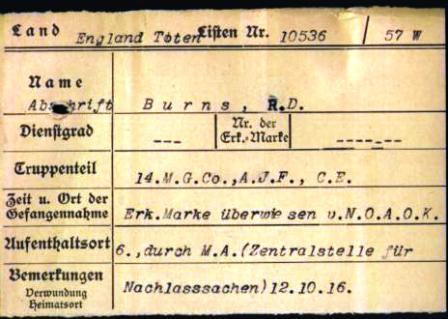
Lambis emphasised that they may be missing but they are not unknown. Names such as Private Ross, Corporal Murray, Lance Corporal Bennett, Sergeant Hill, C.Q. Sergeant Ralston, Lieutenant Burns … the list continues ,…. a full list of the names can be seen on internet at Fromelles Descendants.

Tim Whitford and Lambis told the audience of their feelings on seeing the soldiers’ remains and how this has shaped their views as to what should happen next. Tim elaborated on the graphic descriptions that were included in the contributed article in the Sydney Morning Herald and featured in the RECENT NEWS item Dignity for Diggers.

Tim and Lambis indicated that all of those involved in the archaeological dig, while being highly professional,  were deeply moved by the nature of remains, and an number of distinguished visitors to the site were also very moved by the experience.

Photo: Mrs Janet Howard, Patrick Lindsay and John Howard, Pheasant Wood, June 2008.

One of those who visited the site of the arecheaological dig and were permitted to view the pits was former Australian Prime Minister, John Howard and his wife Janet.  Mr Howard had previously indicated his view in regard to the possible existence of war graves containing the remains of Australian soldiers killed in France during the Battle of Fromelles, when as Prime Minister, in September 2003 he wrote to the Premier of New South Wales, Mr Bob Carr, advising that “I strongly agree, that if the reports can be substantiated and a mass grave containing the remains of Australians does exist, every effort must be made to identify and appropriately honour these soldiers.”

Photo: Major-General Mike O’Brien accompanied Mr & Mrs Howard to view the pits uncovered during the excavation at Pheasant Wood.

Mr Howard had been invited to attend the John Laffin Memorial Lecture but was unable to attend and sent his apologies in the following letter to FFFAIF President, Russell Curley, that was read to the audience:

Dear Mr Curley,
Thank you for your kind invitation to attend the John Laffin Memorial Lecture Day. Unfortunately, I will not be able to attend but I do want to send my good wishes for a successful function.

I note that Lambis Englezos, that wonderful man, who worked so hard to discover “the missing diggers” and who I had the privilege of meeting at Pheasant Wood recently, will address the meeting. Please convey my warm regards to him.

Lambis is an admirable Australian. His persistence has produced a most remarkable discovery. I can testify to that. It was a very moving experience to view, what my wife and I did, on our visit to Fromelles a few weeks ago. ………………………………………

I admire what you have done as a group to keep alive our recognition of the amazing contribution Australia’s 350,000 odd volunteers made to the Great War.

Warm regards.
Yours sincerely
John Howard

Between presentation sessions, Families and Friends of the First AIF President Russell Curley made the following joint media release with Recovering Overseas Australia’s Missing Inc (ROAM – Chris Bryett, President [FFFAIF member]) statement during the media conference held at the Memorial outside the Ashfield RSL.  Accompanying Russell and Chris were:   Neville Kidd (author of An impression that will never fade, the biography of Major Roy Harrison, Ross St.Claire, Professor Richard Wright (mass graves archaeologist), Lambis Englezos, John Fielding and Tim Whitford.

1. Allowing the fallen of the Battle of Fromelles to rest with dignity:
We believe that every Australian soldier who gives his or her life for our country deserves every possible chance to be identified before receiving a decent and honourable burial by Australians in an individual grave beneath an individual headstone in a cemetery.
We will campaign for and support any and all efforts to have the diggers at Pheasant Wood exhumed, separated, identified and reburied individually with an individual headstone bearing his name or as an Australian Soldier of the Great War, Known unto God.
What we as a Nation did for the Zonnebeke diggers last year must be done for these 50 or so diggers exposed by the recent excavation at Fromelles.

2. Inscription of ‘Fromelles’ on national and state memorials:
We believe that appropriate and prominent recognition must be given to ‘Fromelles’ on or at the national and state memorials in Australia. Fromelles deserves primacy on any list of world war one western front battles.
We will campaign for and support any and all efforts to have the sacrifices of those brave young diggers who fought at Fromelles, properly and permanently recognised on the nation’s primary memorials.
“Fromelles” appears on our memorials in France and England. The sacrifices of so many gallant young Australians should not be discounted and ignored here any longer!

The debt we owe them is not diminished by the passage of time.
Lest we forget.

Read the report in The Australian by clicking here

FFFAIF Policy Statement:

The Families and Friends of the First AIF believes that the Australian Government through the Minister for Veterans’ Affairs should commit the to re-burial of the “missing of Fromelles” with individual graves and headstones in a new Commonwealth War Graves Commission Cemetery at Pheasant Wood after DNA testing.

FROMELLES IS NOT HONOURED ON THE NATIONAL OR ANY STATE MEMORIAL IN AUSTRALIA.

FFFAIF SUPPORTS ALL EFFORTS TO RECOGNISE FROMELLES ON OR AT THE NATIONAL AND ALL STATE MEMORIALS THAT PRESENTLY LIST BATTLES BY NAME.

Call back tomorrow for MORE UPDATES

Posted in Books, John Laffin Memorial Lecture, Top Posts | Comments Off on Our Gift to The Empire

Dignity for Diggers 2

Yesterday’s, John Laffin Memorial Lecture, held annually on or near the anniversary of the Battle of Hamel – 4 July 1918, held at Ashfield RSL, Sydney, focused on the 90th anniversary of the Battle of Mount St Quentin and the recent archeological excavations for the missing diggers from the Battle of Fromelles.


Photo: Archaeologists begin work at Pheasant Wood

Around seventy Families and Friends of the First AIF members and their guests heard speakers Ross St Claire, Chris Bryett, Lambis Englezos and Tim Whitford, and a press conference was held along with a popular ‘show & tell’ session. Details will be featured on the website in the near future.

Tim Whitford described his experiences in seeing the pits at Pheasant Wood and elaborated on his thought provoking article published in Saturday’s Sydney Morning Herald.  Readers are encouraged to provide feedback to the SMH by email to readerlink@smh.com.au or Fax 92823253 or Phone 92821569

Give the Fromelles diggers their dignity

I am the great nephew of Private Harry Willis. I grew up with stories about him. He was a good-looking boy, under-aged when he enlisted. He was killed in his first battle, disappearing forever. Well, not forever.

Photo: Private Harry Willis [Tim Whitford]

Now we know where Harry is. Thanks to the amazing detective work of an amateur historian from Melbourne, and a whole lot of dedication from historians, soldiers, archaeologists, defence civilians and politicians, a dig has confirmed Harry is buried in one of eight unmarked pits in the shadow of Pheasant Wood at Fromelles.

Photo: Pheasant Wood ‘Dig’, May 2008.

Harry has been there ever since the Germans tossed in his body and covered it with clay after he was killed in battle in July 1916. His mother never knew that, nor did his brothers or sisters, nor his nephews or nieces down through the generations. He has never been forgotten. But there’s a big chance that Harry might remain anonymous and missing, through a lack of imagination and uninformed sentiment.

There are those who have called for the Fromelles diggers to be “left in peace with their mates”. All I can say to those who are calling for anything less than a complete exhumation, processing and reburial on-site is that, if they had seen what I saw during the dig, I know they would change their minds.

Let me illustrate it for you. It’s not a pretty picture. In pit numbers one, two and three, the soldiers have been laid out in rows, similar to sardines in a can. There appear to be multiple layers of our men in each of these pits and they might have been buried with some care.

Photo: Germans burying allied soldiers in pit. (Vimy 1917)

(www.stahlgewitter.com

Now let’s go to pits four and five. Our men have been thrown in like yesterday’s rubbish. There’s a digger slumped in a sitting position with his handless arms raised above his head. Another is in a semi-foetal position with a man tossed over his chest. One man has the remnants of the telephone wire the German troops used to drag him into the pit still wrapped around his limbs. Another still wears the tourniquet some friend attached in a vain attempt to save his life. In pits four and five there are no neat rows, no order, and no dignity in death for the diggers. They are a sight of abject horror and it would be nothing less than a travesty to leave these fine men like that.

Many of the injuries sustained by these men are distinct and will, in many cases, have been recorded in the Red Cross Wounded and Missing Enquiry Bureau files by their friends. This information can be of great assistance in identification. Without professing to be a qualified archaeologist or forensic scientist, I can confidently say that the remains are in excellent condition. Each man is readily discernible having been locked in place by the glutinous and oxygen-free blue Flanders clay. Each set of remains is frozen in the final pose in which the man was thrown into the pit and tells its own very moving story.

Copious amounts of chloride of lime is evident in all the pits. After speaking with members of the archaeological team at the site, I was informed that many of the preconceptions about lime being destructive to human tissue and bone are totally false and, in fact, in some cases lime may assist preservation.

The German troops who buried our boys at Pheasant Wood recorded their names and sent their identity discs back to the families in Australia through the Red Cross. They may have thrown many of our lads in holes like rotting silage but they had the decency to tell us they had done it and whom they’d done it to. I don’t blame them. They had an abhorrent job to do. Many of the diggers had been in the sun for days and were well on the way to putrefaction. I was a soldier once and couldn’t think of a more unpleasant job, especially considering that they also had to care for their own dead and wounded.

Photo: German ‘death voucher’

As a result of the Bavarian regiment’s very efficient paperwork, we know who these men are. These men aren’t in a sunken ship kilometres below the ocean surface impossible to get to; they are just a metre under the ground in a friendly country. They are close enough to reach out and touch.

Leaving these men in this horrific way is just plain wrong. I understand the wonderful sentiment of some descendants and the national executive of the RSL to say “leave these men with their mates in peace” but it’s uninformed sentiment. There is no peace and certainly no dignity in leaving heroes the way they’ve been discarded. The last person to handle the Fromelles diggers shouldn’t be a German if we have the ability for it to be an Australian.

By simply covering them and placing a memorial on the site, we will deny our diggers any chance of regaining their identity and individuality. We may not be able to give all of them their names back but we can bloody well try. I agree wholeheartedly that they should remain at Pheasant Wood in the long term. It’s a beautiful location, inexorably linked to them, and they will be in the care of a village that knows their sacrifice and loves them.

They should finish their journey with their mates who fought and died with them, but they should not remain there without being granted the basic right of an attempt at individual identification, a soldier’s funeral, and an individual grave. Every other Australian soldier found since the end of World War I has been afforded these basics, why change now? Is it because more years have elapsed? Is it the money? I’d hate to think our war dead were inconvenient.

Photo: 31st Battalion Headstones at Rue Petillon Cemetery with Alexandra and Elizabeth Whitford [Tim Whitford]

Take the opportunity to express your opinion – readers are encouraged to provide feedback to the SMH by email to readerlink@smh.com.au or Fax 92823253or Phone 92821569


FFFAIF Policy Statement:

The Families and Friends of the First AIF believes that the Australian Government through the Minister for Veterans’ Affairs should commit the to re-burial of the “missing of Fromelles” with individual graves and headstones in a new Commonwealth War Graves Commission Cemetery at Pheasant Wood after DNA testing.

FROMELLES IS NOT HONOURED ON THE NATIONAL OR ANY STATE MEMORIAL IN AUSTRALIA.

FFFAIF SUPPORTS ALL EFFORTS TO RECOGNISE FROMELLES ON OR AT THE NATIONAL AND ALL STATE MEMORIALS THAT PRESENTLY LIST BATTLES BY NAME.

Call back tomorrow for MORE UPDATES

Posted in Diggers of First AIF, Top Posts | Comments Off on Dignity for Diggers 2

Dignity for Diggers

The John Laffin Memorial Lecture, held annually on or near the anniversary of the Battle of Hamel – 4 July 1918, is being held today at Ashfield RSL, Sydney.

This year the lecture will focus on the 90th anniversary of the Battle of Mount St Quentin and the recent archeological excavations for the missing diggers from the Battle of Fromelles.

One of those participating in the presentation will be Families and Friends of The First AIF member Tim Whitford , who has recently returned from Fromelles, and has contributed the following article published in yesterday’s Sydney Morning Herald.

Give the Fromelles diggers their dignity

I am the great nephew of Private Harry Willis. I grew up with stories about him. He was a good-looking boy, under-aged when he enlisted. He was killed in his first battle, disappearing forever. Well, not forever.

Photo: Private Harry Willis [Tim Whitford]

Now we know where Harry is. Thanks to the amazing detective work of an amateur historian from Melbourne, and a whole lot of dedication from historians, soldiers, archaeologists, defence civilians and politicians, a dig has confirmed Harry is buried in one of eight unmarked pits in the shadow of Pheasant Wood at Fromelles.

Photo: Pheasant Wood ‘Dig’, May 2008.

Harry has been there ever since the Germans tossed in his body and covered it with clay after he was killed in battle in July 1916. His mother never knew that, nor did his brothers or sisters, nor his nephews or nieces down through the generations. He has never been forgotten. But there’s a big chance that Harry might remain anonymous and missing, through a lack of imagination and uninformed sentiment.

There are those who have called for the Fromelles diggers to be “left in peace with their mates”. All I can say to those who are calling for anything less than a complete exhumation, processing and reburial on-site is that, if they had seen what I saw during the dig, I know they would change their minds.

Let me illustrate it for you. It’s not a pretty picture. In pit numbers one, two and three, the soldiers have been laid out in rows, similar to sardines in a can. There appear to be multiple layers of our men in each of these pits and they might have been buried with some care.

Photo: Germans burying allied soldiers in pit. (Vimy 1917)

(www.stahlgewitter.com

Now let’s go to pits four and five. Our men have been thrown in like yesterday’s rubbish. There’s a digger slumped in a sitting position with his handless arms raised above his head. Another is in a semi-foetal position with a man tossed over his chest. One man has the remnants of the telephone wire the German troops used to drag him into the pit still wrapped around his limbs. Another still wears the tourniquet some friend attached in a vain attempt to save his life. In pits four and five there are no neat rows, no order, and no dignity in death for the diggers. They are a sight of abject horror and it would be nothing less than a travesty to leave these fine men like that.

Many of the injuries sustained by these men are distinct and will, in many cases, have been recorded in the Red Cross Wounded and Missing Enquiry Bureau files by their friends. This information can be of great assistance in identification. Without professing to be a qualified archaeologist or forensic scientist, I can confidently say that the remains are in excellent condition. Each man is readily discernible having been locked in place by the glutinous and oxygen-free blue Flanders clay. Each set of remains is frozen in the final pose in which the man was thrown into the pit and tells its own very moving story.

Copious amounts of chloride of lime is evident in all the pits. After speaking with members of the archaeological team at the site, I was informed that many of the preconceptions about lime being destructive to human tissue and bone are totally false and, in fact, in some cases lime may assist preservation.

The German troops who buried our boys at Pheasant Wood recorded their names and sent their identity discs back to the families in Australia through the Red Cross. They may have thrown many of our lads in holes like rotting silage but they had the decency to tell us they had done it and whom they’d done it to. I don’t blame them. They had an abhorrent job to do. Many of the diggers had been in the sun for days and were well on the way to putrefaction. I was a soldier once and couldn’t think of a more unpleasant job, especially considering that they also had to care for their own dead and wounded.

Photo: German ‘death voucher’

As a result of the Bavarian regiment’s very efficient paperwork, we know who these men are. These men aren’t in a sunken ship kilometres below the ocean surface impossible to get to; they are just a metre under the ground in a friendly country. They are close enough to reach out and touch.

Leaving these men in this horrific way is just plain wrong. I understand the wonderful sentiment of some descendants and the national executive of the RSL to say “leave these men with their mates in peace” but it’s uninformed sentiment. There is no peace and certainly no dignity in leaving heroes the way they’ve been discarded. The last person to handle the Fromelles diggers shouldn’t be a German if we have the ability for it to be an Australian.

By simply covering them and placing a memorial on the site, we will deny our diggers any chance of regaining their identity and individuality. We may not be able to give all of them their names back but we can bloody well try. I agree wholeheartedly that they should remain at Pheasant Wood in the long term. It’s a beautiful location, inexorably linked to them, and they will be in the care of a village that knows their sacrifice and loves them.

They should finish their journey with their mates who fought and died with them, but they should not remain there without being granted the basic right of an attempt at individual identification, a soldier’s funeral, and an individual grave. Every other Australian soldier found since the end of World War I has been afforded these basics, why change now? Is it because more years have elapsed? Is it the money? I’d hate to think our war dead were inconvenient.

Photo: 31st Battalion Headstones at Rue Petillon Cemetery with Alexandra and Elizabeth Whitford [Tim Whitford]

FFFAIF Policy Statement

The Families and Friends of the First AIF believes that the Australian Government through the Minister for Veterans’ Affairs should commit the to re-burial of the “missing of Fromelles” with individual graves and headstones in a new Commonwealth War Graves Commission Cemetery at Pheasant Wood after DNA testing.

FROMELLES IS NOT HONOURED ON THE NATIONAL OR ANY STATE MEMORIAL IN AUSTRALIA.

FFFAIF SUPPORTS ALL EFFORTS TO RECOGNISE FROMELLES ON OR AT THE NATIONAL AND ALL STATE MEMORIALS THAT PRESENTLY LIST BATTLES BY NAME.

Call back tomorrow for MORE UPDATES

Posted in Diggers of First AIF, Top Posts | Comments Off on Dignity for Diggers

An Anzac I Never Knew

The 14th Brigade of the 5th Australian Division formed the centre of the attack, in the Battle of Fromelles on 19 July. The Australian units were (from left flank to right):
8th Brigade: 32nd (WA) and 31st (Qld, Vic) assaulting with 29th (Vic) and 30th (NSW) in reserve.
14th Brigade (NSW): 53rd and 54th assaulting with 55th and 56th in reserve.
15th Brigade (Vic): 59th and 60th assaulting with 57th and 58th in reserve.

The 54th Battalion was raised in Egypt as part of the ‘doubling’ of the AIF after the Australian troops had returned to Egypt following the Gallipoli campaign. Half of the men were 2nd Battalion Gallipoli veterans and the other half newly arrived reinforcements from Australia. The 54th Battalion consisted mainly of men from New South Wales.

The early part of the battalion’s history is described on the Australian War Memorial website as: Moving to France in June 1916, the 54th fought its first major battle on the Western Front at Fromelles, on 19 July. It was a disaster. The 54th was part of the initial assault and suffered casualties equivalent to 65 per cent of its fighting strength. Casualty rates among the rest of the 5th Division were similarly high, but despite these losses it continued to man the front in the Fromelles sector for a further two months.

Photo: Fallen soldiers at Fromelles July 1916
(www.stahlgewitter.com)

The Australian casualties from the Battle of Fromelles were 5,533 men. The 54th Battalion accounted for 540 of those casualties with 155 soldiers paying the supreme sacrifice; including the 30 listed amongst the ‘missing’ at Pheasant Wood Fromelles.

Photo: Pheasant Wood shrouded in mist during May 2008 archaeological dig.

Major Roy Harrison, an original ANZAC, led the first wave of the 54th Battalion over the top at precisely 5:50pm – he was to be dead within 2 hours of the commencement of the battle.

Families and Friends of the First AIF member Neville Kidd first introduced many of us to Major Roy Harrison in his article An Anzac I Never Knew which appeared the DIGGER Magazine in August 2003. Neville’s book An Impression Which Will Never Fade charts the course of Harrison’s enlistment in the AIF and his service with the 2nd and 54th Battalions.

Photo: Roy Harrison

Neville’s article in DIGGER Issue 3 begins by setting the scene:

Members of FFFAIF Inc are encouraged to nominate the servicemen and women of the Great War 1914-1918 whose memory they specially revere as relatives or friends. In my case I listed my father, 3 uncles, 2 friends and last but by no means least, an Anzac I never knew. It is of course not necessary to know or name any particular Veteran to be able to join, assist in perpetuating the memory of those who offered their young lives for us so long ago, and support the objectives of FFFAIF.
My ‘unknown’ Anzac was Roy Harrison, born Yass NSW 1889, educated Goulburn District School, Government Savings Bank clerk 1908-1914, served Citizens’ Military Forces with The NSW Scottish Rifle Regiment 1908-1913 and 21st Woollahra Infantry Regiment 1913-1914 rising to the rank of Lieutenant. He enlisted in the AIF on 17th August 1914 and dropped rank to Second Lieutenant to join 2nd Australian Infantry Battalion when it was raised.

Second Lieutenant Harrison embarked at Sydney aboard HMAT Suffolk to join the First Convoy of the AIF departing Albany WA bound for overseas service.

After training at Mena Camp, Egypt, he saw service in the Canal Zone. By 9th April 1915 he had been promoted to Lieutenant and was at Lemnos preparing for the Gallipoli Campaign.
On 25th April 1915, he landed at Gallipoli and was the only officer of the 2nd Bn to stay for the whole of that battalion’s campaign on Gallipoli. From 9th May 1915 to 9th December 1915 he was Adjutant of the 2nd Bn, and the unit War Diary for that period is in his handwriting.  Harrison gets an honourable mention by name in actions on Gallipoli and in France in Bean’s Official History of the AIF in the Great War.
Following the Evacuation from Gallipoli on 20th December 1915, he reached Egypt on 27th December and shortly afterwards was promoted from Captain to Major.
When, in February 1916, the 1st Australian Division was split in half to provide a nucleus of seasoned troops for the 5th Australian Division then being raised, Roy was transferred as Senior Major to the 54th Bn of the 14th Bde.  On 20th June 1916 on ‘HMT Caledonia’ the Bn sailed for France from Alexandria via Malta and entrained at Marseilles for Northern France and the Western Front.
On the night of 19/20th July the 5th Australian Division and the 61st British Division assaulted German positions at Fromelles. This was the first action by an Australian division as a division on the Western Front and is probably the least known of all the major battles fought by the 1st AIF.  Major Harrison led the first attacking wave of the 54th Bn and although initially reported missing and wounded, he was later found to have been killed in action. He was one of 5,533 Australian casualties that night, almost all fell within 15 HOURS. …….

Roy wrote regularly to his fiancée Emily Ellis (1890-1977) and she transcribed all matters touching upon his service at the war. These transcriptions were given to me by the Ellis family in 1987 and I became aware of this remarkable young soldier. The letters and the Battalion War Diary, which he wrote, constitute a unique record of the distinguished service of an Original Anzac. …….

LETTER – France – 15.7.1916. [Roy’s last to Emily] … we are going in to capture a German position. By the time this reaches you, the result will be known to you through the paper, so, failing any bad news, you may take it that all is well… It is no use worrying as I am quite satisfied that what is to be, will be, and nothing can alter it for good or evil… The men don’t know yet what is before them, but some suspect that there is something in the wind. It is a most pitiful thing to see them all, going about, happy and ignorant of the fact, that a matter of hours will see many of them dead; but as the French say ‘C’est la guerre’.

Roy had never written to Emily like that before, despite his engagement in many desperately dangerous actions on Gallipoli. 

Major Harrison’s was reported as ‘Missing in action’ on 19th/20th July during the Battle of Fromelles, and after a Court of Enquiry was held in December 1916, was recorded as ‘Killed in Action’ on 20th July 1916. Major Harrison’s body was not recovered from the battlefield until 1921 when the remains of an Officer were exhumed by the Imperial War Graves Commission from a field in France. Still within the pocket of the Officer’s uniform was a silver cigarette case bearing the inscription:

To Lieut. Harrison
from
Jeff & Sum
16/9/14

Major Harrison was re-buried at Rue Petillon Military Cemetery near Fleurbaix .  Sixty nine years later Neville Kidd had the opportunity to visit the final resting place of Roy.

Insert photo : Major Harrison’s grave

In 1990, my wife Win and I were accompanied on a six day tour of the Western Front battlefields by our guide, philosopher and friend, John Laffin and his wife Hazelle. I recorded our visit to Roy’s grave in these words:  “Prior to entering Rue Petillon Cemetery, I had undergone at earlier war cemeteries we had visited, singularly unusual impressions and stirrings of emotions, but here as I approached the resting place of my hero, I experienced vibrations and feelings of considerable intensity. I do not know how long I half knelt before his headstone, and later after visiting *Maxted’s grave, how long I knelt at the base of the War Stone and stared in silent prayer at the Great Cross of Sacrifice. I actually dissolved and lost all physical notion of space and time.  At rare times in my life I have had a much milder version of this type of sensation, but nothing so intense and, as I gathered from John Laffin later, nothing so sustained. As we were leaving Rue Petillon Cemetery I apologised to him for having tarried and he said, “I know exactly where you have been – there is no need for any apology.  The AIF on the Western Front have this effect on many of us.”  He meant it, and I knew I was in good company, living and dead.”
[* Chaplain, the Rev Spencer Edward Maxted, attached to 54th Inf Bn, KIA 19th July 1916 at Fromelles – Roy Harrison’s Padre and friend – also buried at Rue Petillon Cemetery.] 

Somehow I hope that I have here conveyed to the readers of ‘Digger’ some idea of what the Anzacs mean to me and of the debt that we all owe to that extraordinary generation of Australians born in the last quarter of the 19th Century who uncomplainingly gave their youth and their young lives so that we may enjoy the freedoms and the way of life we take for granted and as our right. I am so grateful that the benefit of their sacrifice has endured and that the Anzac Tradition has since been maintained in WW2, Malaya, Korea, Vietnam, The Gulf, East Timor, Iraq and nameless other places where our Defence Forces have been involved. Our children, grandchildren and their heirs will continue to owe this debt.

I am grateful too, to all of you special people who have held high the torch thrown by John Laffin as he departed into the Eternal Light, by making his dream of FFFAIF a reality and for establishing the Memorial Fund which bears his name and will keep his name and his aspirations for Digger Heritage alive in the hearts and minds of young Australians; for they are ‘the hope of the side’.

Lest we forget!


Insert photo: Neville, John Laffin & Martial 

Neville Kidd has been a long time campaigner for the recognition of The Battle of Fromelles and has continued to remind us that: 

‘Sadly and shamefully the sacrifice at FROMELLES is not honoured on The Anzac Memorial in Hyde Park, Sydney. Lest we forget!’

Meticulous ‘detective’ work by the Imperial War Graves Commission led to Major Harrison’s remains being identified – after he had been unceremoniously buried during the Battle of Fromelles. Major Harrison’s family was notified of the finding of his body and subsequent re-burial at Rue Petillon Cemetery. Major Harrison’s service record, available on line at the National Archives of Australia shows that his family received a copy of the booklet Where Australians Rest in 1921 and nine years later, in 1930, a copy of the Cemetery Register for Rue Petillon.

Photo: Rue Petillon Cemetery

One hundred and seventy three of Major Harrison’s fellow members of the AIF, who paid the supreme sacrifice 92 years ago at the Battle of Fromelles, and whose bodies have now been found deserve similar treatment. These men should also be given an individual final resting place and every effort should be made to identify them.  These Diggers are known – we have their names, many of their descendants have come forward – a dignified re-burial with an individual headstone is an appropriate recognition of their supreme sacrifice.

FFFAIF Policy Statement

The Families and Friends of the First AIF believes that the Australian Government through the Minister for Veterans’ Affairs should commit the to re-burial of the “missing of Fromelles” with individual graves and headstones in a new Commonwealth War Graves Commission Cemetery at Pheasant Wood after DNA testing.

FROMELLES IS NOT HONOURED ON THE NATIONAL OR ANY STATE MEMORIAL IN AUSTRALIA.

FFFAIF SUPPORTS ALL EFFORTS TO RECOGNISE FROMELLES ON OR AT THE NATIONAL AND ALL STATE MEMORIALS THAT PRESENTLY LIST BATTLES BY NAME.

Call back tomorrow for MORE UPDATES

Posted in Diggers of First AIF, Top Posts | Comments Off on An Anzac I Never Knew