Seeking Harry Bell

The Battle of Fromelles was fought on the evening of the 19th July 1916 when the German front line was attacked after a seven hour artillery bombardment. The bombardment had been ineffective against the strong defences of the German line and only served to destroy any element of surprise for the attacking allied forces. The 5th Australian Division and 61st British Divisions went over the top at 5:43 p.m. on a summer’s evening into heavily fortified territory.

The AIF suffered 5,533 casualties in the Battle of Fromelles with 1,917 Australian volunteer soldiers paying the supreme sacrifice while defending the Empire. The British suffered 1,547 casualties and the German’s just over 1,000 casualties. The ‘missing’ at Fromelles, until recently, have been recorded as having no known graves. The recent archaeological dig at Pheasant Wood near Fromelles has revealed the pits were British and Australian dead from the battle were interred by the German army. As the battlefield was cleared of bodies the details of these men were meticulously recorded on ‘death vouchers’ before being put into the
pits.

Photo: British and Australian soldiers bodies taken from the Fromelles battlefield prior to burial 20 July 1916
(www.stahlgewitter.com)

Four hundred and ninety six Australian were taken prisoner during the battle, 38 of whom died as a result of their wounds. The remaining prisoners were marched back to the town of Lille where they were paraded through the streets before being taken to POW camps. The International Red Cross Bureau worked throughout the Great War liaising between the British and German Army as well as supplying food parcels and delivering mail.

Photo: Present day view from the Sugar Loaf Salient towards British lines. [Warren Baker]

The Australian Red Cross office in Melbourne received the first of many letters from the Bell family seeking information about Private Henry Bell (191) dated 17 September 1916. In this letter written from his brother, John Bell, it states his wife and all of us are exceedingly anxious concerning him. Though we hope & pray for the best.

Photo: Private Henry Bell [AWM DA09996]
This photo has been reproduced with the permission of the
Australian War Memorial

Mrs Dorothy Bell had previously received an official cable, dated 21 August, notifying her that her husband was reported ‘Missing in Action’.  John Bell’s letter also states that they hope Private Bell is amongst the prisoners taken during the battle:
We know only what the Def. Dpt told us that he was missing on 19th-20th July. I understand the Dpt thinks that many of the missing men are prisoners of war. Is there any way in which we could find out?

Private Bell had been a member of the 29th Battalion during the ill-fated Battle of Fromelles on 19 July 1916. 

Henry Bell was a 39 year old insurance agent when he enlisted in the AIF on 8th July 1915 at Bendigo, in country Victoria. Henry Bell was a prominent member of the Bendigo community having been the Secretary of the Bendigo Rose Society and a member of the organising committee for the Bendigo Egg Laying Competitions. Henry & Dorothy Bell were married shortly before his enlistment and embarkation aboard HMAT Ascanius from Melbourne in November 1915.

The Australian War Memorial website notes: The 29th Battalion was raised as part of the 8th Brigade at Broadmeadows Camp in Victoria on 10 August 1915. Having enlisted as part of the recruitment drive that followed the landing at Gallipoli, and having seen the casualty lists, these were men who had offered themselves in full knowledge of their potential fate.
The 29th, 30th, 31st & 32nd Battalions formed the 8th Brigade which was part of the newly raised 5th Division of the AIF in training camp in Egypt.
The 29th Battalion fought its first major battle at Fromelles on 19 July 1916. The nature of this battle was summed up by one 29th soldier: “the novelty of being a soldier wore off in about five seconds…it was like a bloody butcher’s shop.” Although it still spent periods in the front line, the 29th played no major offensive role for the rest of the year.

Mrs Dorothy Bell remained hopeful that her husband was a prisoner of war and began a written campaign to try and contact ‘Harry’. She first wrote to Vera Deakin, daughter of former Australian Prime Minister Alfred Deakin, who headed the Australian Branch of the Wounded and Missing Enquiry Bureau in London.

Photo: Vera Deakin [AWM P02119.001]
This photo has been reproduced with the permission of the
Australian War Memorial

Four letters to Miss Deakin appear in Private Bell’s Red Cross Wounded and Missing Enquiry Bureau Files . The first, dated in November, and the following three, although undated, appear to be written by the end of 1916.

“Mossley”
1208 Dana St
Ballarat
Victoria
15-10-16

Miss Deakin
Dear Madam
Hearing that you are interesting yourself for the missing soldiers I am writing to know if you could possibly get any news of my husband No191 Private Harry Bell A Company 29th Battalion 8th Inf. Brigade A.I.F. reported missing since the 19-20 of July in France. I had a letter from the Chaplain of his Brigade, saying he went into the Germen trenches & that he thought he was a prisoner of war but we have had nothing definite. When hearing of you I thought perhaps you could help us for which we would be very thankful if you could.
Gratefully yours
Dorothy I. Bell

The second letter indicated that Dorothy and Harry’s family were still hopeful of good news.

“Mossley”
1208 Dana St
Ballarat
Victoria

Miss Deakin
Dear Madam
Some time ago I wrote you asking if you could find any trace of my husband (No191 Private Harry Bell A Company 29th Battalion 8th Inf. Brigade missing since July 19-20 1916) I am enclosing a letter for him, in case you do hear something as it takes such a long time for a letter to go from here. I thought if you had one, you could send it to him as soon as you got word. Hoping and trusting you will be able to help me.
I am your truly
Dorothy I. Bell
My husband is a brother of Mrs Oliphant. Bendigo. Mrs Oliphant is also writing you about him.

Dorothy wrote twice more to Miss Deakin, each time enclosing a letter for her husband. By the last of these letters she is sounding increasingly troubled and dismayed. She says
I hope I am not troubling you too much but I feel I must do something. Hoping you will be able to help me.

At the same time Mrs Bell also wrote to the Australian Red Cross in Melbourne on five different occasions, with similar requests and enclosing five more letters to be forwarded to her husband when news is received of his whereabouts. Sadly her efforts were not rewarded as she received the following letter, dated 12th December 1916.

Dear Mrs Bell,
In reply to yours of the 29th. Inst., I extremely regret to inform you that your husband’s name appears on the German death list which means that they have procured some of his belongings, including his identity disc indicating that he was killed on their side of the trenches, which leaves, I regret to say, very little hope that he is a prisoner.
Please accept my heartfelt sympathy in your sad bereavement and while I know too well at the present time the loss of your husband seems irreconcible with everything, yet in the near future knowledge that he died fighting bravely for the Empire will be some compensation to you in your great loss.
Yours very sincerely
Commissioner

On 26th March 1917 the official entry was made in Private Bell’s Service record, which is available on line at the National Archives of Australia, stating that he was ‘Killed in Action’ 19th July 1916. His name had been recorded on ‘German Death Vouchers’ completed by the German army as they buried the allied soldiers removed from their trenches after the battle.

The Red Cross Wounded and Missing Enquiry Bureau Files provided not only evidence for Lambis Englezos when researching the names of the missing from the Battle of Fromelles, but also give an insight into the circumstances surrounding the death of Henry Bell. Information recorded from fellow members of the 29th Battalion reveal that Private Bell died in the German trenches, held for a short time by the Battalion.
Private H.F. Downer (223) stated:
I saw casualty killed in the second line of German trenches at Fleurbaix on the 20th July. Casualty was in the trench which we just occupied when he was destroyed by H.E. shell. The body was not buried.
Private O’Shannassy (317) stated: I saw him killed by a shell ….in German trench at Fromellles as we were coming back to first line.

Mrs Dorothy Bell acted promptly in writing to The Officer in Charge, Base Records Office, Melbourne, requesting her husband’s personal belongings be forwarded to her as soon as possible. The only thing that appears to have been returned to his widow was his identity disc.

Should the heartfelt letters of widow Bell be left unanswered, even after 92 years? Should the family of Private Henry Bell and his fallen comrades be given the opportunity to have their soldier heroes finally laid to rest with dignity?

Photo: Ration Farm Cemetery [Tim Whitford]

FFFAIF Policy Statement

The Families and Friends of the First AIF believes that the Australian Government through the Minister for Veterans’ Affairs should commit the to re-burial of the “missing of Fromelles” with individual graves and headstones in a new Commonwealth War Graves Commission Cemetery at Pheasant Wood after DNA testing.

FROMELLES IS NOT HONOURED ON THE NATIONAL OR ANY STATE MEMORIAL IN AUSTRALIA.

FFFAIF SUPPORTS ALL EFFORTS TO RECOGNISE FROMELLES ON OR AT THE NATIONAL AND ALL STATE MEMORIALS THAT PRESENTLY LIST BATTLES BY NAME.

Call back tomorrow for MORE UPDATES

Posted in Diggers of First AIF, Top Posts | Comments Off on Seeking Harry Bell

Equal in Death

The disposition of the 5th Australian Division and 61st Division units involved in the attack at Fromelles of 19 July 1916 had the 5th Australian Division’s 8th Brigade on the left flank, the 14th Brigade (NSW) in the centre and 15th Brigade (Vic) on the Australian right and adjoining the 61st Division’s 184th Brigade opposite the Sugar Loaf, the 183rd Brigade in the centre and 182nd Brigade on the right flank.  Each Brigade had two Battalions assigned as the assaulting units and two in reserve.  Each Brigade also had its Brigade units, including Field Companies, Machine Gun Companies and Trench Mortar Batteries and was supported by Divisional artillery.


Map showing the Division, Brigade and Battalion dispositions at the commencement of the Battle of Fromelles. Source: Fromelles, Patrick Lindsay.

The 5th Australian Division Battalions involved in the attack were (from north to south):
8th Brigade:
Assaulting battalions 32nd (WA) and 31st (Qld, Vic);
Reserve battalions: 29th (Vic) and 30th (NSW)
14th Brigade (NSW):
Assaulting battalions 53rd and 54th
Reserve battalions: 56th and 55th
15th Brigade (Vic):
Assaulting battalions 59th and 60th
Reserve battalions: 57th and 58th

Photo: The body of an Australian soldier killed in the German 2nd line [AWM1566]

This photo has been reproduced with the permission of the Australian War Memorial

Photo: Pheasant Wood prior to archaeological dig. April 2008

Introducing: Lieutenant Robert David Burns

The Burns Family had a strong connection with the New South Wales Lancers, which later became the 1st Australian Light Horse Brigade, and was commanded by Colonel (the Honourable Sir) James Burns from July 1903 to January 1907. Sir James had three sons who enlisted in the AIF.

Robert David Burns was born at Potts Point Sydney New South Wales in 1888.  Robert was the youngest of three sons of Sir James and Lady Mary Burns of Gowan Brae, Parramatta.  

Lieutenant Robert Burn enlisted at Holsworthy NSW in May 1915. His first commission was with the 4th Light Horse Brigade. Once in Egypt, Lieutenant Burns transferred to the 6th Light Horse Regiment with whom he served for a short time on Gallipoli in the closing stages of the campaign.

 Photo: Lieutenant Robert Burns standing to the right with fellow officers of the 6th Australian Light Horse outside a dugout at Gallipoli. [AWM P01309.013]

This photo have been reproduced with the permission of the Australian War Memorial

On returning to Egypt he was transferred to the 4th Battalion AIF.  He was a member of this battalion for less than a month before being transferred to the newly formed 56th Battalion on 16th February 1916. During February, after undergoing training Lieutenant Burns transferred to the 14th Australian Machine Gun Company attached to the 5th Division. On the 19th June, Lieutenant Burns embarked at Alexandria bound for France and disembarked at Marseilles. The soldiers of the 14th Australian Machine Gun Company then entrained for the northern battlefields and deployment at the Battle of Fromelles.

The next entry in Burn’s Service Record, available on line at the National Archives of Australia, was made on 20th July 1916 when he was reported missing ‘in the field’. Although only reported as missing, Lieutenant Burns’ personal effects were returned to his father who was staying at The Hermitage, Residential Hotel, Maidenhead Bridge, Taplow, England in November 1916. Robert’s father Sir James Burns, head of Burns Philp and Company, personally, and through his company agents in London, made many inquiries through the Red Cross to try to reveal his son’s fate. The family was officially notified of Lieutenant Robert Burns’ fate – Killed In Action – in March 1917, along with the return of his identity disc. Due to the prominence of the Burns Family in Australia, the Australian Governor General was also notified.

Evidence of Lieutenant Robert Burns’ fate can be seen in the Red Cross Wounded and Missing Enquiry Bureau Files  available on line at the Australian War Memorial. This includes the ‘German Death Voucher’ stating he was buried by the German Army at Pheasant Wood. With the knowledge that their son had been buried by the German Army, the Burns Family was motivated to locate the grave. Correspondence in The Red Cross file shows that the family appointed a representative from the Burns Philp & Co. London Office to pursue the investigation after the Armistice.

 10,Jan. 1919

The Australian Red Cross Society
36, Grosvenor Place. S.W.

Dear Sirs,
Colonel Sir James Burns, Sydney, has written to us about his son Lieut. Robert Burns, killed in the neighbourhood of Pozieres, France about two years ago. He has received through the Red Cross his disc punched:-

Burns R.D.
14 M.G.Co
A.I.F.
C.E.

We are very anxious to find out for Sir James Burns whether his grave and actual burial place is known. If so we shall be glad to receive full information. We shall be glad to know whether he was buried singly or in a common grave with others.

Thanking you in anticipation for any information you give us in connection with same.

Yours faithfully
Per pro BURNS,PHILP & COMPANY LTD
[SIGNATURE]
Manager at London

Second letter written in response to acknowledgement by the Red Cross:

The Australian Red Cross Society
36, Grosvenor Place. S.W.

LIEUT.R.D. BURNS

Dear Sir,
With further reference to your letter of 14th January in connection with the above, it occurs to us that possibly you may now be able to communicate direct with the German Authorities who might be able to give you a fuller report than is now available as to what actually happened to the above, and whether the Germans can give any information as to the spot where he was buried.

Sir James Burns at Sydney has written to the writer again especially with regard to same. Please note that no expense is to be considered in making every possible enquiry so that definite information can be obtained as to where Lieut. Burns is buried. We shall therefore be glad to hear from you whether you can now communicate with the German officials who have reports of these matters.

Yours faithfully
Per pro BURNS,PHILP & COMPANY LTD
[SIGNATURE]
Manager at London

An official Australian War Graves inquiry in 1920 revealed that Mr Smith of Burns Philp & Co. was present when a grave in Fournes Cemetery was exhumed. Major G.L. Philips, Officer Commanding Australian Graves Services swore in an affidavit:
The records in Australia House [in London] show that a letter dated the 12th day of May 1919, was received from the Officer in Charge of Records, Administrative Headquarters, AIF, London, addressed to the Corps Burial Officer of the Australian War Graves Registration Section, France and relative to Lieutenant R.D. Burns, 14th Machine Gun Corps, killed in action on 20/7/1916. This letter referred to an inquiry which had been received asking for the place of burial of this officer, further records show that Lieutenant Burns was killed during the action at Fromelles on 20/7/1916. It was also stated that a communication was received from Germany giving information that there were large collective British Graves before Pheasant Wood and also a German Military Cemetery at Fournes. It was asked that a search be made and Australian Headquarters, London, be advised of the result. A digest of these facts was forwarded to Major Allen, then inspector of the AIF Graves Section in France, and instructions were given that a search be made.

Another affidavit from Major Allen was presented to the inquiry:
Before any question of the exhumation of Lieutenant Burns’ body arose, I made an exhaustive search all around Fromelles, Pheasant Wood and a portion of Fournes. I traced where a cross had been removed, the inscription giving the exact date of death, and I was informed a British Officer had been ‘lifted’ by the Germans and removed but no one knew where, and after a further search I located this cross in Fournes Cemetery, the only cross of its kind with the date and the word ‘Fromelles’ on the cross.

Records from the inquiry go on to reveal that when this grave was exhumed five or six bodies were found but they were all identified as soldiers of the British army from their clothing and no trace of Australian remains.

Rank and family connections did not stop Lieutenant Robert Burns joining the list of the missing soldiers after the disastrous Battle of Fromelles on 19 July 1916.

In May 2008 another excavation of a mass grave took place in Pheasant Wood Fromelles and this project has revealed evidence of the presence of a large number of Commonwealth soldiers. The final chapter may soon be written on the final resting place of an original Anzac of the Great War.

Lieutenant Robert Burns is only one of 173 Australian soldiers from the 5th Division AIF listed amongst the missing at Fromelles awaiting a dignified burial and peaceful final resting place.

Fallen comrades from the 5th Division AIF were interred in individual graves by the Imperial War Graves Commission. These soldiers deserve no less from the Commonwealth War Graves Commission and from the Australian Government whose call to duty – to defend The Empire – they answered over 90 years ago, when they volunteered for service to their country.


Photo: Sailly-sur-la-Lys Cemetery [Australian War Graves Photographic Archive]

FFFAIF Policy Statement

The Families and Friends of the First AIF believes that the Australian Government through the Minister for Veterans’ Affairs should commit the to re-burial of the “missing of Fromelles” with individual graves and headstones in a new Commonwealth War Graves Commission Cemetery at Pheasant Wood after DNA testing.

FROMELLES IS NOT HONOURED ON THE NATIONAL OR ANY STATE MEMORIAL IN AUSTRALIA.

FFFAIF SUPPORTS ALL EFFORTS TO RECOGNISE FROMELLES ON OR AT THE NATIONAL AND ALL STATE MEMORIALS THAT PRESENTLY LIST BATTLES BY NAME.

Call back tomorrow for MORE UPDATES

Posted in Diggers of First AIF, Top Posts | Comments Off on Equal in Death

Hit in No-Man's Land

The 8th Brigade of the 5th Australian Division formed the left of the attack, in the Battle of Fromelles on 19 July. The Australian units were (from north to south):

8th Brigade

Assaulting battalions 32nd (WA) and 31st (Qld, Vic)

Reserve battalions: 29th (Vic) and 30th (NSW)

14th Brigade (NSW)

Assaulting battalions 53rd and 54th

Reserve battalions: 56th and 55th

15th Brigade (Vic)

Assaulting battalions 59th and 60th

Reserve battalions: 57th and 58th

 Photo: Fallen ‘Canadian’ soldiers Fromelles 20 July 1916 (www.stahlgewitter.com)

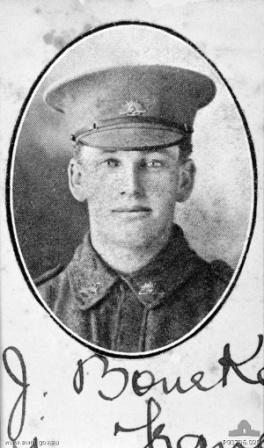
Introducing: Private Harold John Bourke 30th Battalion

Private Bourke’s name not only appears on the memorial at VC Corner Cemetery but also on the German Death List of those buried at Pheasant Wood, in an area undisturbed for over 90 years after the Battle of Fromelles. Twenty two soldiers (22) from the 30th Battalion appear on the list of the ‘missing at Fromelles’.

Photo: Pheasant Wood at commencement of archaeological dig, May 2008. [Carole Laignel, Secretary of the F.W.T.M. 14-18 (Fromelles Museum)]

Harold Bourke was a twenty one year old labourer, with 4 years militia experience, when he enlisted in his home town of West Maitland, New South Wales on the 1 September 1915. Private Bourke’s attestation papers, available on line at the National Archives of Australia, give no indication that he had any difficulty in enlisting. His mother gave a different picture when she completed the Roll of Honour circular. On this form, sent to next of kin seeking details regarding the deceased, Katherine Bourke noted that Harold had tried to enlist shortly after the outbreak of the war but was turned down on ‘medical grounds’, and on his third attempt he was accepted.

Photo: Private Harold John Bourke No1682

This photo has been reproduced with the permission of the Australian War Memorial

Private Bourke trained at the Liverpool camp near Sydney a member of the 30th Battalion which had been raised as part of the 8th Brigade on 5 August 1915. Most of the volunteers in the 30th Battalion came from around the Newcastle area and other parts of country New South Wales.

On 17 December 1915, acting Corporal Bourke embarked aboard HMAT Berrima with the 2nd Reinforcements 30th Battalion bound for Egypt. The Battalion was part of the 8th Brigade which was destined for the Western Front, in June 1916. The Australian War Memorial website states: The 30th Battalion’s first major battle was at Fromelles on 19 July 1916. It was tasked with providing carrying parties for supplies and ammunition but was soon drawn into the vicious fighting. Following Fromelles, the battalion was rotated in and out of the front line along with others in the brigade, but played no major offensive role for the rest of the year.

One hundred and five men (105) men from the 30th Battalion died as a result of The Battle of Fromelles. Private Bourke’s family in West Maitland received a telegram in August 1916 stating he was missing in action. The Red Cross Wounded and Missing Enquiry Bureau Files provided evidence for Lambis Englezos when researching the names of the missing from the Battle of Fromelles but they also give us an insight into the circumstances surrounding the death of Harold. From an entry made on the Red Cross Files from Bugler & Driver A.C.Walker (792) we learn that Private Bourke was first injured soon after the attack had started but not heard from since…..I saw him in the first wave over at Fleurbaix on 19th at about 6:45pm. He was two before me, he was hit in front of the German wire and lay there. I saw him and he asked me to bring someone to bring him in as he was hit in the back…………….We could not go for him. If alive he must be a prisoner, as the Germans came back to that trench.

This is consistent with the description by C. E. W.Bean, The AIF in France 1916 Ch 12 The Battle of Fromelles of the scene at about 6.30, when the first fatigue parties were crossing:

The original carrying parties in the 14th Brigade, half the 55th Battalion and in the 8th Brigade, half the 30th, had crossed No-Man’s Land with their first loads of sandbags and ammunition on the heels of the fourth wave. But with the commencement of the attack the enemy had brought his artillery-fire heavily down upon the old No-Man’s Land, which was also much swept by machine-gun and rifle bullets, making the carriage of supplies across the open very dangerous and burdensome.

Private Bourke was not officially listed as killed in action until March 1917, by which time the British Army had received his identity tags from the German Army. In addition the German War Office had also returned a ‘notebook & silk skien’ belonging to Private Bourke. These three items were eventually returned to his mother, who also benefited from Harold’s will. Before proceeding overseas Harold Bourke had bequeathed his mother £25. Harold also made another bequest to Miss Cecilia Hanna from Narrabri West of the ‘rest of my property and money’. There is no indication from public documents of Miss Hanna’s identity but she was obviously close to Harold and would have mourned his death. Private Bourke had served less than 12 months in the AIF.

Photo: Anzac Cemetery, Pas de Calais, France [Australian Photographic War Graves Photographic Archive]

Anzac Cemetery, near the village of Sailly-sur-La-Lys, was started by Australian units shortly before the Battle of Fromelles and contains the graves of many Australian soldiers from the 8th and 14th Brigades who died in the battle. These men have been given the dignity of individual burial in their final resting place. This honour should be afforded to those men buried in the pits at Pheasant Wood by the German army nearly 92 years ago.

FFFAIF Policy Statement

The Families and Friends of the First AIF believes that the Australian Government through the Minister for Veterans’ Affairs should commit the to re-burial of the “missing of Fromelles” with individual graves and headstones in a new Commonwealth War Graves Commission Cemetery at Pheasant Wood after DNA testing.

FROMELLES IS NOT HONOURED ON THE NATIONAL OR ANY STATE MEMORIAL IN AUSTRALIA.

FFFAIF SUPPORTS ALL EFFORTS TO RECOGNISE FROMELLES ON OR AT THE NATIONAL AND ALL STATE MEMORIALS THAT PRESENTLY LIST BATTLES BY NAME.

Call back tomorrow for MORE UPDATES

Posted in Diggers of First AIF, Top Posts | Comments Off on Hit in No-Man's Land

Uncle Harry's Charm

The 5th Australian Division units involved in the Battle of Fromelles on 19 July were (from north to south):

8th Brigade: Assaulting battalions 32nd (WA) and 31st (Qld, Vic) with Reserve battalions 29th (Vic) and 30th (NSW)

14th Brigade (NSW): Assaulting battalions 53rd and 54th with Reserve battalions 56th and 55th

15th Brigade (Vic): Assaulting battalions 59th and 60th with Reserve battalions 57th and 58th 

The Australian troops of the 59th and 60th Battalions near the Sugar-loaf, where No-Man’s Land was wide, went over the parapet at 5.45p.m. following the 53rd at 5.43p.m. on their left and the 54th at 5.50p.m. and then the 31st and 32nd at 5.53p.m.. The 8th Brigade formed the left of the attack, and the 31st Battalion lost 143 men killed during the assault.

 Photo: Australian soldiers killed in the German 2nd line at Fromelles [AWM A01565]

This photo has been reproduced with the permission of the Australian War Memorial

Today Tim Whitford introduces his great uncle, Private Harry (Henry) Willis, one of the 16 members of the 31st Battalion of the 8th Brigade, 5th Division, AIF listed amongst the ‘missing’ at Fromelles.  A good luck charm belonging to Private Willis was found during preliminary searches of the Pheasant Wood site in 2007. This find provided a vital piece of evidence in the initial stages of the investigation.

Tim Whitford, with his wife Elizabeth and daughter Alexandra travelled from their home in Tallarook, Victoria, to be present in Fromelles during this year’s excavation by the GUARD team from Glasgow University. On several occasions Tim was permitted to view the pits during the excavation. He describes the experience as a rare privilege and honour.

Photo: Lambis Englezos, Tim Whitford & Ward Selby at Pheasant Wood [Carole Laignel, Secretary of the F.W.T.M. 14-18 (Fromelles Museum)]

In a newspaper interview while in France Tim said: His (Private Harry Willis) remains are among those that are here and we know that because of the medal that was found. I think this is the beginning of the end of Harry’s story rather than the end.

 Private Harry Willis (Henry Victor Willis) No 983

31st Battalion, AIF

KIA Fromelles 19/20 June 1916

Pheasant Wood

Photo: Private H.V. Willis [Tim Whitford] 

Harry Willis was one of the 14 Children of John and Janet Willis of Alberton, South Gippsland, Victoria. The Willis family were battlers, struggling since the death of their breadwinner John in an accident some years earlier. 

Harry was a good looking boy and always had a smile on his face. He was extremely youthful in his looks and was a hard worker. He worked as a general labourer on the family farmlet and helped on other farms around the district. Harry’s brothers Bert, George, David and Syd all joined the AIF when war came and after receiving a white feather in the post, Harry soon forged his mum’s signature (he was 19 years old – under aged at the time) and joined up as well. Janet mustn’t have minded too much as she never sought to have Harry discharged in the months that he was at Broadmeadows camp. I guess money was tight so the extra really helped. 

Harry became an original member of D Company (OC Captain Mills) of the 31st Battalion (Lt Col Toll), 8th Brigade (Gen Tivey), and was eventually trained as part of a Lewis Gun team. We think Harry was proud of being a soldier. Although he never wrote much, he sent many portraits home to the family.


Photo: Private Harry Willis [Tim Whitford]

Harry, with the rest of the 8th Brigade, missed out on the Gallipoli campaign and spent an extended period of time training in Egypt before sailing for the Western Front. 

The 31st Battalion was allotted to the attack on Fromelles shortly after its arrival in France, and it was while marching up to the Fleurbaix sector that Harry and his Brother Syd had a chance, final meeting. Syd had been in a neighbouring sector with the 21st Battalion and was on a carrying fatigue when the two met. Both brothers knew that Harry’s chances weren’t good and one can only imagine what it feels like, in a few snatched moments, to shake hands and say goodbye to a little brother for what they knew was the last time.  

Syd remained bitter with the “heads”, who he personally blamed for Harry’s death, for the rest of his long life. Syd’s first born son was named Harry in his honour. Harry Jr is still alive and is a veteran of the Second World War. Harry Jr has lived his entire life in the shadow of, and with the legacy of his long dead Digger uncle. 

When the attack on Fromelles started, Harry’s company were held as reserve company for the Battalion, and it is believed that it was as a response to Lt Col Toll’s urgent call for Lewis Guns and Bombs that Harry crossed No Mans Land and headed toward his CO. Lt Col Toll was in action in front of the large German  fortified farm known as the Grashof so it is in all probability that it was a weapon from this position, now a peaceful hunters retreat complete with picturesque fish ponds, which claimed Harry’s life. We know from eyewitness accounts that Harry received a jaw wound. It was this wound or shock that probably killed him.  

The Germans gathered up Harry’s remains and deposited them in one of the pits in front of Pheasant Wood. They removed his ID disc and it eventually made it’s way back to his mother through the Red Cross. Very small change for a good looking boy who was always smiling. Harry’s Mum, Janet, never recovered from the death of her boy. She changed forever. Her Grandkids remember her as a very stern, moody woman, always angry, without joy. Harry’s photo was always on the mantelpiece but his name was only whispered for fear of upsetting Janet.  

Unbeknown to the German troops throwing Harry’s body into the pit, a prize souvenir, Harry’s enamelled copper good-luck medallion, dropped unseen from Harry’s pocket and onto the ground where it was eventually, unknowingly trodden into the earth as the work of burial continued. 91 years later it was that same little copper medallion that turned up in a metal detector sweep, finally linking a known Australian soldier to an anonymous field in front of Pheasant Wood. It was Lambis Englezos’s work that brought the metal detectorist there and it was Harry Willis that confirmed they were in the right place.


Photo: Harry’s original good-luck charm alongside a similar one in near original condition. [Tim Whitford]

Harry was a good boy who always smiled. He disappeared from sight in 1916, but not from memory. Down through the years and through the generations, the descendants of his brothers and sisters have always carried his torch. He’s never been forgotten, we just never knew where he was.  

Now we know. 

Lest we forget Harry Willis.  


As a result of viewing the pits Tim, a former combat-arms soldier himself, is adamant that the Fromelles lads receive a dignified re-burial and an attempt at identification.

Rue Petillon Cemetery, near Fleurbaix, is the final resting place for many of Private Willis’ fallen 31st Battalion comrades from the Battle of Fromelles. These men earnt the dignity of individual headstones in recognition of their sacrifice. The Diggers lying in the pits at Pheasant Wood deserve the same recognition.


Photo: Entrance to Rue Petillon Cemetery

Photo: 31st Battalion Headstones at Rue Petillon Cemetery with Alexandra and Elizabeth Whitford [Tim Whitford]

FFFAIF Policy Statement

The Families and Friends of the First AIF believes that the Australian Government through the Minister for Veterans’ Affairs should commit the to re-burial of the “missing of Fromelles” with individual graves and headstones in a new Commonwealth War Graves Commission Cemetery at Pheasant Wood after DNA testing.

FROMELLES IS NOT HONOURED ON THE NATIONAL OR ANY STATE MEMORIAL IN AUSTRALIA.

FFFAIF SUPPORTS ALL EFFORTS TO RECOGNISE FROMELLES ON OR AT THE NATIONAL AND ALL STATE MEMORIALS THAT PRESENTLY LIST BATTLES BY NAME.

Call back tomorrow for MORE UPDATES

Posted in Diggers of First AIF, Top Posts | Comments Off on Uncle Harry's Charm

I regret to inform you

As the Battle tactics of the Battle of Fromelles reveals, there the planning for the July 1916 was characterised by changes and included a 7 hour artillery bombardment prior to the infantry assault.

The outcome of the battle was a heavy loss of life among the soldiers of the 5th Division, AIF with 1,917 killed among the 5,533 casualties.  Many of these soldiers have headstones marked “Known only unto God” with only 618 of those soldiers killed having their names on their headstones. Some of the soldiers remained unaccounted for in British and Commonwealth War Records. 


Photo: Fallen British soldiers Fromelles 20 July 1916 (www.stahlgewitter.com)

Research by Lambis Englezos using the Red Cross Wounded and Missing Enquiry Bureau Files confirmed that 170 Australian soldiers are recorded as buried by the German Army at a location adjacent to Pheasant Wood on the outskirts of Fromelles.  His investigations also showed no evidence that the Graves Recovery Unit had exhumed any bodies from this location during the post war period. 

In 2007, a non-invasive geophysical survey conducted by British archaeologists from Glasgow University Archaeological Research Division (GUARD) showed that the Pheasant Wood area had been virtually unchanged since 1916 and revealed signs of burial pits, consistent with mass graves for hundreds of soldiers adjacent to Pheasant Wood.


Photo: Pheasant Wood April 2008

The GUARD team returned in May 2008 this time excavating the site to confirm that the soldiers buried after the Battle of Fromelles were still located in the pits dug by the German Army.  

There are 173 Australian ‘missing’ soldiers of Fromelles. Each has been named and for a significant number we can put faces and family details to the names. Today we are proud to introduce Private Norman Arthur Hale of the 31st Battalion AIF.

Norman Arthur Hale enlisted in the AIF on 14 July 1915. In order to be able to enlist Norman gained the consent of his father and also from his employer, the Victorian Railways, with whom he was indentured as an apprentice instrument maker.

Photo: Norman A. Hale [AWM: H05488]

This photo have been reproduced with the permission of the Australian War Memorial

The copy of the following letter from Private Hale’s service record, available on line at the Australian National Archives, grants him leave from his job for the ‘purposes of Defence for as long as required’. Private Hales trained at Broadmeadows Camp, Victoria.

The 31st Battalion had raised companies at both the Broadmeadows Camp in Victoria and at Enogerra on the outskirts of Brisbane. In early October 1915, the two elements came together at the Broadmeadows Camp and embarked at Melbourne for overseas service as part of the 8th Brigade. Private Hale embarked in Melbourne as a member of C Company, 31st Battalion aboard HMAT Wandilla on 9 November 1915.

The Australian War Memorial website traces the 31st Battalion initiation into overseas service: The 8th Brigade joined the newly raised 5th Australian Division in Egypt, and proceeded to France, destined for the Western Front, in June 1916. The 31st Battalion fought its first major battle at Fromelles on 19 July 1916, having only entered the front-line trenches 3 days previously. The attack was a disastrous introduction to battle for the 31st – it suffered 572 casualties, over half of its strength. Although it still spent periods in the front line, the 31st played no major offensive role for the rest of the year.

An eye witness report in the Red Cross Wounded and Missing Enquiry Bureau Files describes the fatal events which surrounded Private Hale’s involvement in the Battle of Fromelles.  Private Thomas Perham, 31st Battalion stated: ….on the night of July 19th he went over with me in the 1st wave at Fromelles. He was slightly wounded, so bandaged him up and he went on with us. We stopped at the German line where we bombed the dugouts and had a feed together. I then took some prisoners back and missed him when we came out of the dugouts and don’t know where he went. I went forwards and joined the others till we withdrew from the German lines.

Private Hale was reported missing in action on 21 June 1916 by his commanding officer and in August 1916 his father received a telegram from the Australian Army conveying the news. Early in February 1917, Mr. Joseph Hale, after receiving no further information from the army since the telegram, wrote to the Army Records Office seeking information and clarification of his son’s fate.  By this time he had received a letter from his son’s Captain stating ….I regret to inform you that he was killed when our Batt first went into action last July. Although he was not actually working with me on that night, I know he was hit by a piece of shell. Your son had always been a pet of mine and I had a good deal to do with him in those days and I grieve his loss almost as much as I know you must. I regret I cannot give you any fuller particulars, but his own platoon commander was very seriously wounded and has not returned to duty. All I know is what I have learnt from the men of the coy. Unless an officer can vouch for a man’s death the authorities will only post as missing, hence the meagre news that has filtered through to you………

It was not until 13 March 1917 that he was officially classified as killed in action following an army board of enquiry at which it was stated that his name had appeared on the ‘German death list’.

Private Hale had the opportunity to serve in the AIF for only one year and one month as he is amongst those 16 men of the 31st Battalion who took part in the Battle of Fromelles and are listed amongst those buried by the German Army at Pheasant Wood.

It is now time that these fallen Australian soldiers of Fromelles are afforded the same respect and laid to rest with the dignity bestowed on other Australian soldiers from World War 1.

 Photo: La Trou Aid Post Cemetery

Photo: CWGC Headstones La Trou Aid Post Cemetery

FFFAIF Policy Statement

The Families and Friends of the First AIF believes that the Australian Government through the Minister for Veterans’ Affairs should commit the to re-burial of the “missing of Fromelles” with individual graves and headstones in a new Commonwealth War Graves Commission Cemetery at Pheasant Wood after DNA testing.

FROMELLES IS NOT HONOURED ON THE NATIONAL OR ANY STATE MEMORIAL IN AUSTRALIA.

FFFAIF SUPPORTS ALL EFFORTS TO RECOGNISE FROMELLES ON OR AT THE NATIONAL AND ALL STATE MEMORIALS THAT PRESENTLY LIST BATTLES BY NAME.

Call back tomorrow for MORE UPDATES

Posted in Diggers of First AIF, Top Posts | Comments Off on I regret to inform you

Dignified Burial Call

The battle for the missing diggers from Fromelles is far from over. 

As the Background to the Battle of Fromelles reveals, there had been an unsuccessful battle at Fromelles in May 1915 with heavy casualties and the planning for the July 1916 was characterised by changes and confusion. 

The result was a heavy loss of life among the soldiers of the 5th Division, AIF with 1,917 killed among the 5,533 casualties.  Many of these soldiers have headstones marked “A Soldier of the Great War” with 618 of soldiers having their names on their headstones. Some of the soldiers remained unaccounted for in British and Commonwealth War Records. 

Photo: Fallen British soldiers Fromelles 20 July 1916 (www.stahlgewitter.com)

Following a visit to the Fromelles battlefield and VC Corner Cemetery in 2002, Lambis Englezos analysed the list of the 1299 names of the Australian soldiers with no known graves and compared this with the number of “unknown” soldiers buried, and identified that there were 163 with no record of a place of burial.  His research using the Red Cross Wounded and Missing Enquiry Bureau Files confirmed that 161 were on the German death list and recorded as being buried by the German Army at Pheasant Wood. Further analysis brought the names of another 9 soldiers listed on the Villers Bretonneux memorial and included in the Red Cross files, giving a total of 170 Australian soldiers recorded as buried at a location adjacent to Pheasant Wood on the outskirts of the Fromelles.

His investigations also showed no evidence that the Graves Recovery Unit had exhumed any bodies from this location during the post war period.  In 2005, the Australian Department of Defence formed a Panel of Investigation, which reviewed the evidence and concluded that there was sufficient doubt that the bodies had been recovered and re-interred as to warrant further investigation.

In 2007, at the request of the Australian government, a non-invasive geophysical survey was conducted by British archaeologists from Glasgow University Archaeological Research Division (GUARD). The first archaeological search in May 2007, led by Dr Tony Pollard showed that the Pheasant Wood area had been virtually unchanged since 1916 and revealed signs of burial pits, consistent with mass graves for hundreds of soldiers adjacent to Pheasant Wood.

Photo: Pheasant Wood April 2008

Using ground penetrating radar the GUARD team reported that: “it was beyond doubt that this site was used as a burial ground”. The GUARD team returned in May 2008 this time excavating the site to confirm that the soldiers buried by the German Army were still located in the pits they dug after the Battle of Fromelles.  

There are 173 Australian ‘missing’ soldiers of Fromelles. Each has been named and for a significant number we can put faces and family details to the names. Today we are proud to introduce Private Albert Williamson (No4249) of 54th Battalion AIF.


Albert Williamson was a 22 year old labourer from Canowindra in country New South Wales when he enlisted in the AIF in August 1915. Private Albert Williamson embarked from Australia as a reinforcement of 2nd Battalion and soon after his arrival in Egypt Private Williamson was transferred to the newly formed 54th Battalion. Private Williamson is listed amongst the thirty soldiers missing from the 54th Battalion after the Battle of Fromelles.


Source: Our Gift to The Empire by Ross StClaire.

 The newspaper clipping above was printed in the Sydney Mail on 20th August 1919. In the feature Mrs Cecilia Williamson, 3 years after the Battle of Fromelles, is seeking to find more information on how her son, the 10th of her 13 children, had died. It is not known if she received any further details from any other soldiers.  

Private Williamson’s Service Record gives no details of his death except that he was reported missing on 21st July 1916 and a Court of Inquiry nearly twelve months later resulted in an entry officially listing him as killed in action on 20th July 1916. Importantly Private Williamson’s Service Record does contain the original German ‘death voucher’ which was completed by the German Army when Private Williamson was buried and was returned with his identification tags to the Australian Army via the German Red Cross. A photograph of the original document can be seen in the Service Record of Private Albert Williamson available on line at the National Archives of Australia.

Reference to this German document is also found in The Red Cross Wounded and Missing Enquiry Bureau Files, which can be viewed on line at the Australian War Memorial website.

Nearly 92 years later some of Mrs Cecilia Williamson’s questions about the fate have an opportunity to be answered.

It is now time that these fallen Australian soldiers of Fromelles are afforded the same respect and laid to rest with the dignity bestowed on the Zonnebeke Five in April 2007. These five Australian soldiers from World War 1 were discovered when a new gas pipe line was being dug in Belgium. 

Photos: ‘Zonnebeke Five’ Graves at Buttes New British Cemetery

Their bodies were exhumed and two of the soldiers were identified using DNA testing. Sergeant G. Calder and Private J. Hunter, along with their Anzac mates, are now buried in Buttes New British Cemetery, Polygon Wood.  Private Hunter’s epitaph reads:

 BELOVED SON OF HARRY AND

EMILY HUNTER NANANGO QLD 

AT REST AFTER BEING

LOST FOR 90 YEARS


FFFAIF Policy Statement

The Families and Friends of the First AIF believes that the Australian Government through the Minister for Veterans’ Affairs should commit the to re-burial of the “missing of Fromelles” with individual graves and headstones in a new Commonwealth War Graves Commission Cemetery at Pheasant Wood after DNA testing.

 FROMELLES IS NOT HONOURED ON THE NATIONAL OR ANY STATE MEMORIAL IN AUSTRALIA.

FFFAIF SUPPORTS ALL EFFORTS TO RECOGNISE FROMELLES ON OR AT THE NATIONAL AND ALL STATE MEMORIALS THAT PRESENTLY LIST BATTLES BY NAME.

Copies of Our Gift to The Empire are available from the author Ross St.Claire. Ross can be contacted at indelec@bigpond.net.au

Photo: Front cover Our Gift to The Empire 54th Australian Infantry Battalion 1916-1919 [ISBN 0-6464589-7-3]

Call back tomorrow for further updates.


Posted in Diggers of First AIF, Top Posts | Comments Off on Dignified Burial Call

Commemoration

The Fifth Division of the AIF was formed in February 1916 and consisted of the 8th Brigade – 29th, 30th, 31st, 32nd Battalions; 14th Brigade – 53rd, 54th, 55th, 56th Battalions and 15th Brigade – 57th, 58th, 59th, 60th Battalions. The Fifth Division embarked from Alexandria in Egypt via Marseilles in France to join the troops on the battlefields of the Western Front. The Fifth Division under the command of Major General James W. McCay took part in the Battle of Fromelles which proved costly for the Division which suffered 5,533 casualties. 

Arthur Joseph Weir was a member of A Company, 29th Battalion when he embarked from Melbourne in November 1915. Private Arthur Weir was 26 years old when he made the supreme sacrifice for his country at the Battle of Fromelles on 19 July 1916.

Private Arthur Joseph Weir

Private Arthur Joseph Weir

Photo: Private Arthur Joseph Weir No 358 [AWM DA120012]

This photo has been reproduced with the permission of the Australian War Memorial

Prior to his enlistment on 15 July 1915 Arthur Weir was a farmer who had been a member of the Winiam Rifle Club in country Victoria. Private Weir’s Service Record, which can be viewed at National Archives of Australia, is a short 22 pages in length and there are no eyewitness accounts in the Red Cross Wounded and Missing Enquiry Bureau Files to give an insight into how he died. The Red Cross files do however contain the vital German documents which provided the evidence for Lambis Englezos to add Private Weir’s name to the missing buried at Pheasant Wood. Private Weir is commemorated on the wall at VC Corner Cemetery Fromelles adjacent to the Australian Memorial Park.

SPECIAL NOTICE OF UPCOMING COMMEMORATIONS AND EVENTS IN MELBOURNE

The Australian Memorial Park contains the Cobbers Sculpture by Peter Corlett which was unveiled in 1998. The sculpture is based on Sergeant Simon Fraser (No.3101) of 57th Battalion rescuing a cobber from the 60th Battalion. On the 92nd Anniversary of the Battle of Fromelles, a second Cobbers sculpture will be unveiled at The Shrine of Remembrance in Melbourne. The Shrine has announced a number of talks which will be held in the week proceeding the unveiling. 

Tuesday 15th July, 2pm – Pompey Elliott: ‘The Slaughter Was Dreadful’. Presented by Dr. Ross McMullin

Thursday 17th July, 2pm – The Investigative Dig at Pheasant Wood, Fromelles. Presented by Maj. Gen. Mike O’Brien

Photo: Major General Mike O’Brien on site at Pheasant Wood, May 2008

 Friday 18th July, 2pm – The AIF’s Mystery Battle: Then and Now. Presented by Mr Patrick Lindsay 

Photo: Author, FROMELLES, Patrick Lindsay

On Saturday 19 July at 11am a public ceremony to unveil the ‘Cobbers’ sculpture by artist Peter Corlett will take place. Proposed by the Friends of the 15th Brigade, this second casting will commemorate the Battle of Fromelles.


Photo: Sculptor Peter Corlett & Lambis Englezos [With the permission of the Shrine of Remembrance]

Bookings are essential for all programs: (03) 9661 8100 or programs@shrine.org.au

For more information about the these programs visit www.shrine.org.au/publicprograms

 FROMELLES IS NOT HONOURED ON THE NATIONAL OR ANY STATE MEMORIAL IN AUSTRALIA.

FFFAIF SUPPORTS ALL EFFORTS TO RECOGNISE FROMELLES ON OR AT THE NATIONAL AND ALL STATE MEMORIALS THAT PRESENTLY LIST BATTLES BY NAME.

Call back tomorrow for MORE NEWS 


Posted in Diggers of First AIF, Top Posts | Comments Off on Commemoration

Three Lads Go To War

Allan Eldridge, Ernest Hopkinson and Justin Breguet were all 18 years old when, with parental permission, they enlisted in the AIF in July 1915. They embarked together aboard HMAT Ballarat from Melbourne on 18 February 1916 as members of the 3rd Reinforcements, 29th Battalion. Only two would return to Australia at the conclusion of the war.

 Privates Eldridge, Hopkinson & Breguet

Photo: Private Ernest Charles Hopkinson No2059, Private Allan James Eldridge No2017 and Private Justin Hercules Breguet No1983 – their positions in this picture are unknown.

This photo have been reproduced with the permission of the Australian War Memorial

Private Hopkinson, originally of Hertfordshire, England survived the war to be discharged in England in 1919, later returning to Australia in 1921. Private Allan Eldridge was wounded at the Battle of Fromelles and recovered to serve again on the Western Front. Lance Corporal Eldridge returned to Australia as a member of 31st Battalion in July 1919.

Private Breguet is one of the 19 members of the 29th Battalion Diggers listed in the Missing Diggers of Fromelles. Breguet’s Service Record, which is available on line from the National Archives of Australia, includes the original letter of consent for enlistment signed by his father John Breguet of Anderson St, West Geelong, Victoria.

The Red Cross Wounded and Missing Enquiry Bureau File on Private Breguet contain many of the examples of documents which provided Lambis Englezos with vital clues to the fate of 173 soldiers who were unaccounted for nearly 92 years. These include copies of the German ‘death vouchers’ completed by the Bavarian soldiers before burying the fallen Australian soldiers adjacent to Pheasant Wood near Fromelles, France; documents stating that the soldier’s identity disk had been returned by the German army through the Red Cross to the British army; translations of German documents received by the British Army in November 1919, which were provided by Captain Mills, who himself was captured at the Battle of Fromelles; and references in official documents to the ‘German death list dated 4-11-16′.

The file also contains copies of statements taken by the Red Cross from soldiers who had information about the fate of Private Breguet. As was often the case some of the reports gave conflicting accounts including a statement saying that Private Breguet was in hospital in England. The most plausible explanation and the one accepted by the Australian army was that after occupying German trenches with other members of the 29th Battalion, and after coming under heavy shelling while withdrawing, Private Breguet was killed by shell fire and not seen again.

Private Breguet and Private Eldridge were counted amongst the 5,533 casualties of the Battle of Fromelles.

FROMELLES IS NOT HONOURED ON THE NATIONAL OR ANY STATE MEMORIAL IN AUSTRALIA.

FFFAIF SUPPORTS ALL EFFORTS TO RECOGNISE FROMELLES ON OR AT THE NATIONAL AND ALL STATE MEMORIALS THAT PRESENTLY LIST BATTLES BY NAME.

Call back tomorrow for MORE NEWS 

Posted in Diggers of First AIF, Top Posts | Comments Off on Three Lads Go To War

The McAulay Brothers

Families and Friends of the First AIF member Ross St.Claire in his book, Our Gift to The Empire – 54th Australian Infantry Battalion 1916-1919, describes Fromelles as: the 54th Battalion’s baptism of fire. Not a sterner trial could have been envisaged. Williams, of the 56th Battalion, said “Men who had fought on Gallipoli from the Landing to the Evacuation, admitted freely that Fromelles was the severest test they had seen.”  From then on any man who had been at Fromelles was known as a “19th of July man.” The tragedy and heroism of Fromelles instantly became part of the battalion folklore. Fromelles veterans were later sought out by recruits to pass on their experiences, just as they had listened to Gallipoli men in Egypt. 

Today we are proud to introduce you two brothers who embarked on overseas duty with the AIF together and stayed together until their deaths on the battlefield at Fromelles. 

Roderick and Hector McAulay were born at Chatsworth Island, near MacLean in the Clarence River district of NSW. The brothers lived with their parents Malcolm and Elizabeth McAulay at “Iona” McPherson St, Waverley, NSW. 

Private Roderick McAulay

Photo: Private Roderick McAulay No4207 [AWM P06085.003]

Private Hector McAulay

Photo: Private Hector McAulay No4391 [AWM P06085.004]

These photos have been reproduced with the permission of the Australian War Memorial

The older of the two sons Roderick was a carpenter and the first to enlist on 18 August 1915. A month later his brother Hector enlisted on 22 September 1915.  Hector listed his occupation as salesman on his attestation papers. He worked in Sydney’s biggest department store, Anthony Hordern and Sons Emporium.

 Anthony Hordern\'s Emporium

Photo: The Anthony Hordern’s Palace Emporium opened in 1905.

Private Roderick McAulay and Private Hector McAulay embarked together aboard HMAT Aeneas from Sydney on 20 December 1915 as members of the 1st Battalion -13th Reinforcements. Once in Egypt they were transferred to the 54th Battalion as members of the Lewis Gun Section.

Private Roderick McAulay was killed at the Battle of Fromelles and his Service Record available online at the National Archives of Australia shows that his family was told of his burial in the cemetery at Sailly-sur-la-Lys, near Estaires and Armentiers. Sadly Roderick’s grave was lost during the following years of the Great War and today he is remembered on the memorial wall at VC Corner Cemetery Fromelles.  

Private Hector McAulay’s Service Record also available online records him as ‘Missing in Action’ on 19th July 1916 and eventually reported as killed in action on the same date after a court of enquiry was held on 4th August 1917. The family then knew for certain that they had lost their second son in the Battle of Fromelles. Private Hector McAulay was one of 48 employees of Anthony Hordern and Sons department store in Sydney who were killed in action during the First World War.

 Anthony Horden\'s Collage

Photo: Large collage of ‘Our Fallen Comrades …. Dedicated to their memory’ from Anthony Hordern & Sons department store Sydney [AWM P02599.001]

This photo have been reproduced with the permission of the Australian War Memorial

There are 30 members of the 54th Battalion listed amongst the 173 identified by Lambis Englezos through his extensive research, including information contained in the Red Cross Wounded and Missing Enquiry Bureau Files ,as being buried by the German Army at Pheasant Wood. Private Hector McAulay is not one of these and his final resting place is unknown.

Copies of Our Gift to The Empire are available from the author Ross St.Claire. Ross can be contacted at indelec@bigpond.net.au

\'Our Gift To The Empire\'

Photo: Front cover Our Gift to The Empire 54th Australian Infantry Battalion 1916-1919 [ISBN 0-6464589-7-3]

FROMELLES IS NOT HONOURED ON THE NATIONAL OR ANY STATE MEMORIAL IN AUSTRALIA.

FFFAIF SUPPORTS ALL EFFORTS TO RECOGNISE FROMELLES ON OR AT THE NATIONAL AND ALL STATE MEMORIALS THAT PRESENTLY LIST BATTLES BY NAME.

Call back tomorrow for MORE NEWS 

Posted in Diggers of First AIF, Top Posts | Comments Off on The McAulay Brothers

Father & Son

Father & Son at Fromelles 

Research by FFFAIF member Stephen Brooks has so far revealed 24 sets of brothers and one father and son who fought together at the Battle of Fromelles. Today we are proud to introduce a unique pair of soldiers from the 60th Battalion of the 15th Brigade of the 5th Division. The 60th Battalion have five members listed amongst the Missing Diggers of Fromelles.

Private Edward Spooner and Private James Spooner were a father and son who were counted amongst the 5,533 Australian casualties.

 Private Edward Spooner

Photo: Private Edward Mason Spooner (No2663) AWM H06135

English born Edward Spooner was a 44 years old carpenter when he enlisted in the AIF on 12th June 1915. Private E. Spooner was a veteran of the Gallipoli campaign as a member of the 7th Battalion.  After returning to Egypt he was transferred to 60th Battalion on 2nd April 1916. The 60th Battalion disembarked at Marseilles on 29th June 1916 and moved north and on 19th July took part in the Battle of Fromelles.

 Private James Spooner

Photo: Private James Edward Spooner (No3941) AWM H06136

These photos have been reproduced with the permission of the Australian War Memorial.

Edward and Rebecca Spooner’s son James was 25 years old when he enlisted in the AIF one month after his father. His enlistment papers indicate he served two years in the Australian Navy which had been formed in 1911. James did not leave Australia until 23rd November 1915. Private James Spooner embarked as a member of the 12th Reinforcements, 7th Battalion – the same Battalion his father served with at Gallipoli. Upon arrival in Egypt he was transferred firstly to the 59th Battalion and later to join his father in the 60th Battalion on 18th March 1916. Thus father and son were serving in the same battalion when the 15th Brigade went into action at the Battle of Fromelles.

Private James Spooner was reported missing on 20th July and his father Private Edward Spooner was wounded in the battle receiving gunshot wounds to both shoulders. As a result of his injury’s Edward was transferred to England for further treatment at H.M.Queen Mary’s R.N.Hospital Chatham. Private Edward Spooner died as a result of his wounds on 31st July 1917 at the age of 45. He is buried at Buried Southend-On-Sea (Sutton Road) Cemetery, Essex, England.

Private James Spooner was finally declared by a Court of Enquiry convened on 4th August 1917 to have been KIA on 19th July.  His Red Cross Wounded and Missing Enquiry Bureau File reveals details of his death from a report given by Pte John O’Dea (No 3862) A Coy 60th Battalion: He was in A Coy. I saw him fall, hit by a shell out in the open by Fleurbaix. He was badly wounded; nothing could be done for him. I took his pack off and made him a little more comfortable. We had orders to go back and did not hold the ground. He was about 5′ 9″, dark and came from Carlton, Victoria.

Many of the Australian soldiers who fell during the Battle of Fromelles lay in no-man’s land until after the Armistice when clearing parties from the Imperial War Graves Commission brought their bodies together for burial at VC Corner Cemetery – the only all-Australian Cemetery in France. Here the fallen diggers were laid to rest in the newly constructed cemetery. Details of the cemetery and its Memorial Wall where the names of 1,299 Diggers who died at the Battle of Fromelles and have no known grave are listed, can be seen on the Commonwealth War Graves Commission website.

VC Corner Cemetery

Photo: VC Corner Cemetery

Mrs Rebecca Spooner, wife of Private Edward Spooner and mother of Private James Spooner was supported after loosing both husband and son by a war pension of £4 per fortnight from the Australian Government.

FROMELLES IS NOT HONOURED ON THE NATIONAL OR ANY STATE MEMORIAL IN AUSTRALIA.

FFFAIF SUPPORTS ALL EFFORTS TO RECOGNISE FROMELLES ON OR AT THE NATIONAL AND ALL STATE MEMORIALS THAT PRESENTLY LIST BATTLES BY NAME.

Call back tomorrow for MORE NEWS 

Stephen Brook’s research into the families who had multiple members involved in the Battle of Fromelles is an ongoing project and Stephen is interested in hearing from any one with further information or photos. Stephen can be contacted by emailing projectfffaif@yahoo.com.au

This is one of many ongoing research projects being undertaken by FFFAIF members. For information on other research projects underway take a look at our Research page by clicking on the tab at the top of the page.

Posted in Diggers of First AIF, Top Posts | Comments Off on Father & Son