*FROMELLES FROST

The mayor of Fromelles, Hubert Huchett, has captured the winter on the Western Front in the following photos.

The Australian Memorial Park, Fromelles, can be seen dusted in snow.

cobbers-statue_winter_3

cobbers-statue_winter_1

The Cobbers Statue photo portrays a clear picture of the conditions under which the allied troops fought during the Great War.

cobbers-statue_winter_closeup_2

VC Corner Australian Cemetery’s rose bushes are bare in the winter weather.

vc-corner_winter

Nearby Pheasant Wood takes on a very different appearance to the archaeological dig site of May 2008, now covered in snow.

pheasant-wood-memorial_winter_2

The Memorial Plaque at Pheasant Wood, which marks the location of the burial pits in which it is believed over 400 allied troops who died at the Battle of Fromelles on 19 and 20 July 1916 are buried, appears serene, wearing a shroud of white snow.

pheasant-wood-memorial_winter1

pheasant-wood-memorial_winter_footsteps

Lest We Forget

*****

The Families and Friends of the First AIF thanks the Australian, UK and French governments for affording Australian and British soldiers – presently buried in mass graves at Pheasant Wood – dignified individual reburials in a new CWGC cemetery at Fromelles, and applauds Minister Snowdon and his British counterpart, Parliamentary Under-Secretary of State for Defence and Minister for Veterans, Kevan Jones MP, for their joint decision to DNA test the remains at exhumation and use every reasonable method to attempt identification of each soldier.

*****

 FFFAIF supports the inscription of “FROMELLES” on National and State Memorials


Posted in Top Posts | Comments Off on *FROMELLES FROST

Christmas Truce.

The first Christmas of The Great War on the Western Front provides a story of how, in the midst of the destruction caused by a war waged on a 600 mile front using the industrial mechanisation that produced machines guns and artillery and other armaments on an industrial scale, shared beliefs and basic humanity led soldiers in small and not so small groups to halt the fighting and reflect on the meaning of Christmas.

christmas-truce_1

Photo: A cross in the fields near Ploegsteert, Belgium marks the site of the Christmas Truce in 1914. [Munro Collection]

There are a number of web-sites dedicated to or carrying details of the Christmas Truce including:

Christmas truce 1914: Operation Plum Puddings contains many first-hand accounts and other information about the truce.  It aims to collate the many letters printed in UK regional papers from soldiers who took part in the Christmas Truce of 1914.  The website gives the following background to the Christmas Truce and includes sections on the songs sung and on many of the soldiers involved.
Setting the scene: Factors leading to the truce
The assassination of heir to the Austrian throne, Archduke Franz Ferdinand and his wife in Sarajevo on June 29 1914 sparked a rapid sequence of events which led to the outbreak of World War One. In early August, Germany swept past Luxembourg and Belgium on their way into France and at first made rapid progress. The Allies and Germans tried a series of outflanking movements which eventually led to a battle line – the Western Front – stretching from Lorraine in the south to the English Channel in the north. Soldiers dug trenches and erected barbed wire to hold their positions: the nightmare that was to become ‘trench warfare’ had begun.

In places the trenches were just yards apart and, as the soldiers realised that neither side was going to make any rapid victories or progress, the trenches became more fortified……

The proximity of the enemies also allowed men to shout out to their opponents or stick up signs on wooden boards. After a particularly heavy barrage of missiles or bullets, the soldiers might shout out “Missed” or “Left a bit”. (1) This black humour was to be the start of a ‘conversation’ between troops that would hasten the onset of a Christmas truce.

Another factor that assisted conditions for an unofficial truce between the men was the weather. For much of December it had been wet but on Christmas Eve the temperature dropped and a sharp frost enveloped the landscape. A ‘white Christmas’ as depicted on all traditional Christmas cards would provide the backdrop to one of the most remarkable Christmas stories in 2,000 years.

The shouting between troops turned into something more during Christmas Eve. Germans celebrate Christmas on December 24 more than they do on the day itself (in Britain and France, December 25 is the main day of celebration). It is on the 24th that the Germans have a large meal with family and ‘Father Christmas’ delivers his gifts. So on the Western Front on Christmas Eve, German soldiers began to sing carols and place Christmas trees lit with lanterns above the trenches. As a sub-altern told the Press Association (and it was then published in numerous UK newspapers): “Their trenches were a blaze of Christmas trees, and our sentries were regaled for hours with the traditional Christmas songs of the Fatherland. Their officers even expressed annoyance the next day that some of these trees had been fired on, insisting that they were part almost of the sacred rite.”

A ‘white Christmas’, singing of carols, shouts of good wishes across the trenches and the erection of illuminated decorations: A truce which days earlier had seemed inconceivable was now all but inevitable.

Other Christmas Truce web-sites include:

FIRSTWORLDWAR.COM

WIKIPEDIA

The Long Long Trail: The British Army of 1914-1918 for Family Historians. This site includes a list of all British units that took part.

THE CHRISTMAS TRUCE OF 1914 . This site has a 3 part description of the Truce and includes a bibliography.

http://www.spartacus.schoolnet.co.uk/FWWchristmas.htm.  This site contains a considerable number of quotes from soldiers’ diaries.

*****

The Families and Friends of the First AIF thanks the Australian, UK and French governments for affording Australian and British soldiers – presently buried in mass graves at Pheasant Wood – dignified individual reburials in a new CWGC cemetery at Fromelles, and applauds Minister Snowdon and his British counterpart, Parliamentary Under-Secretary of State for Defence and Minister for Veterans, Kevan Jones MP, for their joint decision to DNA test the remains at exhumation and use every reasonable method to attempt identification of each soldier.

Posted in Christmas, The Western Front | Comments Off on Christmas Truce.

Joyeux Noël

Screening on ABC 1 National Television on Sunday evening, 21 December is Joyeux Noël. The film depicts, through the eyes of French, British and German troops, the 1914 Christmas Truce on the Western Front.

The film was written and directed by Christian Carion and was nominated for Best Foreign Film at the 78th Academy Awards.

joyeux-noel-poster_smlPhoto: Film Poster Joyeux Noël. Source: http://images.google.com/images

The Sydney Morning Herald’s review states: …..Yes, it’s sentimental but there are moments of unexpected humour and what happened afterwards is devastating. Music plays a central role in the story, from the gentle soundtrack to the performances of German opera singers….to the drone of Scots’ bagpipes and the troops singing Christmas carols.

*****

The Families and Friends of the First AIF thanks the Australian, UK and French governments for affording Australian and British soldiers – presently buried in mass graves at Pheasant Wood – dignified individual reburials in a new CWGC cemetery at Fromelles, and applauds Minister Snowdon and his British counterpart, Parliamentary Under-Secretary of State for Defence and Minister for Veterans, Kevan Jones MP, for their joint decision to DNA test the remains at exhumation and use every reasonable method to attempt identification of each soldier.

Posted in Events, Members' Announcements | Comments Off on Joyeux Noël

Christmas Greetings

christmas-postcardPhoto: Christmas Postcard sent from Australia 1915 [Munro Collection]
Throughout 2008 this, the official Website of The Families and Friends of the First AIF Inc has been updated on a regular basis. The number of times the www.fffaif.org.au site has been visited now exceeds 30,000 since the launch on Australia Day. This week’s Web Wednesday brings the number of postings to 172.

All of these postings continue to be available on-line and it is easy to search this resource of both recent and historical events. To do so, use the Search Field located on the top right of web page (near the Member’s Area tab). Simply enter the topic you are searching for in the search field at the top of the screen and click. Alternatively use the PAST NEWS drop down menu, located below the FFFAIF Photo strip, on the right hand side of the page.

Over the Christmas Season the web manager will take a break from website postings – we hope you will enjoy taking some time to trawl through past postings. We will be back in time for our 1st Anniversary on Australia Day 2009- or sooner if  there is ‘breaking news’.

During the ‘holiday season’ our Membership Secretary and Treasurer, Alan Kitchen, will also be on leave. Please direct all enquiries to projectffaif@yahoo.com.au until February 2009. FFFAIF members please check out the Members Area for more contact details of Committee Members.

During the festive season enjoy the ‘Peace on Earth’ that the men of the First AIF fought to preserve.

Merry Christmas and Happy New Year to All

Posted in Members' Announcements | Comments Off on Christmas Greetings

*Gallipoli Evacuation

Gallipoli Evacuation Begins

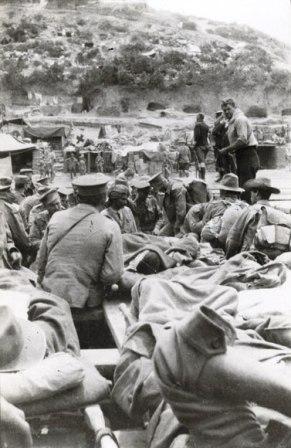
From the 8th to the 20th of December 1915, a total of 90,000 allied troops were evacuated from the Gallipoli Peninsula. Brigadier General Monash wrote about the upcoming evacuation, in a letter he planned to post after he left Gallipoli: It is, of course, an absolutely critical scheme which may come off quite successfully or may end in a frightful disaster. But orders, …  I need not say I feel very unhappy. Being bound to secrecy, I can take none of my Staff or C.O’s into my confidence, I am almost frightened to contemplate the howl of rage and disappointment there will be when the men find out what is afoot, and how they have been fooled, and I am wondering what Australia will think at the desertion of her 6,000 dead, and her 20,000 other casualties.

The official report of the evacuation was published in the Commonwealth of Australia Gazette, No. 3, 10 January 1916. The Gazette is available on line at the National Library of Australia. To read the edition of the Commonwealth of Australia Gazette containing Charles Bean’s report click here.

gallipoli-evacuateion-_nla_smlPhoto: Evacuation of Gallipoli, December 1915.
Source: Ferguson Collection, National Library of Australia
http://nla.gov.au/nla.pic-an24598329

Charles Bean in The Story of Anzac, Official History of Australia in the War of 1914-1918, Vol. 2, confirmed Monash’s predictions: The consideration which did go straight to every man’s heart was the tragedy of confessing failure after so many and well-loved comrades had given their lives to the effort. The men hated to leave their dead mates to the mercy of the Turks. For days after the breaking of the news there were never absent from the cemeteries men by themselves, or in twos and threes, erecting new crosses or tenderly ‘tidying-up’ the grave of a friend. This was by far the deepest regret of the troops. ‘I hope’, said one of them to Birdwood on the final day, pointing to a little cemetery, ‘I hope they don’t hear us marching down the deres (gullies)’.

One of the activities which the AIF encouraged the soldiers to take part in as the planning of the evacuation took place was the production of an ANZAC New Year Magazine. Charles Bean acted as editor for the work which was eventually published as the ANZAC Book in 1916.

anzac-book-cover

Photo: Cover of the ANZAC Book [Munro collection]

The Australian War Memorial website describes the book as: composed of satirical and sombre pieces about the conditions of life at Gallipoli. It also provides a general outline of the April 25 landing at ANZAC Cove and the military advances, offensives and defensives undertaken in the following months until the eventual evacuation of the Allied forces at the end of December 1915. The introduction was written by General Sir W Birdwood, who explains how he named ANZAC Cove on the Gallipoli peninsula after the ANZAC forces. Bean contributed an editor’s note in which he outlined the harsh conditions that the book was produced in, the significance it had taken on, and acknowledged the contributors.

The Australian War Memorial collection contains examples of the original art work contributed for the book. To view this part of the AWM collection click here.

anzac-book-colour-plate

Photo: The ANZAC Book Frontispiece. Written and illustrated in Gallipoli by ‘The Men of Anzac’. [Munro Collection]

To view the ANZAC Book on line click here.

To hear about the evacuation from the New Zealander’s, the other part of the ANZAC acronym, click here.

The Anzac troops would spend three more Christmases at war before they would know ‘Peace on Earth…………..’

*****

The Families and Friends of the First AIF thanks the Australian, UK and French governments for affording Australian and British soldiers – presently buried in mass graves at Pheasant Wood – dignified individual reburials in a new CWGC cemetery at Fromelles, and applauds Minister Snowdon and his British counterpart, Parliamentary Under-Secretary of State for Defence and Minister for Veterans, Kevan Jones MP, for their joint decision to DNA test the remains at exhumation and use every reasonable method to attempt identification of each soldier.

Posted in Books, Diggers of First AIF, Gallipoli | Comments Off on *Gallipoli Evacuation

*In Flanders Fields

poppies_sml

The 8th December 1915 edition of the English magazine Punch published for the first time the moving poem In Flanders Fields written by Canadian doctor, Lieutenant Colonel John McCrae. The poem was written by McCrae the day after he witnessed the death of his friend, Lieutenant Alexis Helmer. This poem symbolises the sacrifices of all who fought in the Great War.

In Flanders fields the poppies blow
Between the crosses, row on row,
That mark our place; and in the sky
The larks, still bravely singing, fly
Scarce heard amid the guns below.

We are the dead. Short days ago
We lived, felt dawn, saw sunset glow,
Loved, and were loved, and now we lie
In Flanders fields.

Take up our quarrel with the foe:
To you from failing hands we throw
The torch; be yours to hold it high.
If ye break faith with us who die
We shall not sleep, though poppies grow
In Flanders fields.

To find out more about the soldier, doctor and poet John McCrae click here.

essex-farm_sml

Photo: Essex Farm Casualty Clearing Station, 2006 [Munro Collection]

*****

The Families and Friends of the First AIF thanks the Australian, UK and French governments for affording Australian and British soldiers – presently buried in mass graves at Pheasant Wood – dignified individual reburials in a new CWGC cemetery at Fromelles, and applauds Minister Snowdon and his British counterpart, Parliamentary Under-Secretary of State for Defence and Minister for Veterans, Kevan Jones MP, for their joint decision to DNA test the remains at exhumation and use every reasonable method to attempt identification of each soldier.

Posted in Books, The Western Front | Comments Off on *In Flanders Fields

*Connecting Spirits

Young Aussies on the Western Front

A group of young Australians from South Australia are presently visiting the Western Front Battlefields of World War 1. The group comes from Meningie Area School and Birdwood High School and are part of the Connecting Spirits Project, an initiative of teacher Julie Reece.

The Connecting Spirits website has a diary of their trip which can be read by clicking here.

On Friday 5 December the group visited Fromelles and braved the adverse weather conditions to visit Pheasant Wood and VC Corner. The photo below taken by Carole Laignel, Secretary of Association Fromelles-Weppes-Terre de Memoire 14-18 (F.W.T.M. 14-18 ) – The Fromelles Museum – shows the group huddled at VC Corner.

5122008-julie-reeces-group-in-fromelles-032_sml

Photo: Connecting Spirits tour group visit VC Corner. [Carole Laignel]

*****

The Families and Friends of the First AIF thanks the Australian, UK and French governments for affording Australian and British soldiers – presently buried in mass graves at Pheasant Wood – dignified individual reburials in a new CWGC cemetery at Fromelles, and applauds Minister Snowdon and his British counterpart, Parliamentary Under-Secretary of State for Defence and Minister for Veterans, Kevan Jones MP, for their joint decision to DNA test the remains at exhumation and use every reasonable method to attempt identification of each soldier.

Posted in Commemorations, The Western Front | Comments Off on *Connecting Spirits

AIF arrive in Egypt.

Ninety four years ago, on 3rd December 1914, the First AIF disembarked at Alexandria, Egypt, after sailing from Albany Western Australia four weeks earlier. The postcard below shows the Australian troopships travelling through the Suez Canal on their way to Egypt.

french-battleships-at-suez-canal_sml

Photo: 1914 Souvenir Postcard [Munro Collection]

Once ashore the troops entrained to Cairo. Private Alan Andrews, C Company 1st Battalion, wrote home to his family of the experience:
We left at 2.30 and arrived at Cairo at 9 o’clock. We had cocoa, a roll of bread and a slice of cheese served out here. It was very good. Before we left the ‘Afric’ we had about 30 large biscuits served out to us as rations. We had to break some with our bayonets or put our heels on them. We lived on those for 2 days………From Cairo we travelled about 10 miles to Mena where we are encamped. This is the spot where Napoleon camped right under the Pyramids. They are about 8 minute walk from us but they look only 200 yards off.
We arrived here at 1 a.m., and lay down where we were and went to sleep.

DIGGER 10 titlepage

The front cover of the FFFAIF magazine DIGGER 10 shows the lines of the 9th & 10th Battalions, encamped at Egypt. Featured in this edition of DIGGER is a story on the work of the Melbourne Age’s official representative Phillip Schuler who sailed on “Orvieto“, the flagship of the convoy that carried the 1st Australian Division to Egypt. He landed with the troops and went with them into the desert camp at Mena. The following is an extract from the DIGGER article describing the arrival of the 5th Battalion:
Mena Camp, when I saw it at daybreak on the morning of 4th December, consisted of a score of tents scattered about in a square mile of desert, and perhaps a thousand men lying in their great-coats, asleep in the sand, their heads resting on their packs. The men of the 5th Battalion – those that are left of them – are not likely to forget that march out from Cairo on the night of 3rd/4th, and the subsequent days of settling down to camp, and the greetings they gave to regiment after regiment as they came crowding into the camp.
On the night the first troop trains came into Abbu Ella station, near Cairo, which was the siding on the southern side of the city, it was cold and sharp, but a bright moon came up towards midnight. Outside the sprinkling of Staff officers present to meet the train, was a line of dusky faces and a jabbering crowd of natives. Electric trams buzzed along outside the station yard, and after the men had been formed up and detrained, they had a few minutes to get, from a temporary coffee-stall, some hot coffee and a roll, which, after the journey was very much appreciated. It was nine o’clock. The guides were ready waiting. Territorials they were, who had been in Cairo for some time, and they led the men out on a long ten-mile march to Mena Camp…………………………

If you found this exert from DIGGER of interest and would like to read more on the soldiers of the First AIF, why not fill out a Membership Application Form today and enjoy the benefits of our DIGGER magazines? Membership is $A40 p.a. For more details visit our Members Area.

Each edition of DIGGER contains many articles and photos, the majority of which are published for the first time and are provided by members. Details of the contents of past DIGGER magazines can be viewed by clicking here.

Copyright © DIGGER Magazine. All material in DIGGER is copyright. Subject to the fair dealing provisions of the Copyright Act 1968, reproduction in any form is not permitted without written permission of the Editor or Author/s.

All website information (i.e. the images, graphics, text etc) on our website are copyright © Families and Friends of the First AIF Incorporated (FFFAIF Inc.) or its individual Members.

*****

The Families and Friends of the First AIF thanks the Australian, UK and French governments for affording Australian and British soldiers – presently buried in mass graves at Pheasant Wood – dignified individual reburials in a new CWGC cemetery at Fromelles, and applauds Minister Snowdon and his British counterpart, Parliamentary Under-Secretary of State for Defence and Minister for Veterans, Kevan Jones MP, for their joint decision to DNA test the remains at exhumation and use every reasonable method to attempt identification of each soldier.

Posted in DIGGER Magazine, Diggers of First AIF, Egypt | Comments Off on AIF arrive in Egypt.

V-Bret. Renovations.

The Commonwealth War Graves Commission has recently announced a major, three-year horticultural renovation project at Villers-Bretonneux Military Cemetery in France.

australian-memorial-villers-bret-view-from-tower_sml

Photo: View from the top of the Australian National Memorial, Villers-Bretonneux. [Chris Munro]

The announcement was made on the Commissions website: www.cwgc.org.  
……….Commencing at the end of November 2008, the work has become necessary because a large proportion of the existing Hornbeam tree belt have deteriorated with age and are impacting upon the fabric of the cemetery.

The Commission’s Director of Horticulture, John Tooke MBE said, “Undertaking the work now will ensure there is minimum disruption for visitors and sufficient time for the new avenue of trees to establish before major commemorative events in 2018. The work will be carried out in three phases and will be complete by 2010.

The project’s aim is to reinstate the original design principle of the cemetery – rows of healthy, conically shaped trees the length of the cemetery, thereby allowing a framed view of the memorial and cemetery entrance. This vital work will also ensure that those buried and remembered at the cemetery and memorial are commemorated in a manner befitting their sacrifice.”

For further information please contact Peter Francis on 01628 507163

australian-memorial-villers-bret-cemetery_sml

Photo: Villers-Bretonneux Military Cemetery. [Chris Munro]

*****

The Families and Friends of the First AIF thanks the Australian, UK and French governments for affording Australian and British soldiers – presently buried in mass graves at Pheasant Wood – dignified individual reburials in a new CWGC cemetery at Fromelles, and applauds Minister Snowdon and his British counterpart, Parliamentary Under-Secretary of State for Defence and Minister for Veterans, Kevan Jones MP, for their joint decision to DNA test the remains at exhumation and use every reasonable method to attempt identification of each soldier.

Posted in Memorials, Villers-Bretonneux | Comments Off on V-Bret. Renovations.

Book Launch Invite.

58th-btn159th-btn 

Lieutenant Colonel Chris Connelly, Commanding Officer, 5th/6th RVR

cordially invites you to the launch

by

Major General Mike O’Brien

of

‘Give me back my dear old cobbers’

the story of the 58th and 59th Australian Infantry Battalions

1913-1942

by

Robin S Corfield

at

the Menin Barracks, 127 Pascoe Vale Road, Moonee Ponds

2.30 pm, Sunday, 14 December 2008.

The MC for the book launch will be Lambis Englezos, a co-founder of the Friends of 15th Brigade, and who initiated the search for the Missing at Fromelles. Speakers will be:

  • Lieutenant Colonel Chris Connelly, CO, 5th/6th RVR; host of today’s event.
  • Major General Mike O’Brien, leader of the Australian Army Group entrusted with the recent successful search for the Missing at Fromelles.
  • Robin Corfield, author of histories of 57th and 60th Australian Infantry Battalions, and  ‘Don’t forget me, cobber’ – an inquiry into what happened at Fromelles 19/20 July 1916.

Light Refreshments will be served.

*****

The Families and Friends of the First AIF thanks the Australian, UK and French governments for affording Australian and British soldiers – presently buried in mass graves at Pheasant Wood – dignified individual reburials in a new CWGC cemetery at Fromelles, and applauds Minister Snowdon and his British counterpart, Parliamentary Under-Secretary of State for Defence and Minister for Veterans, Kevan Jones MP, for their joint decision to DNA test the remains at exhumation and use every reasonable method to attempt identification of each soldier.


Posted in Books, Members' Announcements | Comments Off on Book Launch Invite.